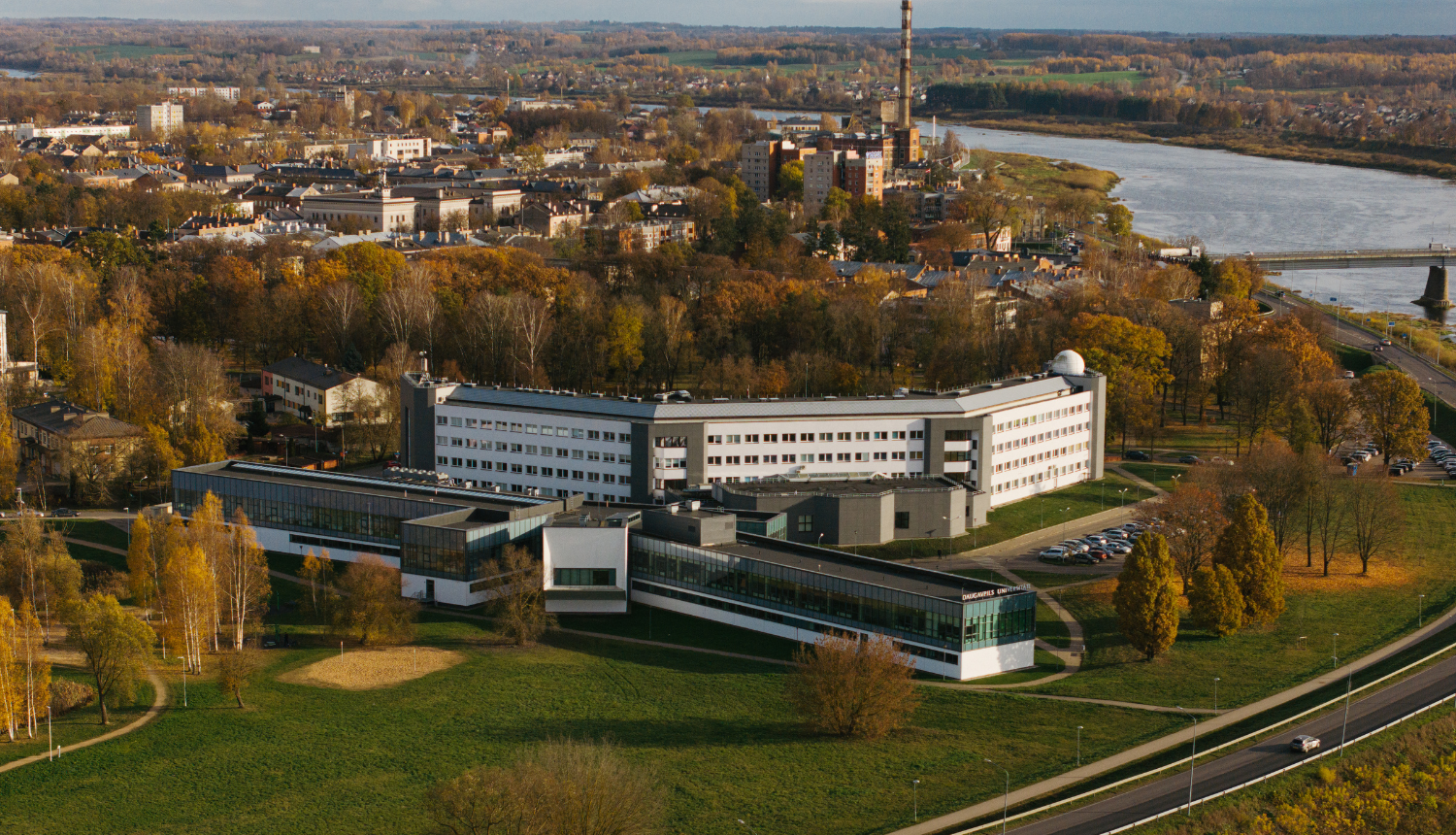
Daugavpils University (DU) is one of the leading research centers in the Latgale region, dedicated to developing an internationally competitive research environment. The work of DU researchers not only contributes to the growth of science in Latvia but also strengthens the regional innovation ecosystem by promoting knowledge exchange, collaboration, and sustainable development of society.
In 2025, DU became one of the first 12 scientific institutions to join researchLatvia – the science communication platform initiated by the Ministry of Education and Science, thus reaffirming the university's significant role in the development of Latvian science. DU’s contribution is particularly highlighted in this year's traveling exhibition and calendar Research Latvia 2025.
This initiative features 12 centers of scientific excellence from Latvia, representing the country’s leading research institutions and affirming Latvia’s place in the European Research Area. Among the scientists included in the 2025 calendar is Dr. biol. Artūrs Škute, Professor at the DU Institute of Life Sciences and Technology, whose research focuses on the sustainability of aquatic ecosystems, biodiversity, and the study of environmental processes. As Professor Škute himself puts it:
"Science enlightens minds and the world. Sometimes I feel like Holmes, other times I resonate with Watson. These wonderful feelings foster new knowledge that broadens our perspectives and makes us happy."
DU is an educational and research institution in Latvia that conducts multidisciplinary and interdisciplinary scientific activities based on three strategic specializations: natural sciences, social sciences, and the humanities and arts.
The university’s research infrastructure includes two scientific institutes:
-
Institute of Life Sciences and Technology,
-
Institute of Humanities and Social Sciences,
with more than 70 qualified researchers and senior researchers, facilitating the production of high-quality research outcomes and their integration into the international scientific community.
DU has been granted the right to award doctoral degrees in nine scientific fields, and currently hosts 124 doctoral students actively engaged in research, collaborating with scientific institutions both nationally and internationally. Each year, DU scientists prepare more than 200 scientific publications, many of which are indexed in the prestigious SCOPUS and Web of Science databases, demonstrating the institution’s research capacity and quality.
Key Research Performance Indicators for 2024:
-
A total of 275 scientific publications, of which 200 are indexed in the SCOPUS/Web of Science databases;
-
Implementation of over 70 projects and commissioned works, including:
- 5 Horizon Europe projects,
- 3 LIFE Programme projects,
- 4 projects funded by the Latvian Council of Science (LZP),
- 2 projects under the National Research Programme (VPP).
The Daugavpils University Doctoral School plays an essential role in ensuring the quality and sustainability of scientific activities. It serves as a platform for academic and research excellence by promoting:
-
the development of doctoral students' research competencies,
-
the improvement of the mentoring system,
-
access to modern research infrastructure,
-
international mobility and participation in research projects,
-
support in the preparation and dissemination of scientific publications.
In addition to externally funded projects, DU also implements internal research projects for academic staff and students, thus strengthening the development of the research environment within the university and the region.
DU is involved in numerous national and international projects, reflecting the institution’s interdisciplinary capacity and its contribution to environmental sustainability, biodiversity conservation, and bioengineering.
Examples of major projects:
- Horizon Europe project BETTER Life – “Enhancing Public Engagement in Life Sciences Excellence Development through Integrated Digital Center Framework”
-
Horizon 2020 project OPTAIN – “Optimal Strategies for Water and Nutrient Retention and Reuse in Small Agricultural Catchments Across Europe”
-
Horizon Europe project GUIDEPREP – “Growing Up in Digital Europe Preparation Phase”
-
Horizon Europe project CLiViE – “The Value of Cultural Literacy in Europe”
-
Horizon Europe project PULSE-ART – “The Contribution of Art and Culture to Promoting Understanding and Lifelong Learning”
-
ERA-NET project EMYS-R – “Socio-ecological Assessment of Wetland Restoration and Reintroduction Programmes Targeting the European Pond Turtle and Related Biodiversity: A Pan-European Approach”
-
EU LIFE Environment Programme project LIFE FOR SPECIES – “Endangered Species in Latvia: Enhanced Knowledge, Capacity, Information Flow, and Awareness”
-
EU LIFE Environment Programme project LIFE-IP LATVIANATURE – “Optimization of Management and Governance of Natura 2000 Protected Areas”
-
EU LIFE Environment Programme project LIFE OSMO BALTIC – “Creating an Ecological Network for the Conservation of the Hermit Beetle in the Baltic Region”
-
Latvian Council of Science (LZP) Fundamental and Applied Research Project – “New Fluorescent Functional Materials Based on Anthrone for Bioimaging Applications”
-
Latvian Council of Science (LZP) Fundamental and Applied Research Project – “The Link Between Insect Life Cycles, Stress Resistance, Metabolic Dysfunction, and Memory Formation”
-
European Regional Development Fund Interreg Latvia-Lithuania Cross-Border Cooperation Programme Project Green Stories – “Educating Society and Raising Awareness About the Role of Plants in Human Life”
-
Latvian Council of Science (LZP) National Research Programme Project – “The History of Latvia in the 20th–21st Centuries: Social Morphogenesis, Heritage, and Challenges”
-
Latvian Council of Science (LZP) National Research Programme Project HiQBioDiv – “High-Resolution Biodiversity Quantification for Nature Conservation and Management”
-
ERASMUS-EDU-2024-EUR-UNIV OPENEU project OpenEU – “A Learner-centered, Inclusive, Digital, and Environmentally Friendly Open European University for Strengthening the European Higher Education Area”