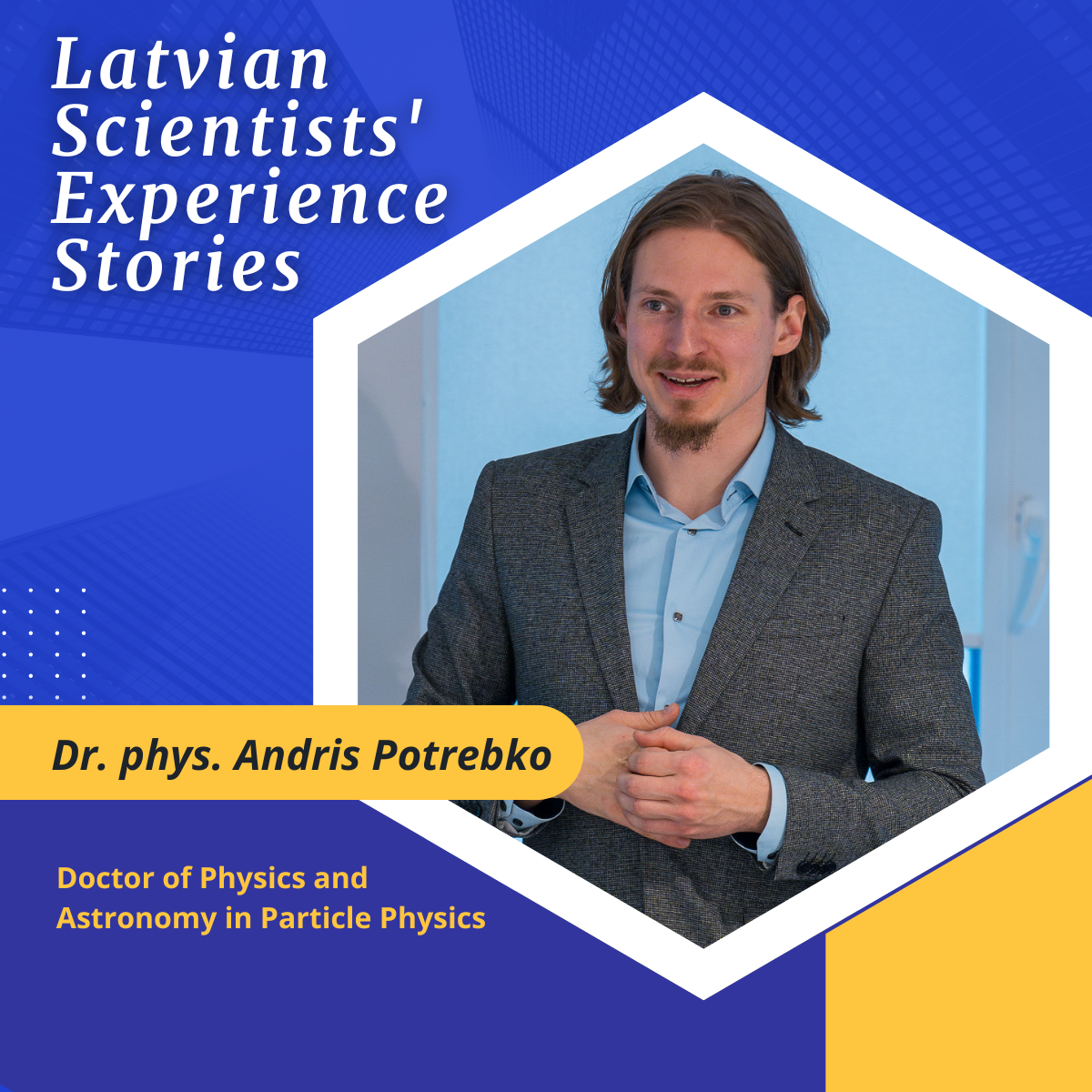
How do you measure a particle that exists for only ten to the power of minus twenty-five seconds? And how can an accelerator produce hundreds of billions of collisions – if the protons are destroyed with each collision? Physicist Dr. phys. Andris Potrebko – Latvia's first young doctor, who conducted his doctoral research at the European Organization for Nuclear Research (CERN) and graduated from the joint doctoral study programme in Particle Physics and Accelerator Technologies at Riga Technical University (RTU) and the University of Latvia (LU) – studies the world at its smallest scale. The science communication portal researchLatvia talks with Dr. phys. A. Potrebko about particle physics, life at CERN, and why a single measurement can take years.
Dr. phys. A. Potrebko has studied the mass difference between the top quark and its antimatter counterpart – the top antiquark. The results obtained are the most precise measurements of this characteristic in the world to date.
The Beginning: From a Radio Programme to CERN
In 2012, the Higgs boson was discovered. Andris was still in primary school at the time, but a story he heard on the radio programme "The Known Unknown" – about a particle theoretically predicted 50 years earlier, whose discovery required a sufficiently powerful accelerator – sparked his curiosity. "I found it genuinely fascinating, and even people around me who had nothing to do with science were talking about the discovery with excitement," recalls Dr. phys. A. Potrebko.
The decisive step came during his bachelor's studies, when the opportunity to apply for the CERN Summer Student Programme arose. "I applied – and got in." To be eligible, he had to write a motivation letter and obtain recommendations from two professors. "It was a bit difficult to write the motivation letter, because at that point I didn't know much about the field yet and wrote quite broadly about what interests me in particle physics. I wasn't happy with how vague it was," admits Dr. phys. A. Potrebko. Nevertheless, this first step opened the door to a world where scientists discuss dark matter over dinner.
What Fascinates in Particle Physics
Particle physics studies the fundamental units from which all matter is built. It was once believed that the atom was the indivisible basic unit – the word itself means "indivisible" in Greek. Then it was discovered that atoms consist of an electron cloud surrounding a nucleus, the nucleus is made up of protons and neutrons, and those in turn are made up of quarks. "Quarks are currently the elementary particle that we don't know how to divide any further," explains the physicist.
What captivates Andris is not only the theory, but also the way of studying it: "The particles we study exist for only ten to the power of minus twenty-five seconds. They don't even have time to travel the diameter of an atom before they have already decayed, and we only see their effects." It is precisely this paradoxical situation – knowing about something you cannot directly observe – that draws the physicist back to his work time and again.
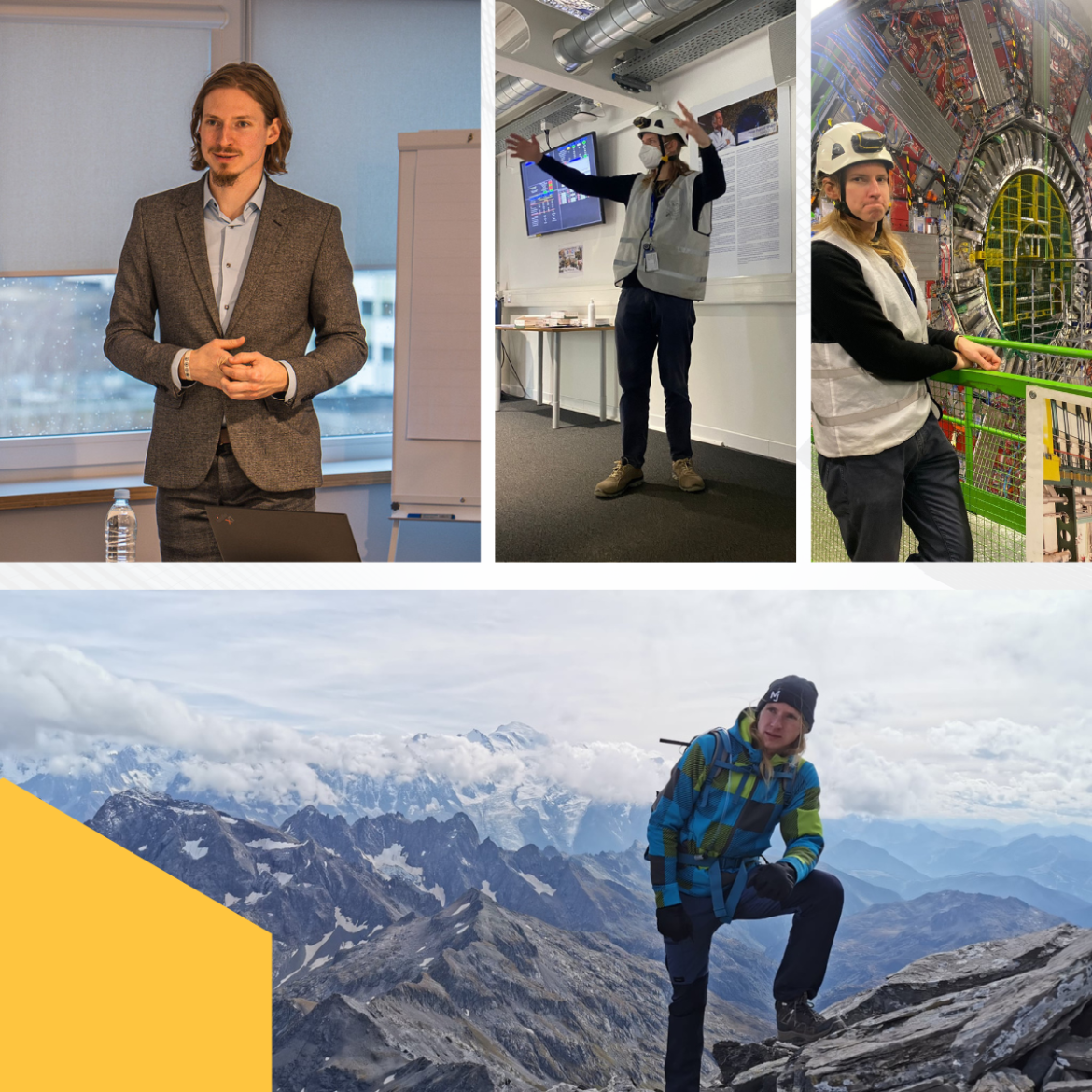
Photo collage from Andris Potrebko's personal archive: glimpses of the researcher's professional life and leisure time – climbing Mont Blanc, defending his doctoral thesis in particle physics, and leading a tour of the Large Hadron Collider.
CERN: Science as a Way of Life
CERN is not just a laboratory – it is an entire infrastructure with three restaurants in different parts of its grounds, a fire station, a small souvenir shop and a museum. Two of Andris's doctoral years were spent in this environment, and it was precisely the everyday life at CERN – informal conversations over lunch, colleagues with whom every problem could be discussed – that became one of the most important sources of support for his research.
In the Large Hadron Collider – a tunnel with a circumference of 27 kilometres – not just two individual protons, but entire beams containing hundreds of billions of particles are accelerated and directed towards one another. That is why collisions can continue for hours on end. The system is cooled to just below 2 Kelvin – lower than the average temperature of the universe. This temperature is necessary for the superconducting cables in the magnets to generate a sufficiently strong magnetic field to control the proton beams. "The entire setup of the Large Hadron Collider is quite fragile," admits Dr. phys. A. Potrebko – if a proton strays from its trajectory, its energy can destabilise the entire system.
The Research: The Most Precise Measurements in the World
Andris devoted three of his five doctoral years to a single measurement – the mass difference between the top quark and the top antiquark. According to the CPT (the combination of charge conjugation, parity and time reversal symmetries) symmetry principle of quantum field theory, the masses of a particle and its antiparticle are identical. Any deviation from zero would be scientifically sensational – it would point to physics beyond our current understanding. "Overall it is an important step, but as a single result it does not overturn all the physics we know," explains the physicist.
The measurements obtained are the most precise in the world for this characteristic to date. This clearly illustrates what fundamental science means: a single number, which takes years to obtain, can become the foundation for the next breakthrough.
Doctoral Studies: A Marathon with a Shadow Overhead
In the exact sciences, doctoral studies are primarily research work – the dissertation is written in parallel with everyday research. In the background there was always an anxious thought: "Will I finish in time? At some point the funding will run out." When the work was finally done, something else took its place – a heartfelt sense of accomplishment, like the afterglow following a long marathon. "There is something tangible that has been achieved over these years," says Andris.
In particle physics, a doctoral student is not very independent at first – the young researcher must acquire a vast body of insider knowledge about the experiment, the methods and their history. "You have to gradually become more independent – it is a little daunting," admits Andris. Yet it is precisely this process, in which young researchers come with many questions and take nothing for granted, that is often the source of the greatest discoveries.
International Collaboration and Latvia's Role
Modern fundamental science is impossible without international collaboration. CERN employs thousands of scientists from many countries. "It shows that sometimes large endeavours, where thousands of people are working together, can function with great precision," says Dr. phys. A. Potrebko.
Latvia has been actively moving towards full CERN membership in recent years – a process that began with associate member status during Dr. phys. A. Potrebko's doctoral studies. This opens up broader opportunities for Latvian students and researchers, and also generates direct economic returns: participation in CERN comes back in the form of orders placed with Latvian companies. Latvia is also involved in the development of the MIP Timing Detector (MTD) – a system for detecting the timing of minimally ionising particles – which will be an entirely new detector component in the next operating period of the Large Hadron Collider.
Why Society Needs Fundamental Science
"I enjoy communicating science, but it is difficult to do without overstating things," says Andris candidly. "People want results that are sensational. But research that doesn't overturn all of physics, but adds a new piece to the puzzle of our knowledge, is almost as important as sensational discoveries." The physicist considers this tension between science communication and reality to be one of the greatest challenges.
The answer to the question of the practical application of his measurements is a historical one. Faraday, studying magnetism and electricity, had no idea that his discoveries would become the foundation of all modern electrical power. Quantum physics, which once seemed abstract, today underpins computers and mobile phones. "I don't know where this will be applied or when it will pay off," admits Dr. phys. A. Potrebko, "but if we don't invest in fundamental science, we risk stagnation."
CERN has already given society an enormous amount: the World Wide Web protocol, accelerator technologies in medicine, advances in superconducting materials, and artificial intelligence tools that particle physicists were already using ten years ago. "The majority of accelerators are not in science, but in medical institutions – in cancer diagnostics and treatment," notes Andris.
Motivation and Advice for Young Researchers
Motivation is sustained by colleagues and the ability to occasionally step back and remind oneself of the bigger picture. "I often get so absorbed in one small problem that I lose sight of the big picture – it is vital to remind yourself of it," says Dr. phys. A. Potrebko.
Andris advises students not to hesitate – to seek out international opportunities with an open mind, just as he once applied to the CERN Summer School without expecting too much. "Talk to your lecturers – they can seem intimidating because they know so much, but in my experience, if you approach them, they are very open."
And finally – don't give up when things aren't working. "The code I write doesn't work. The hypothesis doesn't work. Then you have to think further, try to figure out why these things are happening. It is challenging – but so fascinating to study what our world is made of."
Photo: Armins Ronis