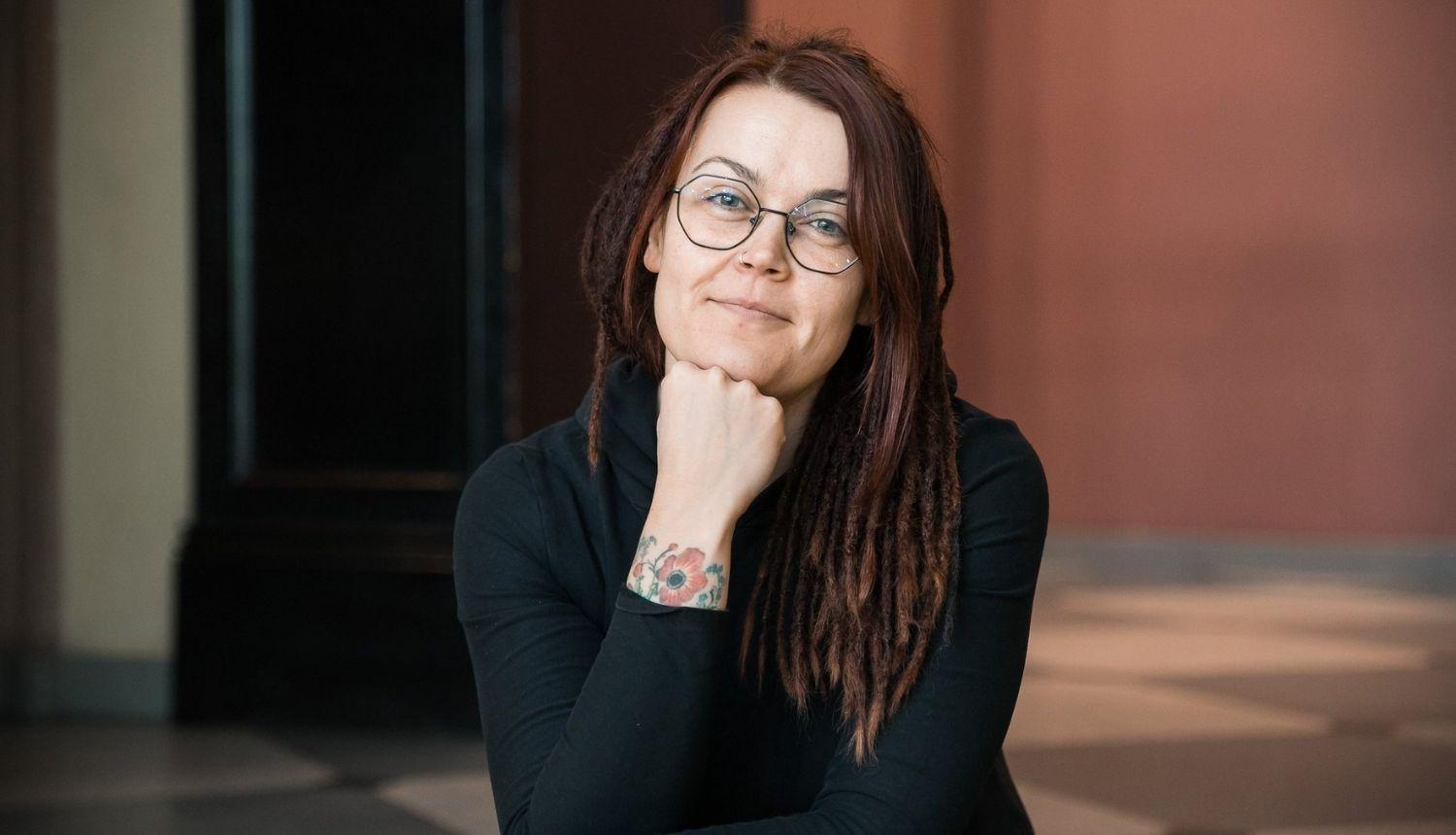
"Easy language is not an alternative to literature – it works like glasses for those with poor eyesight," emphasises University of Latvia (UL) researcher Velga Polinska, who in November represented Latvia in an international science communication competition in France, presenting her research on easy language in four minutes. Velga is the first person in Latvia to write a dissertation on this topic. In Latvia, the subject is often met with scepticism, but in the European academic environment, it is becoming increasingly important. In the spring 2026 issue of the UL magazine Alma Mater, the researcher discusses the role of easy language in the Latvian language system, her path in science, her motivation, and why accessible language is a matter of democracy.
In November, you represented Latvia in the final of the FORTHEM international university alliance short-format presentation competition, introducing your research on the use and importance of easy language in society. What was your main message in the competition, and what did you want the audience to remember?
he main focus of the competition was a call to recognise that many people need accessible, understandable information, rather than content presented in the way we find convenient. I had four minutes to explain the main message of my research. In my dissertation, which has already been approved by the Latvian Council of Science and which I will be allowed to defend very soon, I focus specifically on the Latvian language, its system, and the place of easy language within it. In the competition, I emphasised who can benefit from easy language. There is often an assumption that if a person cannot read, that is their own problem. My message was a call to recognise that many people are unable to read fluently, not because they do not want to, but because of objective reasons.
Is there any statistics on this?
The World Health Organisation indicates that around 15% of the world's population needs adapted information. This does not apply only to easy language, but the scale is significant. In Latvia, there is a lack of data in this field, and society still tends to view solutions that promote inclusion with scepticism. There is a belief that everyone must fit into one common standard, while people with different needs are often excluded from a very early age. As a result, the entire burden often falls on families, who have to find solutions on their own. That has also been my experience.
You received many compliments at the competition. Which comment moved you the most?
Nine participants from different countries took part in the competition. In Latvia, I am used to the fact that easy language is often not regarded as a serious field of research. Over the years, I have often encountered dismissive attitudes: "What is there even to study?" or "Once easy language has been researched, then you can go and study something else." I have not heard people say that about any other branch of linguistics, such as onomastics or dialectology.
In France, my inner critic was very loud – around me, doctoral students were presenting on the use of mathematical equations to avoid the need for contrast agents in magnetic resonance imaging, on monitoring crab catch rates to preserve species, on nanomaterials in clothing to kill bacteria... And I was talking about easy language. Is my topic scientific enough? After all, everyone has heard of easy language – what kind of science is that?
That is why it was moving to receive comments after my presentation from people who had never previously thought my topic was globally significant or should be discussed more often. Listening to others, I felt that they were talking about changing the order of the world, and I was not. But after the presentation, people came up to me and said that my story was exactly about that. That experience gave me a powerful boost for my future efforts.
Many people confuse easy language with plain language. What is the difference?
The terms and definitions of easy language and plain language are not yet fully established; there are no national-level guidelines or support institutions. Moreover, neither easy language nor plain language has yet become standard practice. That is why there is so much confusion.
Easy language is a specific form of language for people with temporary or permanent comprehension difficulties: language learners, people after a stroke or with intellectual disabilities, and older people whose mental sharpness may have declined. It allows them to understand a text from the first to the last letter. The fact that we sometimes use easy language ourselves to quickly grasp the main idea is not its primary purpose.
Plain language, by contrast, is intended for anyone who is not a specialist in a particular field. It avoids professional jargon and complex sentence structures. Almost everyone has at some point received a contract where the sentences are so long and complicated that you can no longer remember how they began or understand what the subordinate clauses or explanatory information refer to. Plain language is meant to organise such documents more clearly. So, easy language is for people with comprehension difficulties, while plain language helps anyone who is not a field specialist.
I understand that the concept of easy language comes from Scandinavia, where it has long been established.
Yes, I would attribute its origins to Sweden – in the late 1960s, attitudes toward people with disabilities began to change, and they gradually came to be seen as full members of society. Social movements emerged alongside efforts to provide accessible information, and neighbouring countries adopted this comparatively quickly as well. In Sweden, easy language began to be seen as a tool that allows a person to be part of society even if they cannot meet every standard. It was closely linked to human rights – the right to information, freedom, and independence. In Latvia, we are talking about it, but in practice, we are still only at the beginning of the road.
How did you choose your dissertation topic – why easy language?
The dissertation topic followed logically from my master's thesis and later from my practical and research work in the PERLSI project (Promoting Easy-to-Read Language for Social Inclusion). When I began working in this field, I realised that society's attitude toward easy language was very sceptical. One comment I read while studying people's opinions about easy language on social media has stayed with me: "Easy language is like a cream product, full of harmful substances." I wanted to change that attitude. Easy language is also part of standard Latvian.
The main aim of my doctoral thesis was to investigate whether there is anything in easy language that does not comply with standard Latvian. The conclusion was this: easy language does not use all the expressive means available in standard Latvian, but the means it does use fully comply with the norms of standard Latvian.
My task was both easy and difficult, because I am the first person in Latvia whose doctoral work is on easy language. In it, I wanted to summarise everything I have learned over the past five years, and also to leave room for future research. It will be a good resource for master's and bachelor's students who, in the future, want to write about easy language. At present, there is very little scholarly literature on the subject in Latvia.
Awareness of easy language will grow in Latvia, allowing us to consider it a legitimate means of communication. Easy language is often burdened with prejudice in society – we still have not learned to accept that people may have different needs.
One common view is that easy language could negatively affect the Latvian language.
People are afraid that in the future, schools and publishing in general will offer only books in easy language.
Easy language is not an alternative to literature – it works like glasses for those with poor eyesight. Equality does not mean giving everyone the same thing; it means giving each person what they need.
For example, in German studies, older people said they did not read texts in easy language because they did not offer them any new information. But the people who need support do use it.
No one is going to burn The Surveyors' Times or make it compulsory reading in easy language. But people who cannot follow the original due to the language's complexity also have the right to read. Why deny them that? Easy language is reduced – without figurative language and long strings of synonyms – but it allows access to stories and fairy tales for those who would otherwise be left out. I see no reason why stories and fairy tales in easy language should not exist alongside the originals.
Why is this issue personally important to you? I can see that you are deeply passionate about it.
I have two children. My younger child has Down syndrome. I would never have thought about the usability of resources for people with disabilities if I myself did not have a child with Down syndrome. I was raised in a family where excellence was the norm, so for a long time, it was difficult for me to understand a reality in which someone did not understand something even after it had been explained three times. My son brought me into a world where we are all so different. I do not regret for a moment that I ended up there – it is valuable to see something beyond your own ego.
However, part of my motivation may sound harsh – I do not want to live with my children all my life. I want them to be independent and have lives of their own. In the current situation in Latvia, my son has no real opportunities to live independently, because he does not meet the standards imposed on children, young people, and adults. If we talk only about fixing children with disabilities, and not about creating an environment in which people with different needs can fulfil their potential, he will be forced to live with me for his whole life.
Did you also write your doctoral thesis in easy language?
No. I think that in science and legislation, easy language will never become the primary or fully legitimate form of communication – rather, it will become an addition to the way we already work in these fields.
By the way, a colleague in Germany who pioneered oral interpreting into easy language told me that her master's thesis had two versions – one for official submission and another in easy language.
There is also a university in Belgium, where, before defending the thesis, the author is given time to explain their research to the audience in plain language. That is a very good initiative, because in academic defences it often happens that people outside the field understand almost nothing of what is being said.
You also actively participate in international conferences, representing Latvia and easy language.
Yes. This field of research is currently developing rapidly worldwide, so it is important to clearly demonstrate at international conferences that Latvia is also working in this area. Important collaborations have developed with colleagues in Sweden, Germany, Slovenia, and elsewhere. In the context of projects, Latvia is already seen as an equal partner. When new initiatives arise, colleagues know that we can put our heads together. I have presented Latvia's experience in Portugal, Germany, Finland, Lithuania, Italy, and Australia, and it is gratifying to see that ideas born here are also being adopted in other countries. That confirms how important it is for this field to be represented internationally as well.
Together with UL researcher and Riga Stradiņš University (RSU) lecturer, Doctor of Linguistics Dite Liepa, we are the first in Latvia to devote such serious research-level attention to easy language. Although easy language has existed here for more than 25 years, it has mainly been developed in practice – based on intuition, available resources, and opportunities. I am interested in understanding easy language scientifically: what it consists of, its history, the processes taking place in the world, and its legal framework. Until now, this kind of focused perspective has received little attention in Latvia.
The presence and support of Dite Liepa and my doctoral supervisor, UL Professor Ina Druviete, have been decisive in my academic path – without them, I most likely would not have been taken seriously in the academic environment. For them, easy language is a secondary topic; for me, it is the central one.
What is happening elsewhere in the world in the field of easy language?
A great deal is happening, and what is interesting is that in each country, easy language is developing in a slightly different direction. That is exactly why international experience is so important – first, to discover new perspectives and understand what more can be done, and second, to avoid repeating what others have already researched.
In Spain, a lot of work is being done with audiovisual materials. In Sweden, a great deal of fiction is published in easy language. In Germany, easy language is established in legal acts – there is a mandatory requirement to offer materials in easy language. There is a huge market, and universities study how readers read these texts using special equipment and by analysing reading order. Large projects are also being implemented there, in which websites allow users to switch from standard text to easy language text with a single click.
In Finland, there is extensive work on easy language because Finnish is difficult, and there is a strict requirement that everyone living in Finland must know the language. For this reason, the Finns actively offer a broad range of content in easy language to help people learn it more easily. There is even a hospital there where, for more than ten years, all patient materials have been provided only in easy language.
In Slovenia, readers themselves are especially actively involved – there are courses teaching people how to become good text evaluators and the skills needed to participate in commissions that assess a text's functionality. There is a great deal of work to be done, particularly with target groups.
Whichever country you look at, you can see something specific in each one. I think that we have to keep going too. As long as I have the strength, I will continue to cooperate with foreign researchers, because I gain a great deal of knowledge from them. I am already known there, and Latvia's name in the world of easy language has become much more visible.
Does Latvia have anything to be proud of that sets it apart?
We have Latvian Radio news in easy language. Very few countries have a public media outlet that regularly broadcasts in easy language, so Latvian Radio's news at 9 p.m. is a real treasure. Of course, the quality can be discussed, and the radio is already working on that, but the idea itself is extremely important. If people in Latvia are asked whether they have heard of easy language, many mention this news program in particular.
I am also proud of the writing competition – we borrowed the idea from Slovenia, where such a competition had already taken place. As a result, stories in easy language have been created in Latvia. In some countries, fiction in easy language is widely available, for example, in the Nordic countries, but looking more broadly across Europe, there actually are not many such books. Easy language is still mainly used for everyday information – signs, instructions, notices. So in this area, too, Latvia has something to be proud of.
Continuing on the writing competition – thanks to you, the first original literary books in the history of Latvian publishing written in easy language have been published. Tell us about them!
Stories in Easy Language is my third child! At one point, I heard practitioners criticise universities for talking only about dry theory. That is not true, and opinions like that make me angry. I want people to see that we are not only talking theoretically about easy language, but also creating practical materials that readers can access.
The first competition was the idea of the PERLSI project leader – she saw the value of the competition in cooperation with the Slovenians. Five participants applied for the first competition. When the project ended, we decided the competition had to continue. This competition is also the only cooperation between UL and the Easy Language Agency. In continuing the competition, both UL and the Easy Language Agency spoke to writers about easy language and carried out promotional work. Then, in the second competition, 31 entries were submitted, and this year, in the third competition, 35 entries were submitted. It is precisely the works submitted to the competition that make up Stories in Easy Language.
My greatest wish was for the books to reach bookstores too. After the second competition, I worked actively for a year and a half to make that happen: I approached publishers and looked for an illustrator. The joint-stock company Valters un Rapa agreed to bring the idea to life. The books are being bought, even if people are not talking loudly about it – the first edition has already had a second printing.
I am very happy that with this project, Marta Leimane began working at Valters un Rapa, and she is very enthusiastic – she started with stories in easy language, but is now also producing publications for readers with dyslexia and other reading difficulties, expanding the offer of accessible literature.
When did you yourself first encounter easy language?
In 2021, when I was writing my second master's thesis in the UL Conference Interpreting study program. For a long time, I could not choose a topic – I wanted the thesis to be meaningful, not merely formal. UL Professor Andrejs Veisbergs rejected several topics I proposed – either they had already been studied too much, or the data would be too difficult to obtain. One morning, I woke up with the thought: besides music, I also know about people with disabilities. I was convinced that surely somewhere in the world, there must be oral interpreting for people with comprehension difficulties. I proposed the topic; it was approved, but I had not checked the literature's availability. And then I started searching... I could not find anything and was miserable!
Through my association's email, I learned of a conference in Germany where oral interpretation of content into easy language was offered. I got in touch with the interpreter who had initiated this practice, and the interview was very valuable. Until then, I had been unable to find anything because I did not know the correct English terms, and most of the information was in German. At that time, even the Easy Language Agency in Latvia did not know that oral interpreting into easy language was taking place in Germany.
Your first master's degree was earned at the Jāzeps Vītols Latvian Academy of Music. Has your background in music, combined with translation, helped you understand easy language?
Not directly in relation to easy language, no, but definitely in conference interpreting. Sitting in an interpreter's booth, listening, translating into another language, and at the same time following the next speaker is very similar to playing in an orchestra. They are the same skills and senses: you follow the notes, out of the corner of your eye, you see the conductor, your hands are playing, your mind is already one step ahead, you follow the markings in the score. The processing of information is surprisingly similar.
Is writing in easy language easy?
Writing in easy language is difficult – it requires a good command of language and the ability to express oneself precisely and clearly. It is important not only to choose the right words but also to consider the nuances and flow of the text. It is a skill that can be developed, but it requires both theoretical knowledge and going to your readers to understand how they read it and how successfully you have managed it.
In easy language, the focus is on making the text meaningful and understandable for a specific audience. For example, for young people with hearing difficulties, the word reserved may mean only "closed, shut," not "reserved" in the sense of a withdrawn person.
We are used to dressing our thoughts in bureaucratic phrases and often fail to notice how many unnecessary words we attach. In trying to say more, we often say it less clearly. Verbs disappear from the language: we no longer work, but perform work duties; we no longer pay, but make payments; we no longer investigate, but conduct investigations.
What basic principles should be kept in mind when writing texts in easy language?
Before writing a text in either easy language or plain language, the first question to answer is: why am I writing it? What is the main message, what information is needed for it, and in what order should it be presented?
It is equally important to understand who the reader will be and in what situation they will read the text. For example, insurance terms and conditions are ideally read calmly while comparing offers. But in reality, people read them under stress, after an accident has already happened, and they urgently need to find out what will be compensated. Context significantly changes how a text should be written.
When writing in easy language, the basic principle is: one sentence, one idea. But even the scope of one idea is not universal – it always depends on the reader. For one reader, one idea may be: "Jānis was approached by Ieva in a yellow sweater," while for another reader, this sentence may contain three separate ideas. That is why there are no absolute rules in easy language – everything is based on the reader's needs.
The text should use words understandable in everyday life and mostly simple, expanded sentences, avoiding subordinate clauses, participles, and parenthetical insertions unless truly necessary. Sometimes a participle is a better solution than several disconnected sentences, but it is never the starting point.
Visual design is also important – a clear layout, sufficient font size, spacing, and white space, so that the text does not create confusion at first glance. Where possible, explanatory images also help. The goal is to create a text that can not only be read, but also understood. More about all of this can be learned in the UL study course in easy language.
In 2021, the UL Academic Press published an open-access handbook on easy language – the first publication of this kind in Latvia. You were also involved in its creation.
Dite Liepa and I were the scientific editors of this book. I joined the project later, starting with one article, but my interest grew so deep that it became a broader work, which was a very valuable experience for me. While working on the book, we combined our knowledge: Dite with her expertise in linguistics and language culture, and I with my experience with the target group. The handbook contains articles by several authors and was created within the ERASMUS+ PERLSI project.
Although ERASMUS projects are not always highly valued in academic environments because they may involve people from outside the world of science, they provide very good opportunities for international cooperation. This project allowed us to see how similar issues are addressed, for example, in Lithuania and Slovenia.
Is the field of easy language currently developing so quickly that the book would need a new edition?
If we were working on the book now, it would be different from what we created four years ago. Since then, together with Dite Liepa, we have developed a university course on easy language at UL and RSU, and, alongside that, we have created both lectures and new publications. I have participated in international conferences, become familiar with the work of foreign researchers, and this experience has significantly changed my view of the field. If the book were written today, it would definitely be much richer.
At the time the book was created, there were mainly easy-language guidelines developed by European organisations. These recommendations remain useful and relevant across all languages: use simple words, short sentences, align text to the left margin, and so on. But at that time, there was a lack of recommendations specific to Latvian, because each language has its own nuances. For example, how to use suffixes and prefixes, which conjunctions to choose, and how to build sentence structure and grammatical centres.
Over these four years, our experience has grown considerably, so today we would create the material differently – not radically different, but more nuanced and precise in many respects.
The university course on easy language that you created at UL was launched in 2023. As I understand it, UL became the first higher education institution in the Baltics to offer such a course.
Yes, UL was the first higher education institution in the Baltics to offer a course in easy language. I know that Estonia has a language centre that answers questions about easy language, but I have not met their representatives in the European easy language network. Lithuania has now also created and started offering an easy language course. Dite, I also offered it at RSU; the previous semester was the last time we taught it there. Colleagues at Ventspils University of Applied Sciences also provide an introduction to easy language in several lectures. But a full course currently exists only at UL.
I am very disappointed that, in UL's new education program, Special Education Teacher, this course – which, in content and methodology, corresponds to European-level university courses – has not been made compulsory, but is offered only as an elective.
Is this course available to everyone?
Yes, it is also available to people who do not study at UL – anyone can apply through the Open University, and each semester, one or two people take advantage of that opportunity.
Since the publication of the handbook and the launch of the easy language course, have there been visible improvements in public attitudes?
It is difficult for me to judge society as a whole, because I live in a very strong bubble, and what happens there does not always reflect the situation in society at large. However, among linguists, attitudes have changed significantly – the earlier scepticism is decreasing, and more and more researchers understand why easy language is valuable.
At the state level, I am encouraged by the cooperation with the State Language Centre (VVC), which has recognised the need and is exploring ways to provide consultative support. Latvia has implemented the accessibility directive, which includes requirements for both easy language and plain language, but these are very vague and lack clear reference points. Here, VVC support will be very valuable.
I also consider the storybooks a significant contribution to visibility – I know that teachers use them in language teaching, and that is a very good sign. I do not think this is only my achievement; changes have happened, and I am convinced they will continue.
How do you see the future of easy language in Latvia, and what would you like to say to society, colleagues, and students about easy language and its importance?
The development of easy language in Latvia is closely connected with society's maturity. It will become the norm when different needs are perceived as a self-evident part of society. But that requires a change in public thinking. As long as children with developmental disorders in schools are called "heavy-code children," excluded, or separated, society is unable to see that a person with a disability is a full member of it.
Two years ago, I had the opportunity to participate in the World Down Syndrome Congress in Australia. There, people with Down syndrome work paid jobs, live independently or with partial support, attend social and cultural events, run businesses, and participate in conferences – including those who do not speak, because they use speech tablets. In Latvia, similar people are often isolated. The difference is very simple: in Australia, entrepreneurs told us they were the first generation to study at school alongside children with different needs. They understood what to expect and how to support them. Therefore, entrepreneurs can now create appropriate workplaces for people with different disabilities, thereby promoting greater independence more broadly.
Here, we lack such experience, and society's attitude is often sceptical or even humiliating. Once, after a two-hour seminar that I led at a state institution, someone in the audience asked: "How can I know that a person with Down syndrome has come to me?"
The development of easy language goes hand in hand with a society in which each person receives not one standard solution, but exactly what they need. My call is simple – to do this together, supporting one another so that no one is left alone.
What should be improved at the state level to make language development easier?
At first, society often responds negatively to new ideas; that was also the case in Scandinavia. But over time, attitudes change. I had hoped that this period of rejection could be shortened, but apparently that is not possible – this evolution has to be lived through. If no one talks about it, the evolution will not happen. We have to accept the stage we are at and keep going so that in 30 years we can be where the Finns, Swedes, and others are now, both in terms of easy language and disability issues in general.
Easy language has several drivers of development, and laws are only one of them. The only country where easy language is established in law is Germany. In Finland, it is not written into law, but the tradition is very strong. Experiences vary.
The state should begin by learning and introducing clear definitions, as well as by creating a consultative institution where businesses, associations, and institutions can receive answers in plain language. In that respect, I look forward to the VVC.
Projects are also important – both scientific ones and those not intended only for researchers, but for anyone who can justify an idea and take on a large workload, for example, ERASMUS+. Education is equally important – the opportunity to learn how to create texts in easy language, because it is not simple. And, of course, individual initiatives and people who believe in what they do are valuable too.
Is there life after writing a dissertation?
My main job is still at the Jāzeps Mediņš Riga Secondary School of Music, where I have been working for the nineteenth year. There, I teach violin. At the same time, I also work at the Institute of the Latvian Language at the UL Faculty of Humanities.
Together with Veronika Bašarina, I lead the association Down Syndrome Latvia, providing information, emotional support, and practical support to families with children who have Down syndrome. We organise events so that families can meet. We also try to provide information to specialists and medical professionals when we learn something important at foreign conferences. The work in the association is voluntary and supported by donations. The fact that so many volunteers join us is the best proof of the meaning of our work.
For the past 10 years, I have also worked in translation. I mainly translate descriptions of medical devices. But recently, I founded my own company because I want to devote more energy to plain-language services. After earning my doctorate, I plan to expand this work by turning to issues that are less covered in Latvia – learning sign language and communication tablets. In this field, I still have much to learn myself. I hope I will have the strength for it. My family – my husband, daughter, and son – supports me, so that together we can help others and build an inclusive society. Every one of us can help create a more inclusive environment!