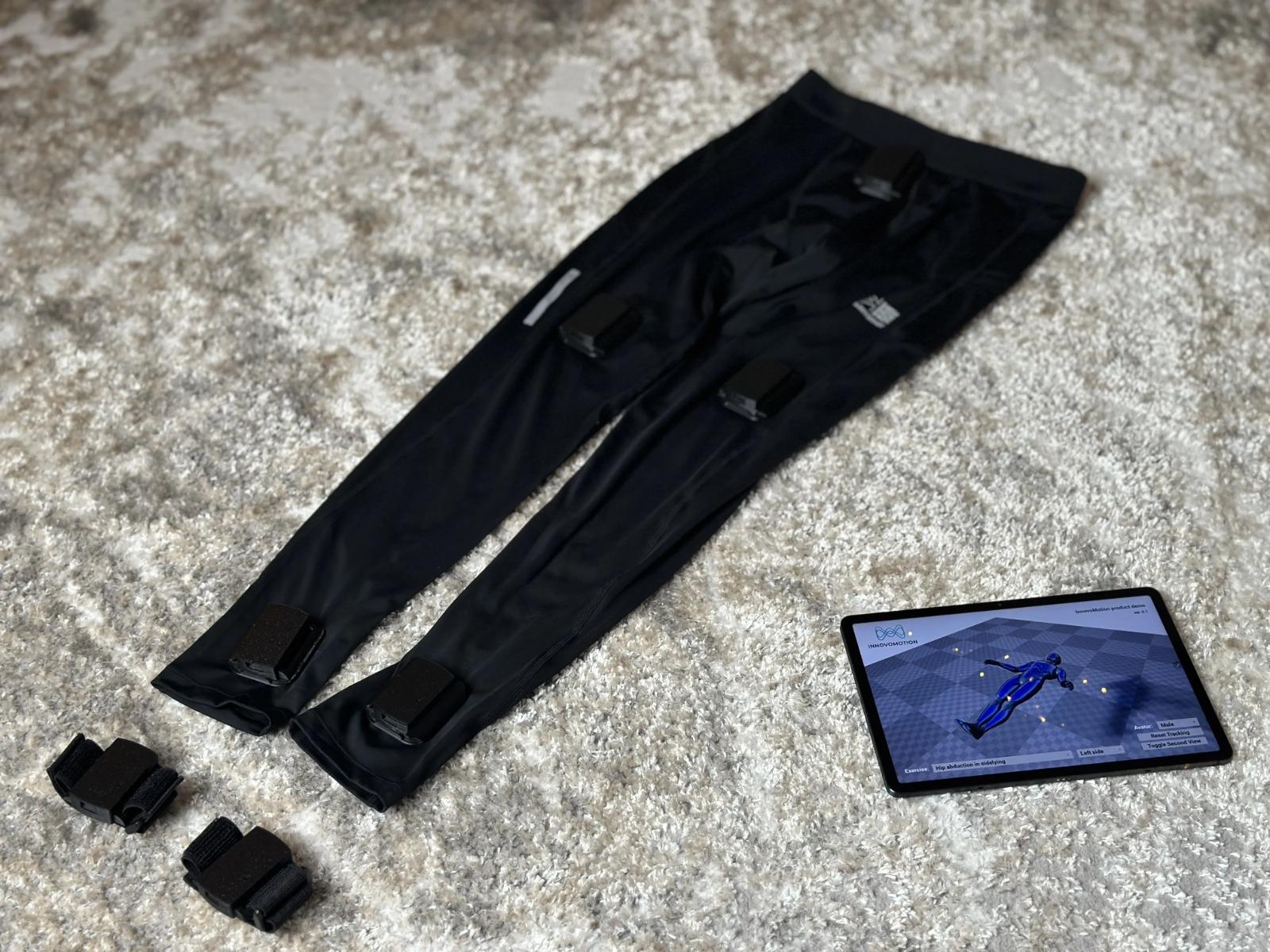
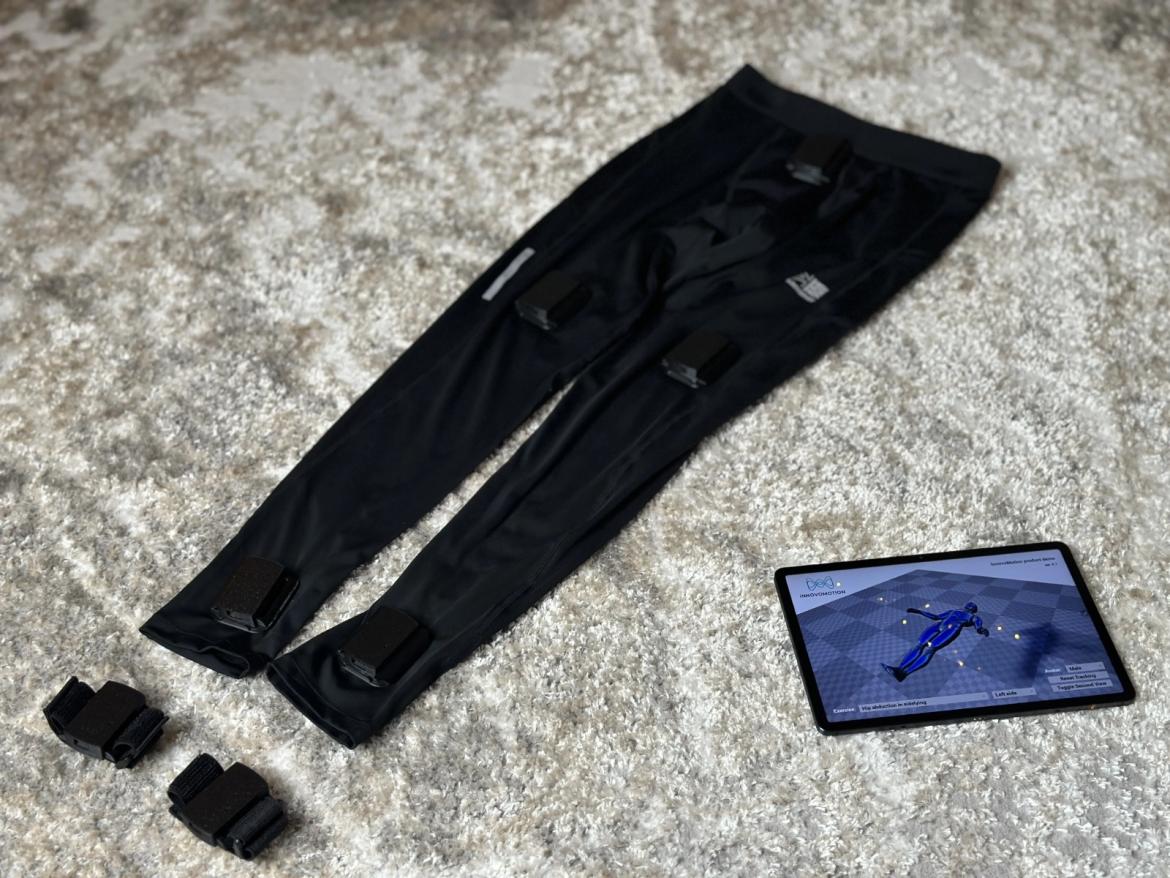
Every year, more than one million people in Europe experience a stroke, and for many of them it results in severe consequences, including the loss of movement control in parts of the body. Timely rehabilitation is crucial: during the first weeks, the brain is most actively forming new neural connections that help restore walking ability, maintain balance, and return to independent daily life. However, the recovery process is often hindered by limited access to physiotherapy—waiting lists are long, and it is impossible to attend sessions as regularly as patients need. To reduce this accessibility problem, the Latvian company InnovoMotion has developed smart leggings equipped with a precise sensor system that allows patients to perform therapeutic exercises at home while receiving feedback that is nearly as reliable as in-person sessions.
The origins of the idea date back to the time when company co-founder Pēteris Kozirevs was studying medical engineering and physics. As part of his bachelor’s and master’s theses, he explored ways to digitally capture and analyze human movement. After graduation, the idea was put aside for a while until Pēteris’s friend and now co-founder Romualds Petrovs encouraged him to turn this scientific experiment into a real product to help patients.
Today, the company’s core team consists of four people—the two co-founders, a physiotherapist, and an engineer. At the pre-commercialization stage, they work on a voluntary basis, investing their knowledge and time because they truly believe that this solution can significantly improve the quality of life for stroke patients, especially those relearning how to walk.
Displays Patient Errors in a Mobile App
The smart leggings developed by the company combine medical engineering with modern motion analysis. Sensors integrated into the garment capture the patient’s leg movements and transmit the data to a smart device, where it is analyzed and displayed in a 3D environment. The application immediately shows whether the exercise has been performed correctly or whether the patient has unintentionally deviated from the correct posture. If a mistake occurs, a virtual avatar—or, as the developers themselves call it, a “ghost”—appears on the screen, demonstrating what the correct movement should look like: where to turn, how high to lift the leg, and where adjustments are needed.
“The idea is very simple—the patient is never left alone wondering: am I doing this correctly?” says Pēteris. “It’s a safety net that allows people to exercise at home while still receiving high-quality feedback and maintaining motivation.”
Not a Replacement for a Physiotherapist
As the developers explain, the goal is not to replace physiotherapists, but to reduce their workload and make rehabilitation more accessible. In rehabilitation, the presence of a specialist is invaluable, yet in reality physiotherapists are overloaded, waiting lists are long, and patients often delay the start of rehabilitation. The technology enables patients to begin exercising sooner, while physiotherapists can monitor progress remotely, adjust exercises, and modify programs when necessary. This significantly increases specialist capacity—they can follow several patients simultaneously while maintaining quality and safety.
“We don’t want to replace physiotherapists. On the contrary—we want to help them serve more patients,” emphasizes Pēteris. “For stroke patients, time is the most critical factor. The sooner proper rehabilitation begins, the greater the chance of regaining movement. And that is exactly what we aim to provide—speed, precision, and the ability for patients to work safely even when the physiotherapist is not physically present.”
The InnovoMotion leggings and application are a fully innovative solution. While various motion-monitoring tools exist on the market, they are mostly designed for yoga, fitness, or general health monitoring rather than addressing the specific needs of stroke patients.
InnovoMotion focuses its product specifically on leg functionality—one of the most important components of quality of life after a stroke—because it helps restore mobility and independence, allowing patients to remain active rather than bedridden.
Focus on Export
As product development continues and the company takes its next growth steps, it actively uses incubation support provided by the Latvian Investment and Development Agency (LIAA) representation in Daugavpils. The team has received consultations, participated in events, built contacts, and, with the help of incubation support, secured funding from the innovation voucher program for software development.
Currently, the team is working on a second-generation product while simultaneously improving the application. The Latvian market is being used for testing and content adaptation, in close cooperation with physiotherapists, the National Rehabilitation Centre “Vaivari”, and specialists from Pauls Stradiņš Clinical University Hospital. During the testing phase, feedback from physiotherapists has been very positive, and product improvements have been purposefully guided by their comments on exercises and functionality.
Although the product is still in development, international interest has already emerged—rehabilitation specialists from Estonia, Finland, and Sweden have expressed their willingness to participate in testing. InnovoMotion’s goal is to complete product development and obtain certification for use. The main focus is on exports and the European Union market, where certification in one country allows the product to be distributed in others.
The preparation of this article was funded by the European Regional Development Fund under the Small and Medium-Sized Enterprise Programme’s incubator subproject.