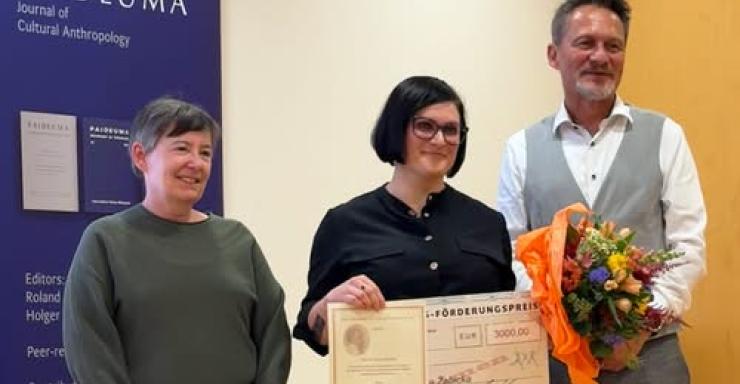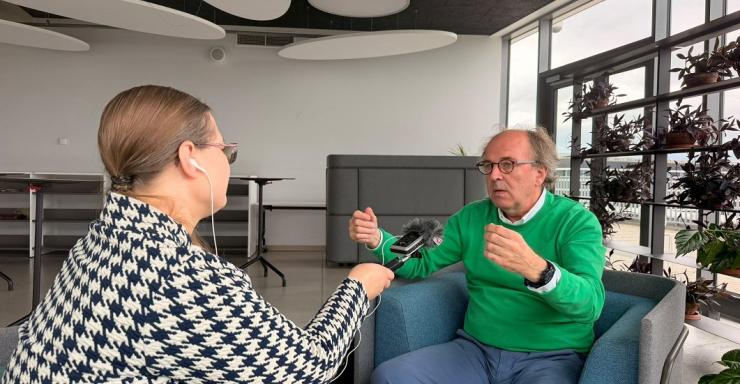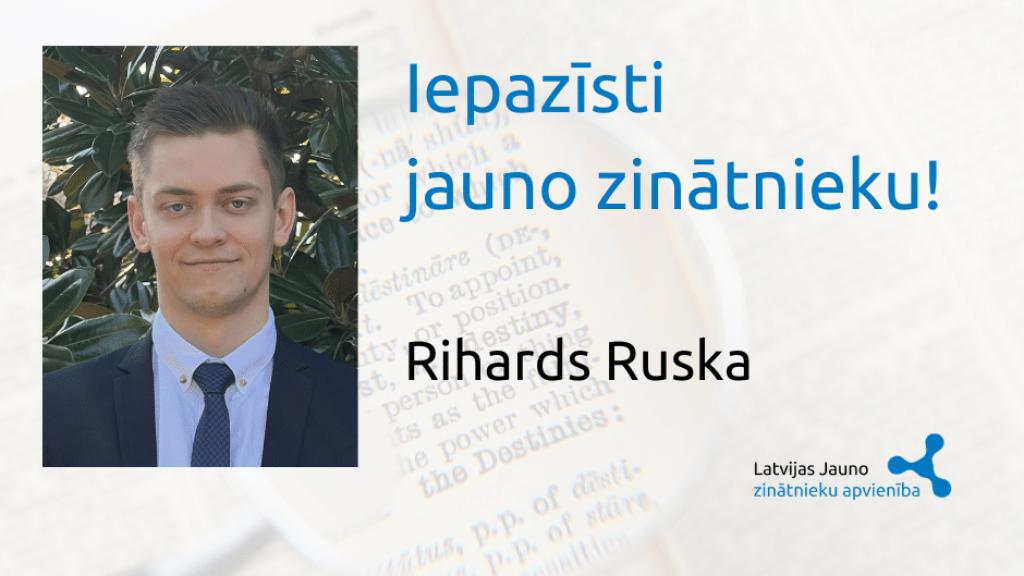
Rihards Ruska is a doctoral student at the University of Latvia (UL) and is developing his PhD thesis at the UL Institute of Solid State Physics on the applications of luminescent nanomaterials in biosensors. Recently, Rihards received the Artūrs Balklavs Prize of the Latvian Academy of Sciences for science communication. We congratulate Rihards on his achievements and invite you to a conversation in the series “Meet the Young Scientist!”
Your research topic is related to nanoparticles and photoluminescence. How did you choose your field of study and end up in physics?
Physics and chemistry interested me already at school. At the time, it seemed almost miraculous that it was possible to predict what would happen when two solutions are mixed or when a certain physical action is performed. For this reason, after finishing school I decided to continue my education, first studying in a bachelor’s programme in chemistry and then in a master’s programme in physics. Pursuing a PhD in materials science was a logical next step, as it combines both chemistry and physics.
Alongside my studies, I started doing research in the second year of my bachelor’s studies. At that time, I learned from my coursemates that various interesting light-emitting materials were being studied at the Institute of Solid State Physics of the University of Latvia. I subsequently applied for an internship and joined the Spectroscopy Laboratory, where I still work today.
How would you briefly explain why your research is important for society?
In my research, I develop light-emitting particles that could in the future be used to monitor processes in agriculture, medicine, and other biological systems. For example, farmers could incorporate these particles into fields and determine the concentration of substances in different areas based on the intensity of the emitted light. This would allow them to plan the use of fertilizers or other substances more precisely and optimize the operation of agricultural machinery.
In medicine, the use of such particles could provide opportunities to obtain information about processes in the human body without surgery or other invasive procedures.
What motivates you in research?
What motivates me in research is the opportunity to understand how the things around us work and to build something new based on the knowledge we gain. To discover something new, it is necessary to constantly place oneself in new situations and accumulate new experiences. This is because our brains create new ideas from what we have already experienced. As a result, the best and most creative scientists I know are extremely curious, active, and open to different life experiences.
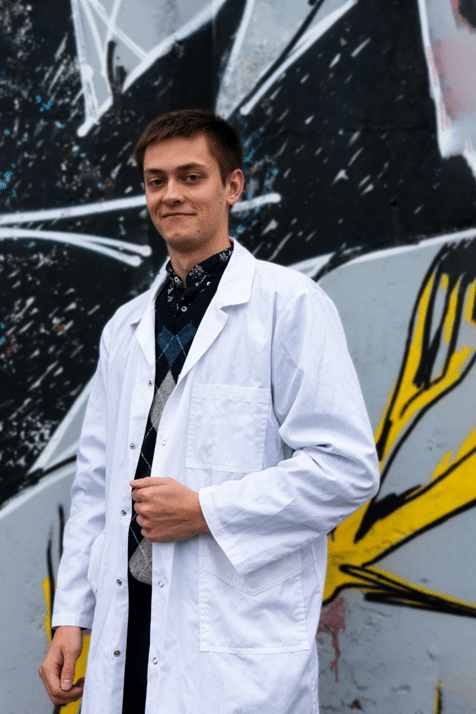
You are the founder and chairman of the board of the startup “Sprayify”. How did the idea for this product arise, and what drew you to entrepreneurship?
The idea for the first product emerged during the COVID-19 pandemic, when various surfaces were regularly disinfected. We saw an opportunity to optimize this process and developed a surface coating called Dezosil. After the pandemic, demand for such coatings decreased, so we decided to redirect the experience we had gained to another niche — protection against mold.
In my case, the desire to engage in entrepreneurship is closely connected with an interest in understanding processes and their interactions. In business and science, the ways of thinking often differ. In entrepreneurship, the emphasis is usually on quick action and efficiency, whereas in science the focus is on high quality and precision. This difference itself motivated me — I wanted to understand both modes of thinking and learn how to combine them.
What kind of support is important for scientists in order to create a strong and encouraging environment for developing solutions that can be applied in practice?
For a solution to find application in the real world, technical competence alone is not enough — it is also necessary to understand the practical needs of the relevant field. Therefore, one way to encourage the development of practically applicable solutions is to strengthen cooperation between Latvian scientists and solution implementers — companies, hospitals, and private individuals. Such collaboration would allow scientists to receive prompt feedback, while implementers could address issues that are directly relevant to them.
Another approach could be to promote closer collaboration between business and STEM students at the doctoral, master’s, and possibly even bachelor’s level. Students are often motivated, creative, and willing to work on new — sometimes even “crazy” — ideas. Bringing together the most enthusiastic STEM and business students already during their studies could therefore be particularly valuable for the development of more experimental solutions.
By forming interdisciplinary teams under the guidance of experienced scientists and business mentors, students could develop laboratory-created solutions in a practical direction and commercialize them. In my opinion, it might even be worth considering allowing students to create interdisciplinary final theses — not as traditional, theory-oriented research papers, but as real projects focused on developing practical solutions.
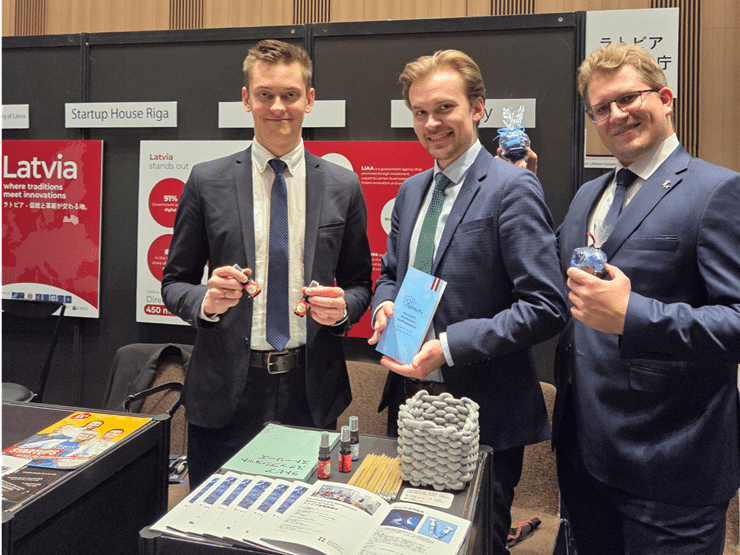
We can also congratulate you on recently receiving the Artūrs Balklavs Prize of the Latvian Academy of Sciences for science communication. What is your approach to turning complex physical processes into a clear and engaging story?
Thank you very much! People are rarely captivated by demonstrations of complexity; rather, they are drawn to ideas that are explained clearly and understandably. When the core idea is easy to grasp, it creates space both for interesting discussions and for potential collaboration. Since audiences can be very diverse, I follow the principle: “too much is as bad as too little.”
A good example is school mathematics — learning does not begin with integrals, and in the first grades negative numbers do not yet even “exist.” Knowledge is gradually adapted to the learner’s level of understanding. I apply a similar approach in science communication. When addressing a broad audience, I deliberately avoid going into technical details that would complicate rather than help understanding. My goal is to build a narrative that allows people to “capture” the essence of an idea and sparks their curiosity to learn more.
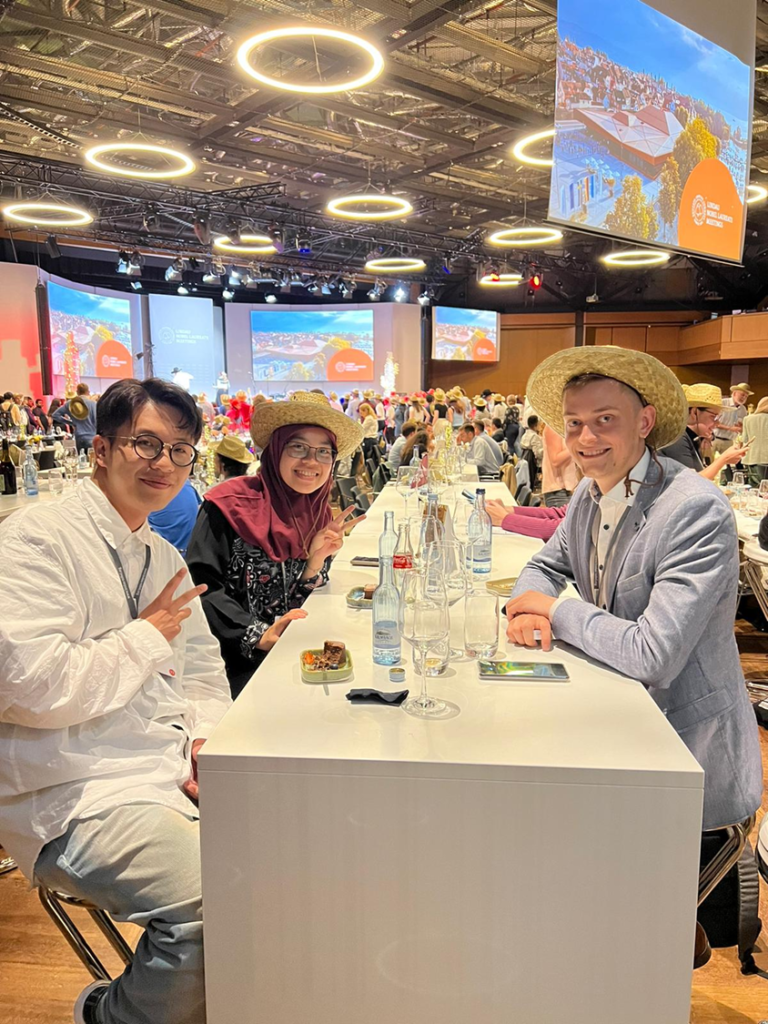
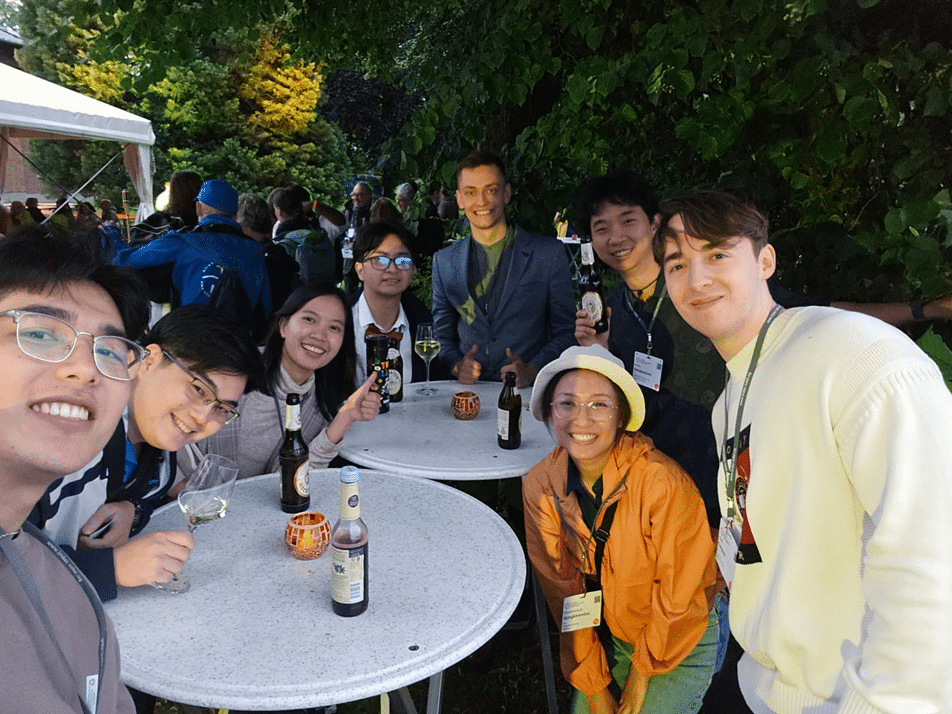
In 2024, you had a unique experience at the prestigious Lindau Nobel Laureate Meeting in Germany. The event brought together more than 30 Nobel Prize laureates and around 600 young scientists, and you were the first representative from Latvia to participate in this annual meeting. What did taking part in the Lindau Nobel Laureate Meeting mean to you personally and for the Latvian science system as a whole?
Participating in the Lindau Nobel Laureate Meeting was a great honor for me personally and would not have been possible without the support of the Latvian Association of Young Scientists. It was an opportunity to meet and have informal conversations with Nobel laureates and to realize that behind outstanding scientific achievements stand very human — yet extraordinarily curious — individuals. This experience helped me understand that science grows and develops where there is the courage to ask questions and the freedom to do things differently.
For the Latvian scientific system, I believe this event will bring benefits in the long term. During the meeting, I was able to establish contacts with several potential collaborators with whom international projects could develop in the future, thereby strengthening Latvia’s scientific environment and its international engagement.
So you combine scientific excellence, the ability to communicate science to the public, and entrepreneurship. How do you manage to balance these areas in your daily life?
Although these fields may initially seem separate, in practice they often complement one another. Entrepreneurship helps develop science communication skills and encourages looking at research from the perspective of practical application. Science communication, in turn, helps to formulate the essence of one’s research more clearly and to think about the next steps. Meanwhile, science teaches you to make decisions rationally and without emotion, which is very useful when developing a company and planning public talks.
What encouraged you to apply to the Latvian Association of Young Scientists?
I was encouraged to apply to the Latvian Association of Young Scientists by the opportunity to connect with representatives from other scientific disciplines. Being a member of the association provides a strong sense of community and the confidence that there will always be someone I can turn to if I encounter questions I cannot answer on my own.
What would you like to wish or recommend to young people who are considering a career in science?
First, I would suggest realizing that it is impossible to “make a mistake” by choosing a career in science, because scientific thinking is valuable in any field — from politics to cooking.
Second, I would recommend never giving up. Both in life and in studies there will be difficult moments, but overcoming them is exactly what shapes us into the kind of people and professionals we want to become.