If we want to find out whether a person is healthy, we carry out medical tests. With the help of sensors, we can understand the condition of roads or building structures – not only assess them visually, but also see what is happening inside them. This would make it possible to maintain infrastructure much more efficiently and at lower cost. Jānis Braunfelds, Associate Professor at the Faculty of Computer Science, Information Technology and Energy of Riga Technical University (RTU), and researcher Nauris Silkāns discuss smart solutions in cities and on roads on the Latvian Radio programme “Zināmais nezināmajā”.
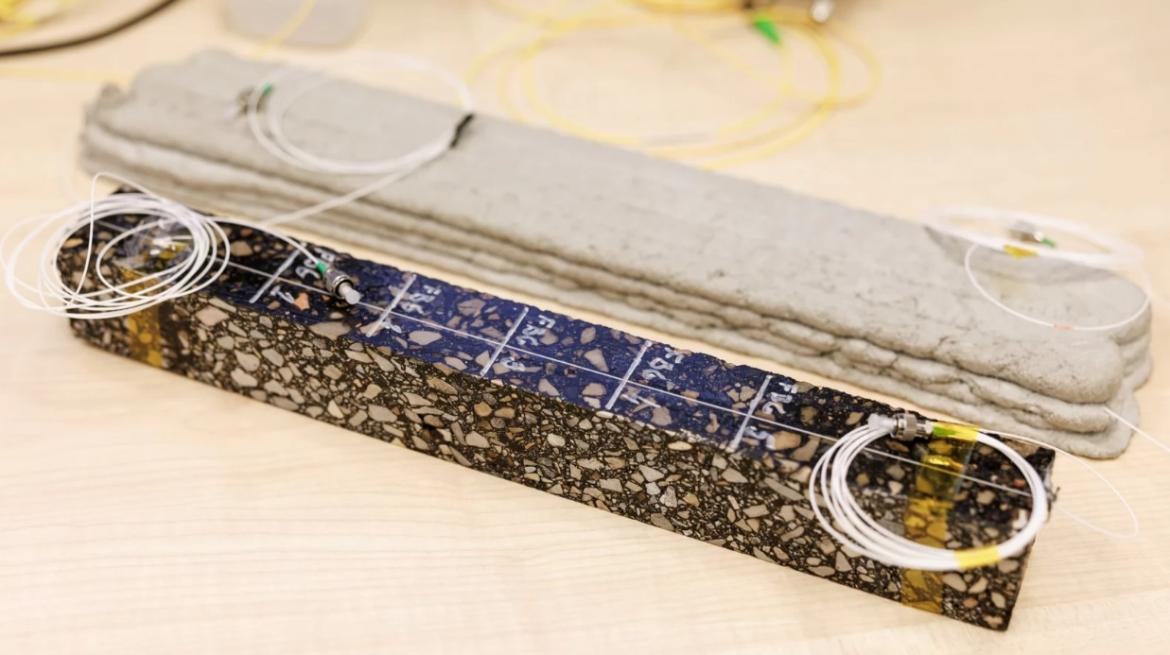
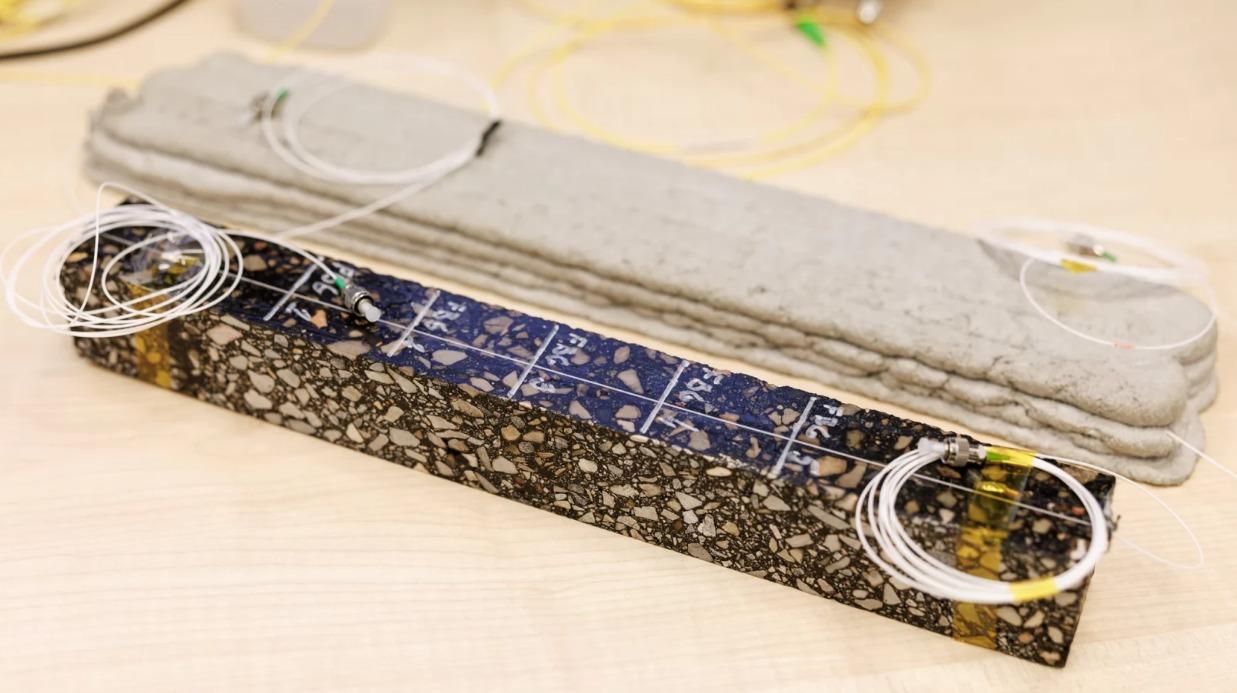
We are developing sensor solutions and technologies for measuring temperature-induced deformation, and testing and validating technologies for monitoring various road surfaces and concrete structures, including by integrating sensors into asphalt pavements, building floors, slabs and panels, explains J. Braunfelds, leading researcher at the Institute of Photonics, Electronics and Electronic Communications. Temperature-induced deformation measurements provide information on how materials and structures change, including whether microcracks are forming inside a structure long before they become visible to the naked eye. As J. Braunfelds points out, data on changes in, for example, a bridge or road section could provide a basis for maintenance operators to decide on repairs earlier, when costs are lower than after the road has already deteriorated, and to plan the necessary resources.
“We would move towards more efficient management. We could rely on data, for example, to decide on repair work only in a specific location rather than across the entire structure, allowing funds to be used more efficiently,” adds N. Silkāns.
Assessing how smart city technologies are being introduced in Riga, the researchers note that smart traffic lights are already in use, for example, while devices that collect data on air humidity and CO2 concentrations indoors are being tested and installed, and heating and ventilation systems are being automated. However, as N. Silkāns points out, the potential of these technologies is not being fully utilised. For example, in smart traffic lights the signal changes not at fixed intervals but based on an analysis of traffic flow, which means that “we can determine the flow of traffic through an intersection, but we do not obtain information about the condition of the asphalt concrete pavement at the intersection.” To achieve this, sensors need to be integrated into the asphalt pavement, while data from vehicles should also be used. Cars are being equipped with an increasing number of sensors, and by obtaining sensor data on vibrations, road construction engineers could predict where potholes are likely to form, whether the pavement profile is correct, and so on.
Within the Swiss–Latvian Cooperation Programme “Applied Research” project LACHMAT, N. Silkāns is developing sensor technologies that can be embedded in road surfaces. His research shows that creating fibre-optic sensor networks in roads and bridges would allow them to diagnose pavement fatigue in real time and monitor dynamic axle loads.
J. Braunfelds emphasises: “Science is ahead of implementation, by at least five years. The sensor solutions we are testing also have great potential to be implemented in the future.”
Within LACHMAT, RTU, in cooperation with researchers from the Swiss Federal Laboratories for Materials Science and Technology (Empa), is developing advanced construction and road-building materials and technologies, focusing on innovative approaches to smart concrete and asphalt, data-driven extension of asphalt pavement life cycles and advanced road pavement material solutions, as well as the development of ultra-high-performance fibre-reinforced concrete and 3D-printed concrete using local raw materials. More information.