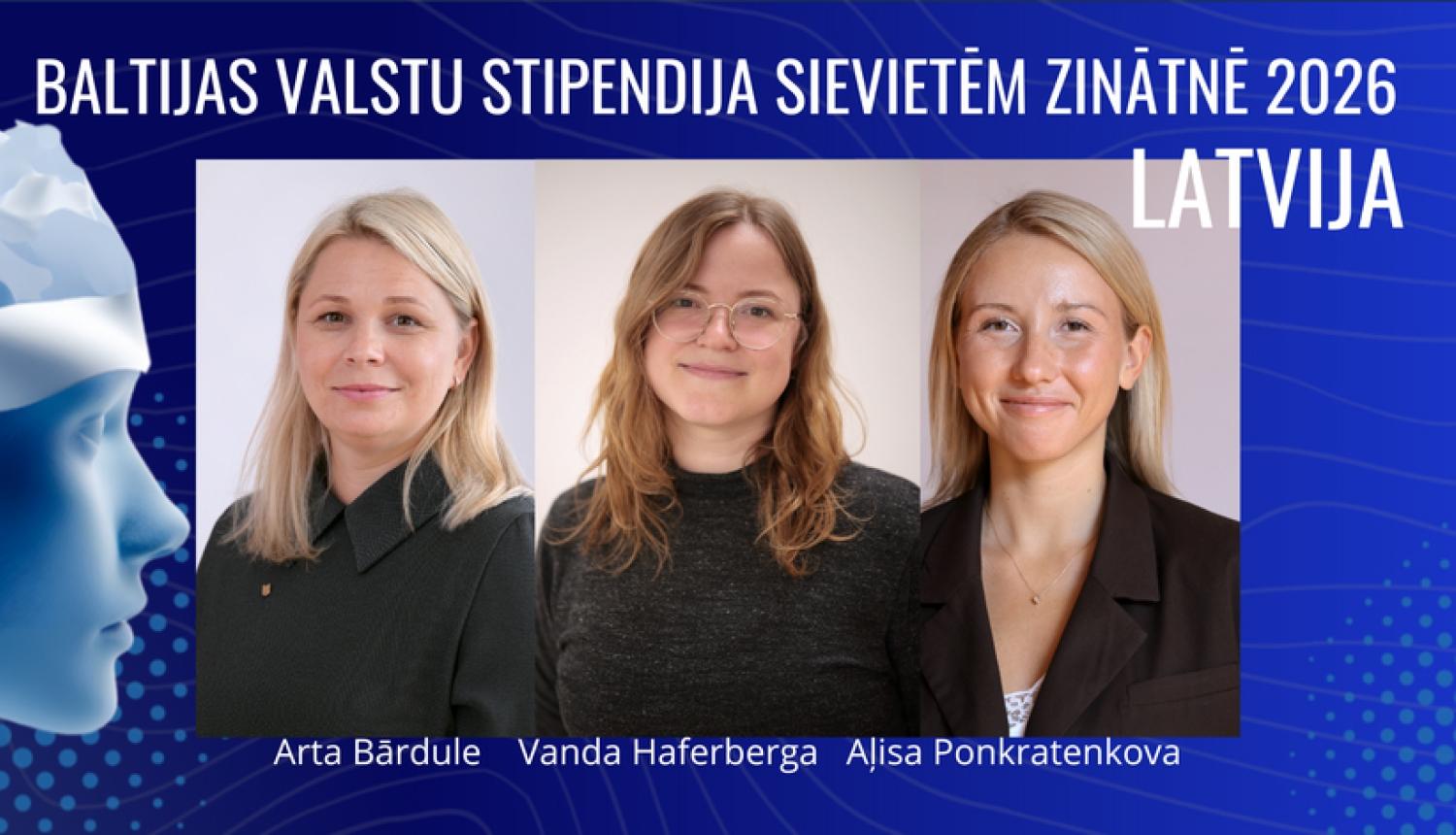
In Latvia, three young researchers – Arta Bārdule, Vanda Haferberga, and Aļisa Ponkratenkova – have become laureates of the “Baltic Fellowship for Women in Science 2026” competition. The initiative is implemented by the Latvian Academy of Sciences (LAS) and the Latvian National Commission for UNESCO (UNESCO LNC), with financial support from the Ministry of Education and Science.
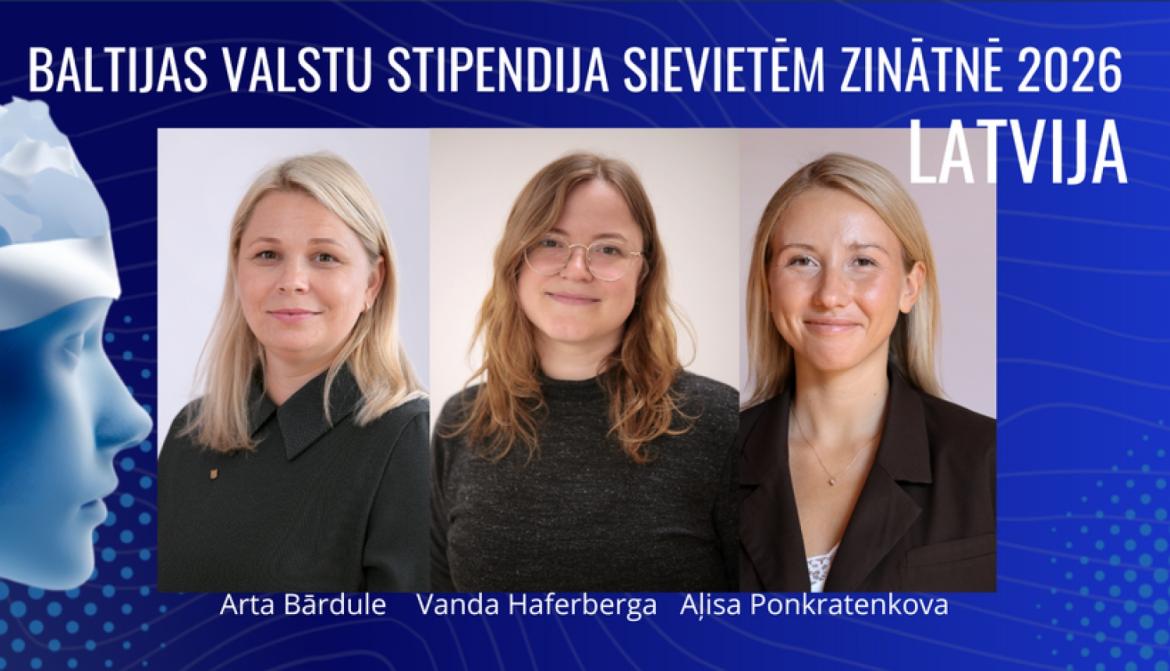
The fellowship is awarded across the Baltic States through cooperation between the Baltic academies of sciences and UNESCO national commissions – for the third year, it is being granted to nine female researchers from Latvia, Lithuania, and Estonia. Each researcher receives €7,000 in support to continue her research.
Doctor of Chemical Sciences Arta Bārdule (Dr. chem.) has been awarded the 2026 Baltic Fellowship for Women in Science for the study “Impact of Reduced Tillage Intensity on Greenhouse Gas Emissions from Organic Matter-Rich Agricultural Soils”.
Doctor of Humanities Vanda Haferberga (PhD) has been awarded the 2026 Baltic Fellowship for Women in Science for the study “Early Neolithic Pottery in the Territory of Latvia: Technology, Origins and Distribution”.
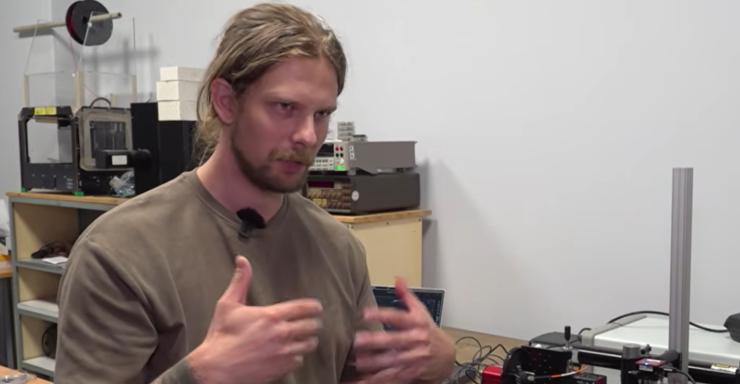
Doctoral candidate Aļisa Ponkratenkova (Mg. sc. ing.) has been awarded the 2026 Baltic Fellowship for Women in Science for the study “Preparation of Binary and Ternary Biopolymer Blends and Biocomposites and Investigation of 3D Printing”.
President of the Latvian Academy of Sciences Ivars Kalviņš emphasises: “The joint initiative of the academies of sciences and UNESCO National Commissions of Latvia, Estonia, and Lithuania to support outstanding young female researchers at the early stage of their careers through the Baltic Fellowship for Women in Science is a highly significant undertaking, and we are grateful to the ministries of education and science of our countries for providing the necessary funding. We are pleased that this fellowship is highly valued within the scientific community, as demonstrated by the large number of applicants taking part in the competition. I am confident that the winners will achieve outstanding results in research and, in the future, become top-level scientists who will also encourage other young women to choose scientific research as their lifelong profession. This will undoubtedly contribute to strengthening the research and innovation capacity, as well as the competitiveness, of our countries.”
“Today, women still make up only about one-third of the global scientific community. This means not only untapped talent and potential, but also that science loses part of the diversity of ideas and perspectives. We therefore want this fellowship to provide financial support while also strengthening confidence that women scientists’ ideas, research, and contributions matter. The opportunity to devote oneself fully to research and bring ideas to fruition is an essential prerequisite for talent to develop into scientific excellence,” says Dace Resele, Secretary-General of the Latvian National Commission for UNESCO.
In Latvia, 48 applicants applied for the fellowship. Of these, 31 applications were submitted for the competition for holders of doctoral degrees, while 17 applications were submitted for the competition for doctoral candidates. Thirty-eight applications were evaluated in the fields of natural sciences, engineering and technology, medical and health sciences, as well as agricultural and veterinary sciences, while 10 applications were evaluated in the humanities and social sciences. The applications were assessed by expert committees of the scientific divisions of the Latvian Academy of Sciences, with the final decision made by a joint expert committee of the Latvian Academy of Sciences and the Latvian National Commission for UNESCO. The “Baltic Fellowship for Women in Science 2026” competition is financially supported by the Ministry of Education and Science.
The award ceremony for the laureates of the “Baltic Fellowship for Women in Science 2026” competition will take place in Tallinn on 1 October this year.
About the Fellowship
The fellowship was established in 2024 by the Latvian Academy of Sciences, the Estonian Academy of Sciences, and the Lithuanian Academy of Sciences in cooperation with the Latvian National Commission for UNESCO, the Estonian National Commission for UNESCO, and the Lithuanian National Commission for UNESCO. The aim of the fellowship is to evaluate and support the best young female researchers in the Baltic States through national competitions on their path towards excellence in science, as well as to promote the achievements of young female researchers and encourage the most talented students to choose a career in science.
The 2024 fellowship laureates were Anne Sauka, Daniela Godiņa, Līga Ignatāne (Latvia), Mari Tõrv, Kadri-Ann Pankratov, Marju Himma (Estonia), and Greta Varkalaitė, Šarūnė Daškevičiūtė, Viltė Janušauskaitė (Lithuania).
In 2025, the fellowship was awarded to Monta Brīvība, Jana Kukaine, and Elīna Pavlovska (Latvia). The fellowship was also received by Estonian researchers Renu Geetha Bai, Katriin Reedo, and Kerttu Rozenvalde, as well as Lithuanian researchers Mažena Mackoit-Sinkevičienė, Greta Striganavičiūtė, and Rūta Ubarevičienė.
About UNESCO
UNESCO (United Nations Educational, Scientific and Cultural Organization) is a specialised agency of the United Nations that brings together 194 countries worldwide for cooperation in the fields of education, science, culture, communication, and information, with the aim of promoting peace, social well-being, and sustainable development. Latvia joined UNESCO in 1991, while the Latvian National Commission for UNESCO, established in 1994, ensures the implementation of UNESCO programmes in Latvia and represents Latvia’s interests and experience internationally in UNESCO’s areas of activity.
More information: www.unesco.lv and Facebook.com/UNESCOLNK.
About the Latvian Academy of Sciences
The Academy of Sciences in Latvia was established in 1946. On 15 March 1990, it was reorganised as the Latvian Academy of Sciences (LAS), becoming a classical-type personal academy characteristic of European countries, operating as an association of elected outstanding scientists and creative professionals. LAS is a multidisciplinary centre of science, research, and expertise of national and international significance that promotes the visibility of science, research, and innovation, represents Latvian science internationally, and contributes to fostering national identity and excellence in culture and the arts.
More information: www.lza.lv and Facebook.com/latvijaszinatnuakademija.