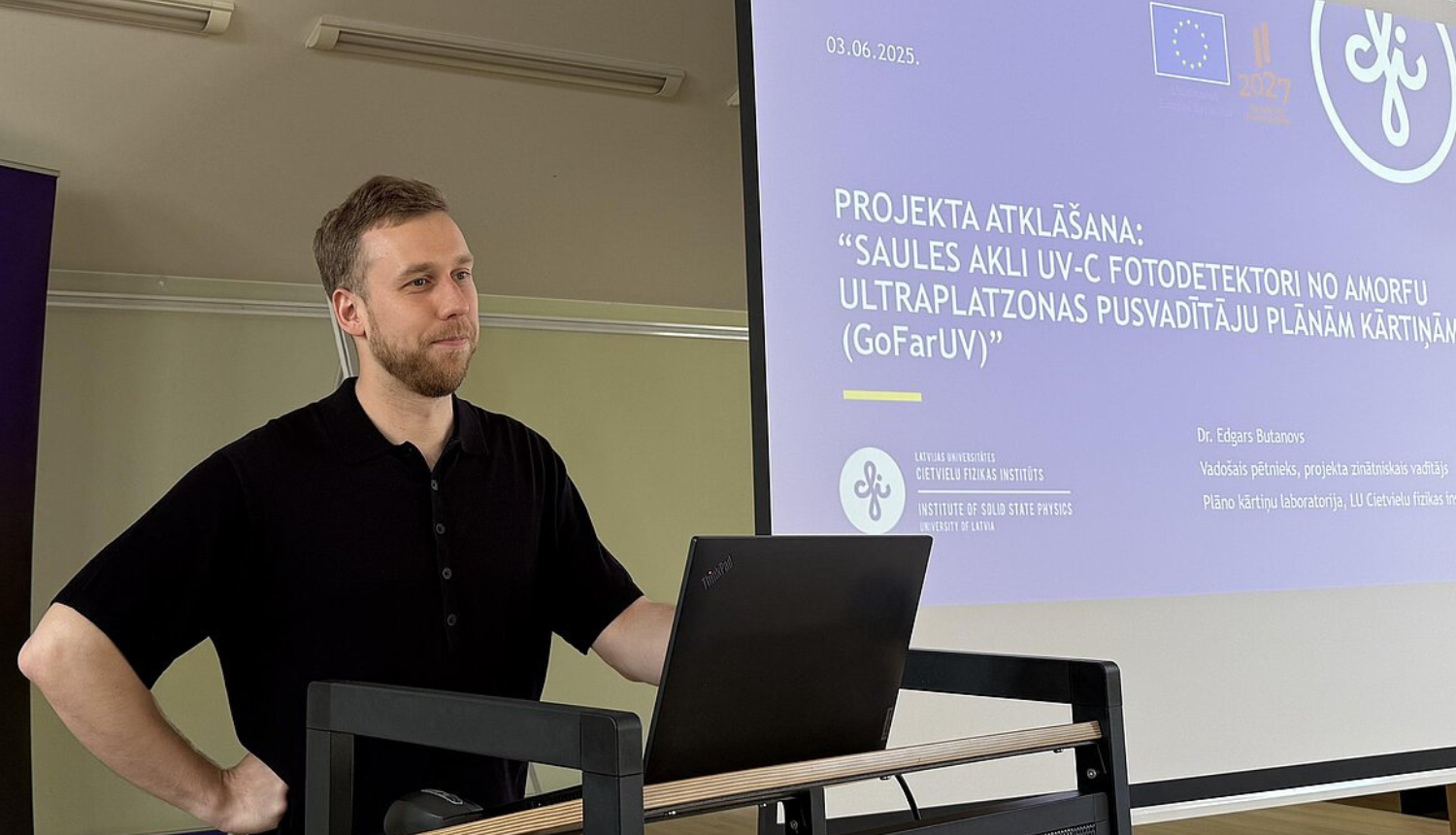
A new applied research project "GoFarUV" has been launched at the Institute of Solid State Physics (UL CFI) of the University of Latvia, aimed at developing new technological solutions using the potential of ultraviolet radiation in various industries. The project is led by Ph.D. Edgars Butanovs, Leading Researcher of the Thin Films Laboratory.
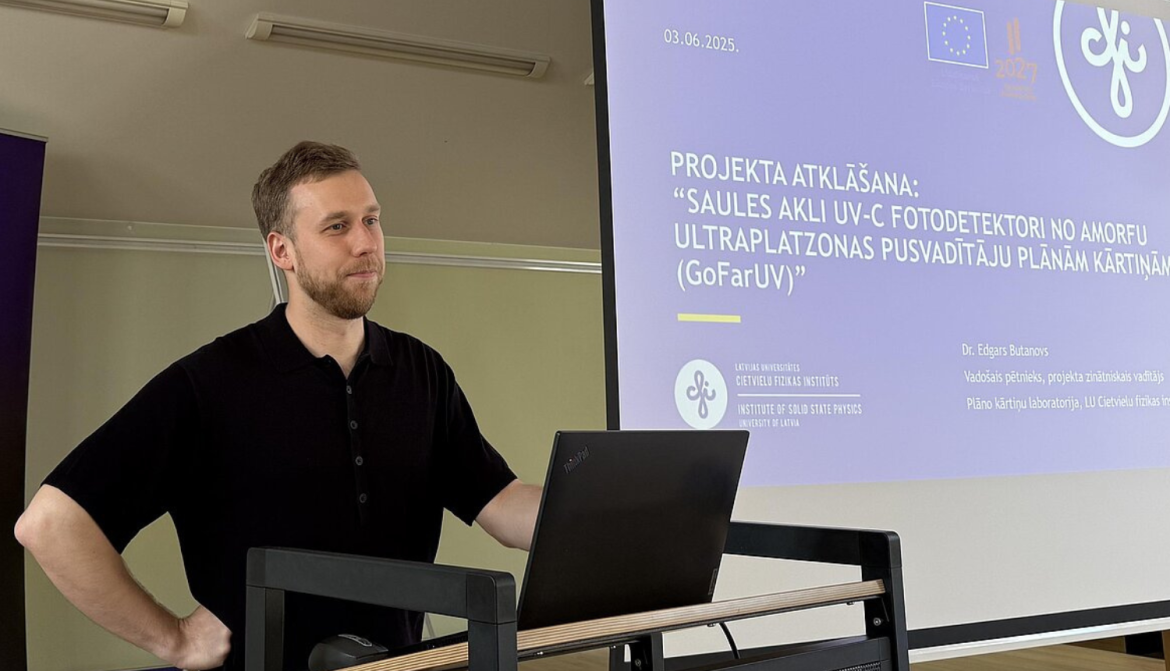
On June 3, the project launch event was held at the CFI of the University of Latvia, marking the beginning of the collaboration and the main directions of the research work. The “GoFarUV” project aims to develop a new type of photodetectors that detect only ultraviolet C (UV-C) radiation, the so-called solar-blind sensors. They will be created using amorphous aluminium gallium oxide (AlGaO) semiconductor thin films and modern magnetron sputtering technology, which ensures both high performance and the ability to adapt the technology to wider production. This innovative approach promises significant breakthroughs in the applications of UV-C sensors in environmental monitoring, security and other industries.
“Currently, UV-C photodetectors are used in environmental monitoring, for example, to detect forest fires in large areas in a timely manner, as well as in space exploration, and there is potential for their use in the military field as well,” adds Ph. D. Edgars Butanovs, leading partner of the LU CFI Institute and scientific director of the project.
This interdisciplinary project consists of research activities in physics and chemistry, electrical engineering, electronics, information and communication technologies, as well as materials sciences.
Project results:
- A novel reactive DC magnetron sputtering process for depositing amorphous AlGaO thin films on rigid and flexible substrates for use in UV-C photosensors (patent application);
- New knowledge of the physical phenomena that determine the relationship between sputtering process parameters and the optical and photovoltaic properties of the films to optimise the photovoltaic performance of AlGaO films (scientific articles);
- Innovative packaging solutions for integrating the developed semiconductor chips suitable for UV-C detection up to 200 nm wavelength, including backlighting capability (prototype demonstration).
The project combines academic and industrial expertise – the main collaboration partners are AGL Technologies and RD ALFA Microelectronics..
"With such projects, we increase the competitiveness of local companies and open the door to new opportunities to export innovative technologies, as well as promote cooperation between research institutions and private companies, not to mention investing in Latvia's knowledge base and human capital," emphasises Doctor of Physics E. Butanovs.
During the first meeting, the project team agreed on key administrative aspects, outlined the implementation plan, and approved the schedule of activities – an exciting start to a three-year journey to bring Latvian innovations closer to high-tech commercialisation.
The scientific leader of the project adds: “GoFarUV aims to innovate in the field of UV light photodetectors, using a new thin film (AlGaO or amorphous aluminium gallium oxide) and its deposition method (scalable and rapid magnetron sputtering). Compared to the current offering of UV-C photodetectors, our approach is greener, faster and increases the maximum sensitivity of the detectors directly in the far UV light range.”
The initiative is funded by the European Regional Development Fund (ERDF).