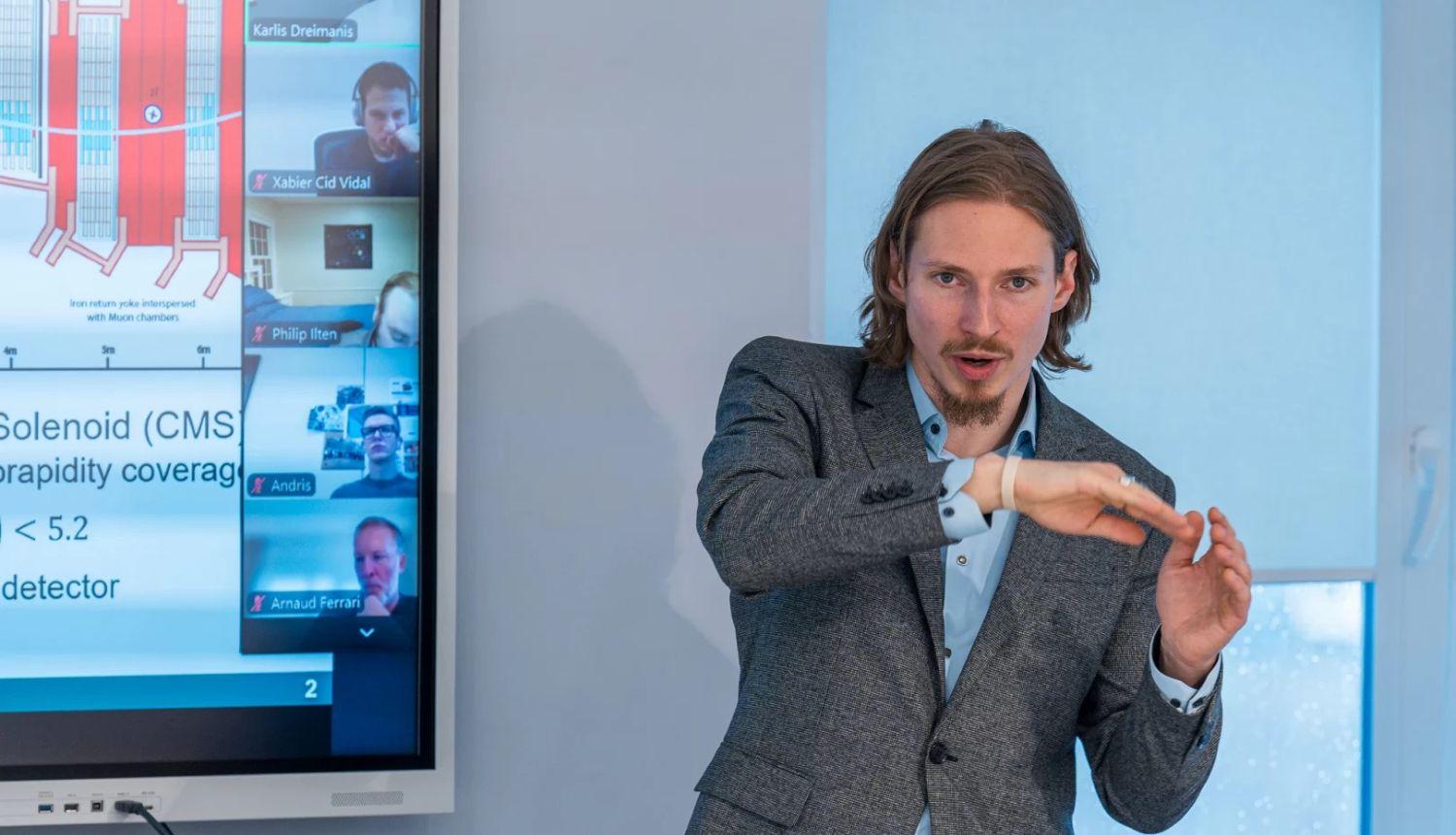
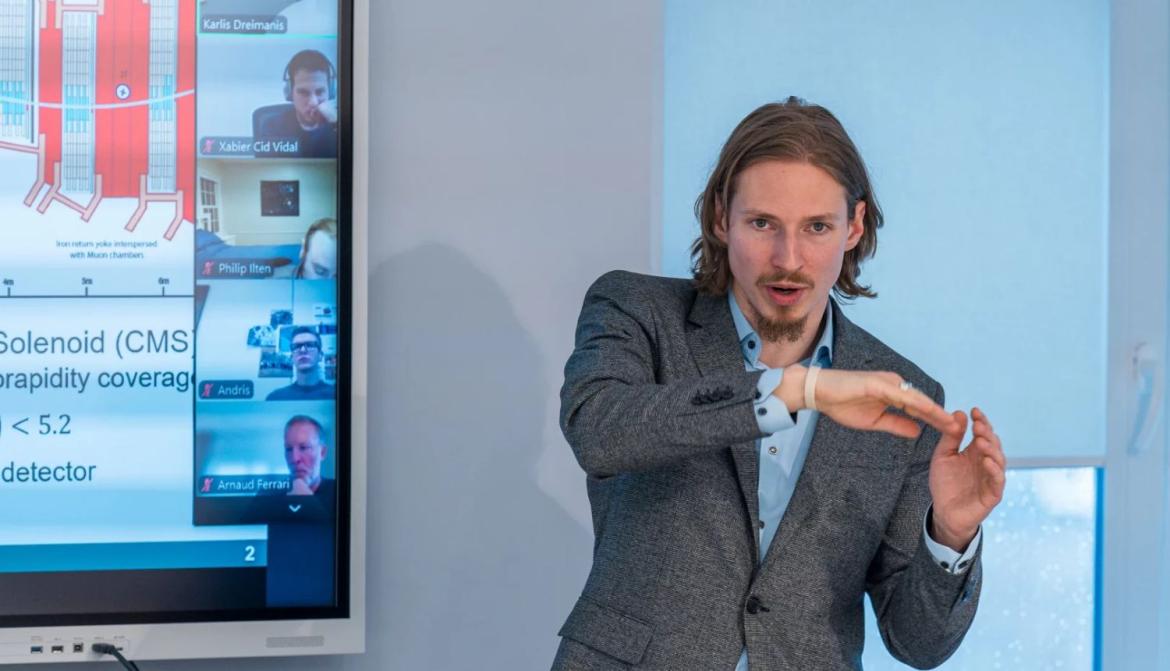
Latvia now has its first newly qualified doctor, Andris Potrebko, who, while studying particle physics, carried out his doctoral research at the European Organisation for Nuclear Research (CERN) and is the very first graduate of the joint doctoral programme Particle Physics and Accelerator Technologies offered by Riga Technical University (RTU) and the University of Latvia (LU). Potrebko examined the mass difference between the top quark and its antimatter counterpart, the top antiquark, by measuring the mass difference between the two particles and obtaining the most precise results for this parameter to date.
The top quark is the heaviest elementary particle discovered so far, and every particle has an antiparticle with identical properties but an opposite charge. The Standard Model of elementary particles successfully describes the structure of the Universe, the particles discovered to date, and predicts that particle masses should be equal to the masses of their corresponding antiparticles. In other words, physicists assume that the mass difference between particles and antiparticles must be zero. However, the Standard Model cannot explain several phenomena in the Universe, prompting CERN physicists to use the Large Hadron Collider to create particle collisions and conduct experiments that may reveal new physics.
“In my dissertation, I examined the assumption of the similarity between particles and antiparticles,” Potrebko explains. His doctoral thesis, Measurement of the Top Quark–Antiquark Mass Difference in 13 TeV Proton–Proton Collisions Using the CMS Detector, was developed at CERN, where he measured the mass difference between the quark and antiquark using data collected during the second data-taking period, Run 2, of the CMS (Compact Muon Solenoid) experiment. “In my data, when comparing the particle and the antiparticle, we observe a slight shift, although this could also be a statistical artefact with some probability,” he notes.

His supervisor, Kārlis Dreimanis, Director of the RTU Faculty of Natural Sciences and Technologies’ Institute of Particle Physics and Accelerator Technologies, adds: “Of course, we believe that the mass difference between the quark and antiquark is zero, but the only way to know is to measure it — and Andris’s result is the most precise measurement of this parameter ever achieved.” Still, if even more precise measurements eventually showed that the mass difference is not zero, then “it would shake the foundations of all modern physics — not only particle physics but also general relativity,” Dreimanis says.
“That is why it is important to continue such research and perform measurements using newer data and ever-increasing precision,” Potrebko believes. Such studies continue at CERN, as the third data-taking period, Run 3, is now underway. However, Potrebko plans to investigate other Standard Model processes in the future: “I will focus more on numerical calculations to determine the probabilities of various processes occurring in particle collisions.” Beginning on 15 December, he will start his postdoctoral research period at the Université Libre de Bruxelles in Belgium.
Potrebko is the first doctoral graduate among the students who began their studies in the RTU–LU joint doctoral programme Particle Physics and Accelerator Technologies in the 2021/2022 academic year. He is also the first whose dissertation was evaluated by the recently established RTU Promotion Council for Physics and Astronomy.
Students of the Particle Physics and Accelerator Technologies programme conduct their doctoral research at CERN thanks to Latvia’s status as an associate member state. The Latvian government has also expressed interest in becoming a complete CERN member state, making it especially important for young scientists to receive appropriate training and for the particle physics and accelerator technology community to continue developing in Latvia.
Doctoral Thesis «The measurement of the mass difference between the top quark and antiquark at 13 TeV proton-proton collisions using CMS detector»