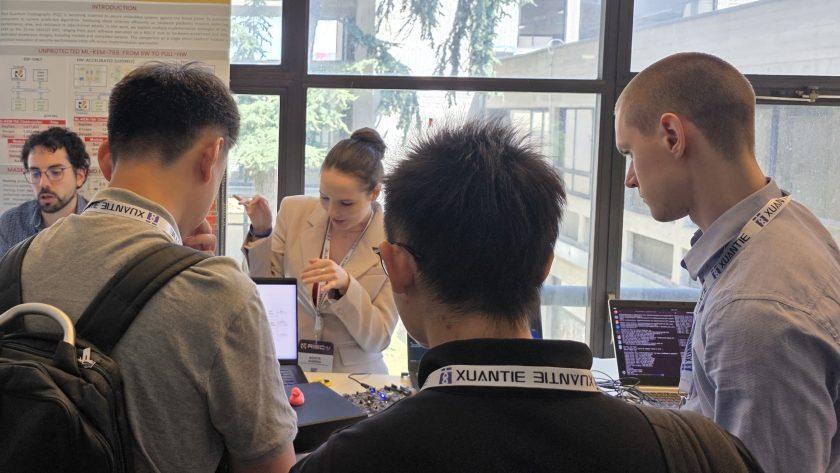
From June 8 to 11, 2026, representatives of the Integrated Circuits and Systems Laboratory (ISS) of the Institute of Electronics and Computer Science (EDI), Agata Kušnina and Marks Jānis Ratniks, participated in Europe’s leading RISC‑V processor conference “RISC‑V Summit Europe 2026” in Bologna, Italy. As part of the event, EDI staff presented a quantum sensor system developed by ISS, based on the open‑standard RISC‑V processor. The system is designed for highly precise magnetic field measurements even at room temperature (without the need for cryogenic cooling), using nitrogen‑vacancy (NV) centre defects in diamond.
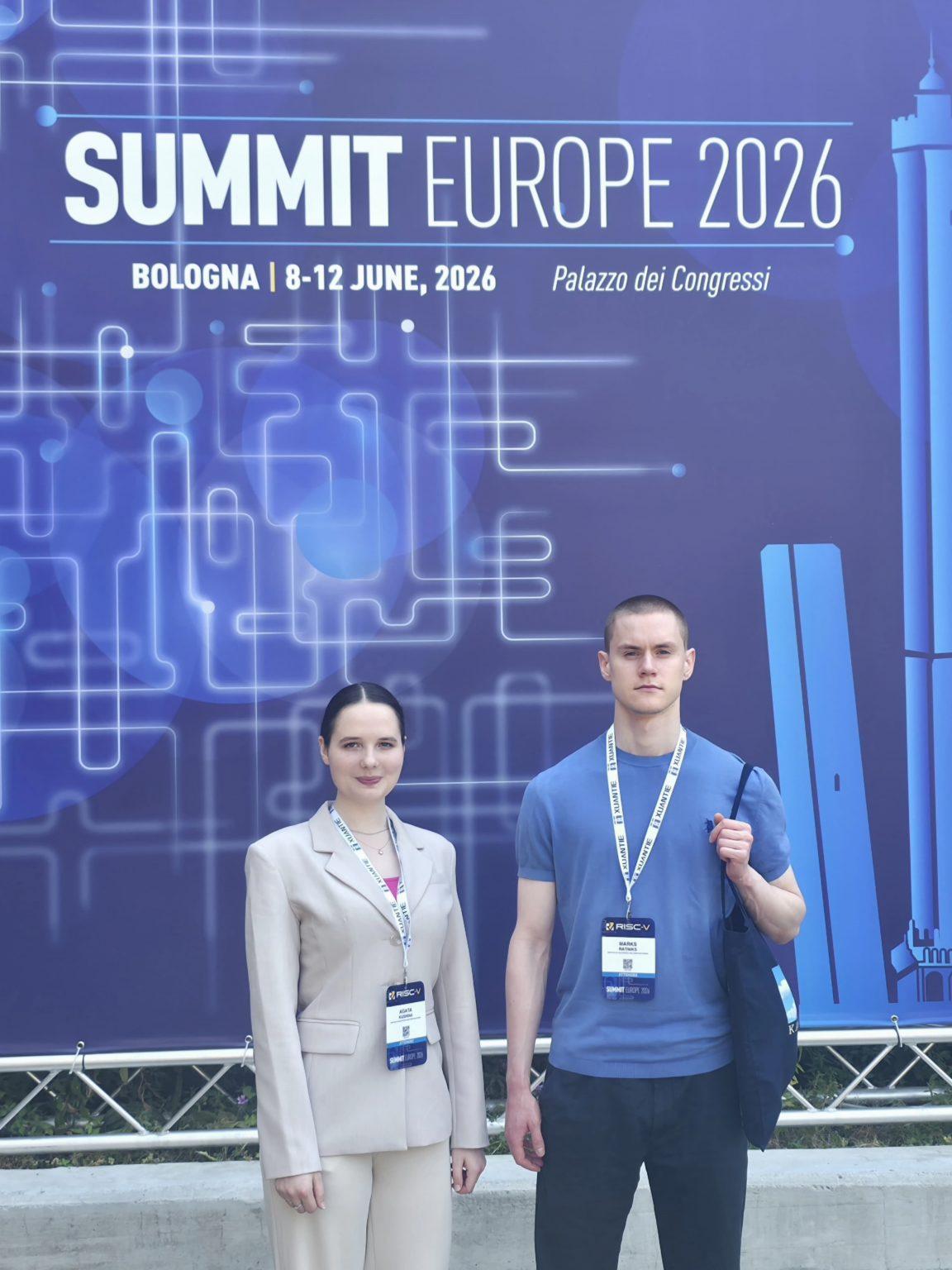
At the conference, A. Kušnina and M. Ratniks emphasized the vision of EDI ISS: a path from fundamental physical phenomena to real‑world applications. The concept of NV magnetometry was explained — namely, a nitrogen‑vacancy centre is a defect in the regular crystal lattice of diamond, which, when illuminated with a green light laser, allows detection of the intensity of red light emitted from the diamond, thereby obtaining an optically detected magnetic resonance (ODMR) spectrum. By determining the corresponding fluorescence minimum frequency, it is possible to reconstruct the magnetic field.
By integrating a RISC‑V processor into the quantum magnetometer system, it becomes possible to achieve the world’s most efficient readout and to develop an application‑specific integrated circuit (ASIC), miniaturising the existing prototype. Quantum magnetometers — devices capable of very precise magnetic field detection — have a wide range of applications, for example in localisation when satellite navigation (Global Navigation Satellite System, GNSS) is not available, as well as in biomedicine, microscopy, and others.
During the demonstration of the quantum magnetometer in the conference DevZone section, particular attention was attracted by the event‑based architecture developed by EDI, in which the RISC‑V processor performs the function of coordinating measurements, enabling the implementation of both continuous‑wave optically detected magnetic resonance (CW‑ODMR) and pulse‑based methods, which provide significantly higher measurement precision.
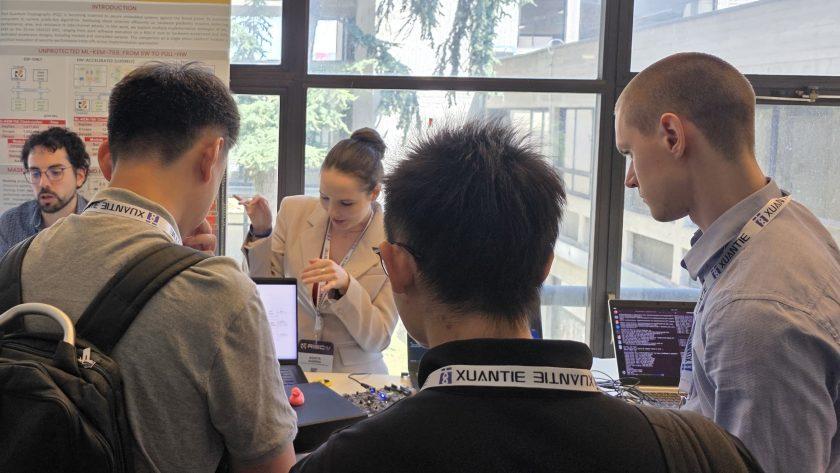
During the conference, networking events took place, where EDI colleagues established new contacts, outlining opportunities for future collaboration. In addition, the plenary panel discussions addressed current challenges in the philosophy of RISC (Reduced Instruction Set Computer) central processor design, which is based on a reduced set of instructions with short execution times.
As part of the event, A. Kušnina also participated in the “Women in Tech” forum, where she actively engaged in discussions about the role of women in technological progress and the promotion of gender equality, and was invited to take part in the “Female Frontiers” inspirational talk series.