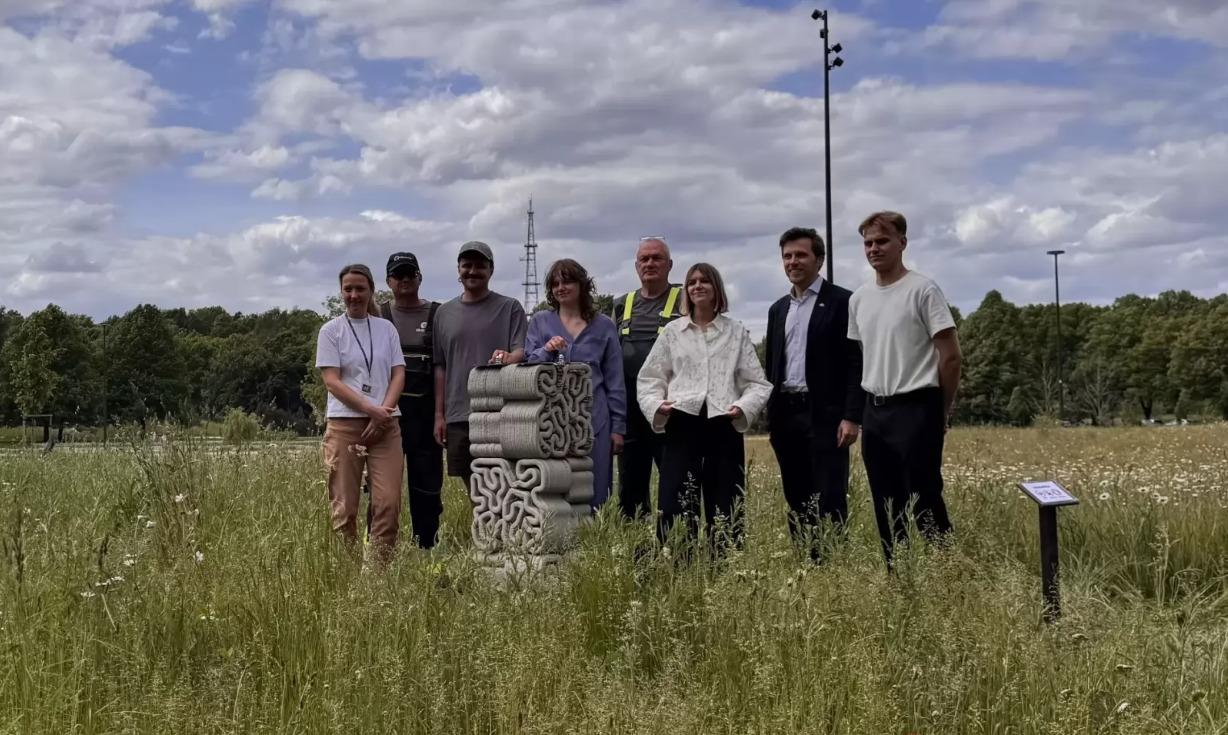
This summer, a pilot project is being implemented in Riga — to promote biodiversity in the urban environment, experimental 3D‑printed concrete insect houses for solitary bees and other pollinators have been installed in Victory Park. They have been produced at the scientific laboratory for 3D concrete printing of the Faculty of Civil Engineering and Mechanical Engineering at Riga Technical University (RTU).
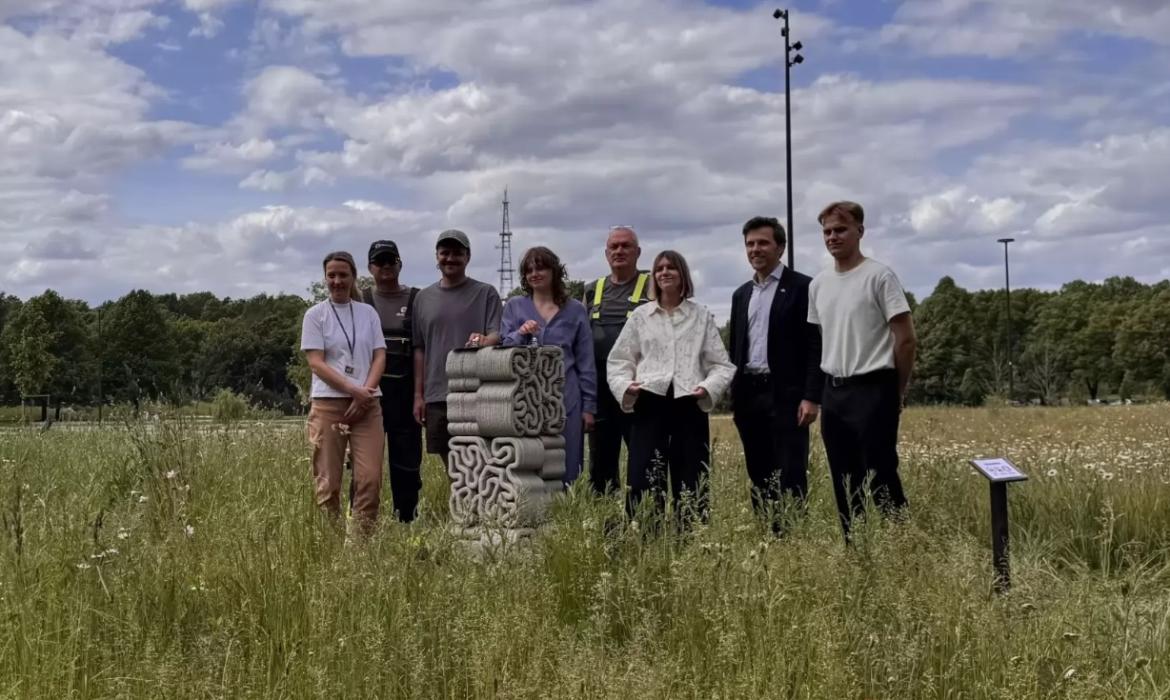
The project “Insect Houses in Riga Parks” has been created through a collaboration between the creative collective “Fabula”, architect Helmuts Nežborts, the RTU 3D concrete printing scientific laboratory, the municipal company “Rīgas meži”, and the European Climate Pact, in consultation with entomologist Uģis Piterāns and the Latvian Nature Fund. Its aim is to promote biodiversity in the urban environment by creating suitable habitats for solitary bees — an important group of pollinators that ensure plant pollination and the functioning of ecosystems. At the same time, the project demonstrates how architecture and 3D printing technologies can be used to develop nature‑based solutions in the urban environment.
The insect houses are made of 3D‑printed concrete using an alternative composition with lower emissions. The concrete structures contain reed and grass stems, which serve as suitable habitats for solitary bees. The material for 3D printing is being developed within the Swiss–Latvian cooperation programme “Applied Research” project LACHMAT.
In summer, the occupancy of the insect houses will be observed and documented in order to assess the effectiveness of the solution and its potential for the wider introduction of nature-based solutions in Riga. Information about solitary bees and their role in ecosystems is also available next to the houses.
The insect houses that have been installed are reported on by Latvian Television’s programme Panorāma.
At the beginning of the year, the RTU 3D Concrete Printing Scientific Laboratory and the association “Fabula” also collaborated to create bat homes from innovative building materials. They were exhibited in an exhibition that explored the urban environment from a multispecies perspective, considering living beings in the city that often go unnoticed. More information.
The Swiss–Latvian Cooperation Programme’s “Applied Research” project LACHMAT is implemented by RTU in close cooperation with the Swiss Federal Laboratories for Materials Science and Technology (Empa) to promote research and innovation in the field of advanced materials, focusing on innovative smart concrete and asphalt approaches, data-based extension of the asphalt pavement life cycle and advanced road pavement material solutions, as well as the development of ultra-high-performance fibre-reinforced concrete and 3D-printed concrete from local raw materials. The “Applied Research” programme is part of the Swiss contribution to European Union Member States, aimed at strengthening research excellence and the innovation knowledge base in Latvia, promoting economic transformation and sustainable growth. The programme provides more than EUR 12 million for the development of science and research in Latvia, of which 85%, or around EUR 10.5 million, is Swiss funding, while 15% is co-financing from the Latvian state budget. More information about the project.