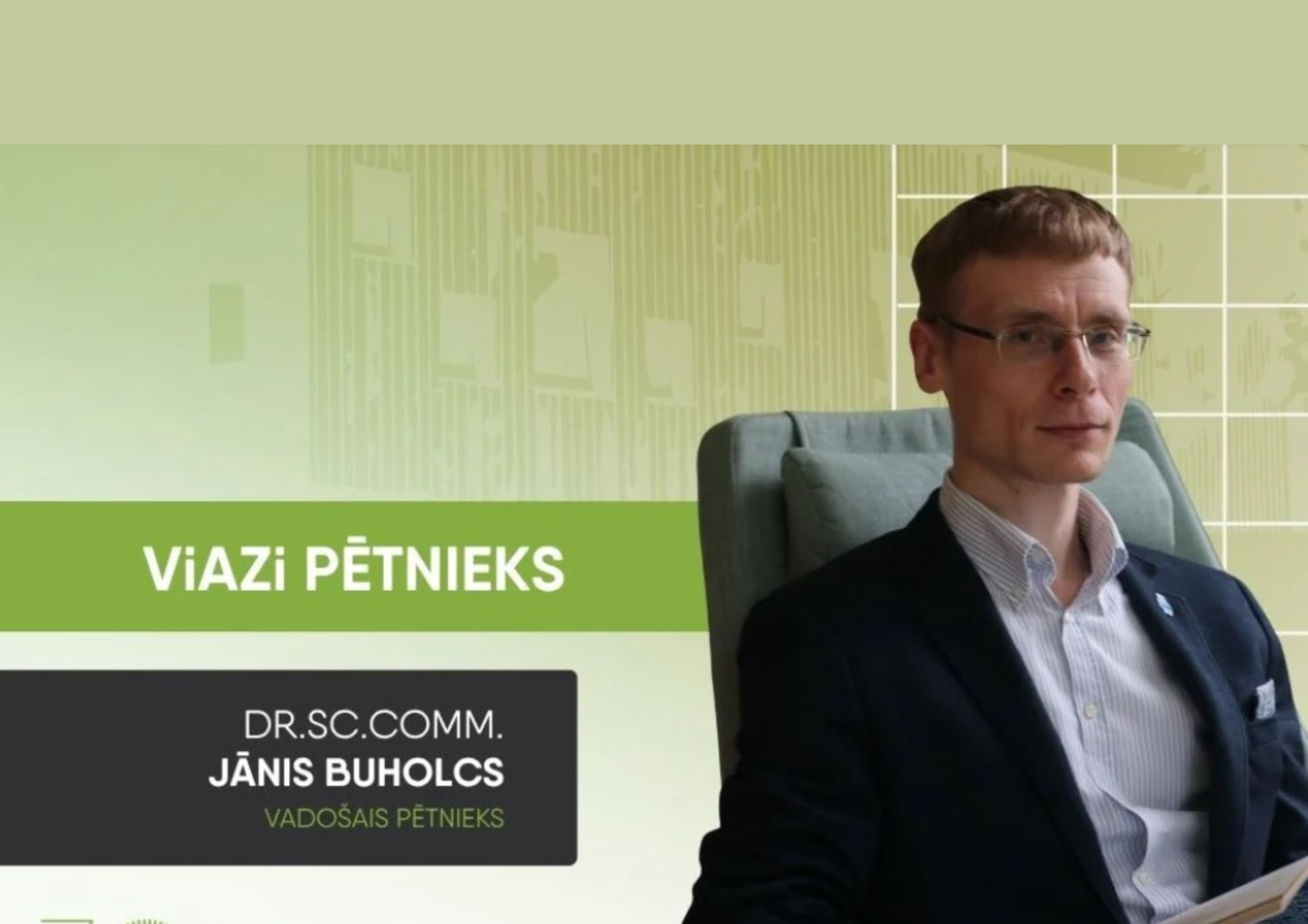
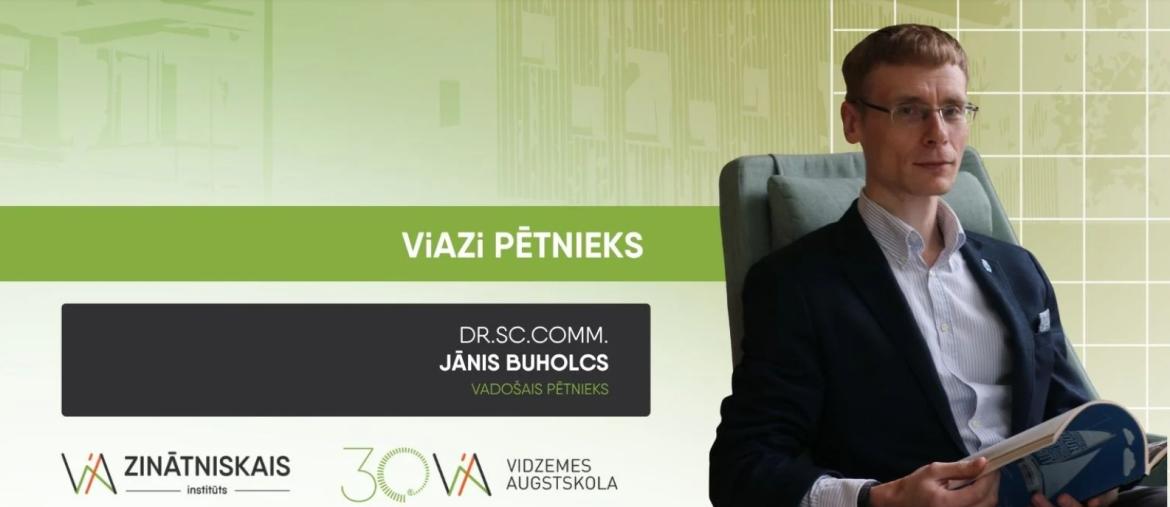
Jānis Buholcs, a leading researcher and professor at Vidzeme University of Applied Sciences (ViA), began his professional career in journalism, writing news articles and commentaries. He currently researches social media, journalism ethics and civic participation, as well as teaches study courses. His recently published scientific monograph The Age of Social Media examines how social media platforms operate, how relationships between people develop on these platforms, and how the platforms interact with the information environment.
One of the recent events in your academic life is the publication of the book The Age of Social Media. How did it come about?
Jānis: I worked on the book for approximately two years. I began writing it during my academic leave, but afterwards I returned to working on it in my free time from other responsibilities.
The book is based on observations and explanations developed over a longer period of time. I had already described the initial versions of some ideas in my doctoral thesis, while others were drawn both from my own research in subsequent years and from the findings of many other researchers. Teaching has also contributed greatly. Not only social media, but the entire media industry is changing rapidly – study courses need to be updated every year, and this both clearly illustrates development trends and forces me to reconsider my own previous perceptions. At some point, I realised that I had so much to say that I could bring it all together in a book.
How did you know the book was finished? After all, social media continues to change.
Jānis: Yes, the process certainly does not stop, and alongside what is written in the book, it would have been possible to explore other aspects as well. Moreover, new ideas also emerged during the writing process itself. But at some point, you simply have to put a full stop – or at least an ellipsis. I think that in a few years, there will again be things I will want to formulate differently or that will be worth writing about anew.
Before turning to research, you worked in journalism. How did you go from writing news articles to working at Vidzeme University of Applied Sciences?
Jānis: When I chose to study communication science, I wanted to become a journalist. I enjoyed writing and working with information. During my studies, while writing academic papers and getting involved in my first research projects, I discovered that I was also interested in research and attracted to the academic environment itself.
When I first came to ViA, my main job was writing foreign news articles, and I was pursuing doctoral studies at the University of Latvia. Agnese Dāvidsone, who was then the Director of the Communication and Media Studies Programme, approached me – first about the opportunity to participate in evaluating bachelor's theses and later about teaching study courses. Over time, I began to focus increasingly on working with students and conducting research.
What research topics have interested you besides social media?
Jānis: One of them has been journalism – including journalists' understanding of professional ethics. Among journalists, there is general agreement on ethical principles at an abstract level – truth, objectivity, honesty. However, the meaning they assign to these concepts when making decisions in their daily work can differ considerably. For example, does objectivity mean that one must not take sides, even if one side is the victim and the other is the aggressor? And what does it mean to "report the truth" in a situation where not all the important details are yet known – and it is not known what remains unknown? The way journalists resolve dilemmas explains a great deal about why the results of their work turn out the way they do.
I have also studied civic participation. Voter turnout in Latvia is not high, and relatively few people are involved in civic organisations – but at the same time, there are other forms of participation through which people also express their civic positions, such as engaging in discussions about important issues on social media or choosing not to buy certain products or cooperate with certain companies because of differences in values. Together with A. Dāvidsone and Vineta Silkāne, I have studied the relationship between media literacy and civic participation. The conclusion was that although media-literate people have skills and knowledge that are also useful for civic participation, this does not mean that they are motivated to use these skills for that purpose.
I have also studied migration-related topics, specifically how people maintain connections with Latvia and other Latvians living abroad after moving to another country. Social media is one of the ways to maintain these relationships, and the way it is used also reflects the connections that emigrants establish with people in their host country.
What do you value most about working as a researcher, and what is the most difficult part of it?
Jānis: What I value most is academic freedom. At Vidzeme University of Applied Sciences, I can focus on issues that interest me and develop them both in research and in the classroom, and there is an opportunity to combine applied and fundamental research. Sometimes a researcher may be given a specific problem and asked to find a solution. In fundamental research, work often begins with a desire to better understand a particular phenomenon, even if it is not immediately obvious where this knowledge might be useful in the future. The opportunity to conduct fundamental research gives researchers the freedom to be creative, and this is an important element in making unexpected discoveries. Moreover, this research makes it possible to engage in academic dialogue with other researchers at an international level.
The most difficult part is the workload. Flexible working hours allow me to plan my own day, but when there is a lot of work, it becomes more difficult to draw a boundary between work and the rest of life.
If you had an entire year in which you could choose what to research, what would you focus on?
Jānis: I am interested in how people perceive the online environment they inhabit. Social media and other online spaces have become so seemingly ordinary nowadays that we often do not think about how these different spaces differ from one another and how we experience and perceive them. We do not think of them as "spaces", but that is what they are, just like physical spaces in buildings and urban environments. What characterises the social spaces that emerge on different social media platforms, and how are they shaped by technological solutions and user behaviour? Our understanding of online spaces also changes over time, and this can be observed in language as well. People used to use the phrase "surfing the internet", but nowadays we no longer say that; we do something different on social media.
There are also other examples of how words shape the way we perceive the environment to which we apply them. In everyday language, social media are sometimes referred to as "social networks". However, a social network is a collection of connections based on acquaintance and interaction, regardless of whether we use online platforms to maintain them or communicate in person. In terms of networking, there is nothing unique about social media – people develop social networks at work, at home, when visiting others, in entertainment venues and so on. Thus, social media are just one of the environments in which people can network. However, if we think that only social media are social networks, in our perception they become something separate from broader social processes – a distinct, isolated world to which the principles governing the rest of the world do not apply. Which, of course, is incorrect.
What helps you regain your energy after intensive work?
Jānis: I enjoy the opportunity to switch activities – to do practical things with my hands. A few years ago, I moved from Riga to Cēsis, and during this time, the major project has been renovating my house. There is always something left to improve or make. The fact that the results are immediately visible and that I can do it without rushing gives me satisfaction.
If you had to choose what to do again today, would you choose something different?
Jānis: I am doing what I would like to do. I enjoy writing, working with information and thinking about issues of social importance – and academic work gives me that opportunity.