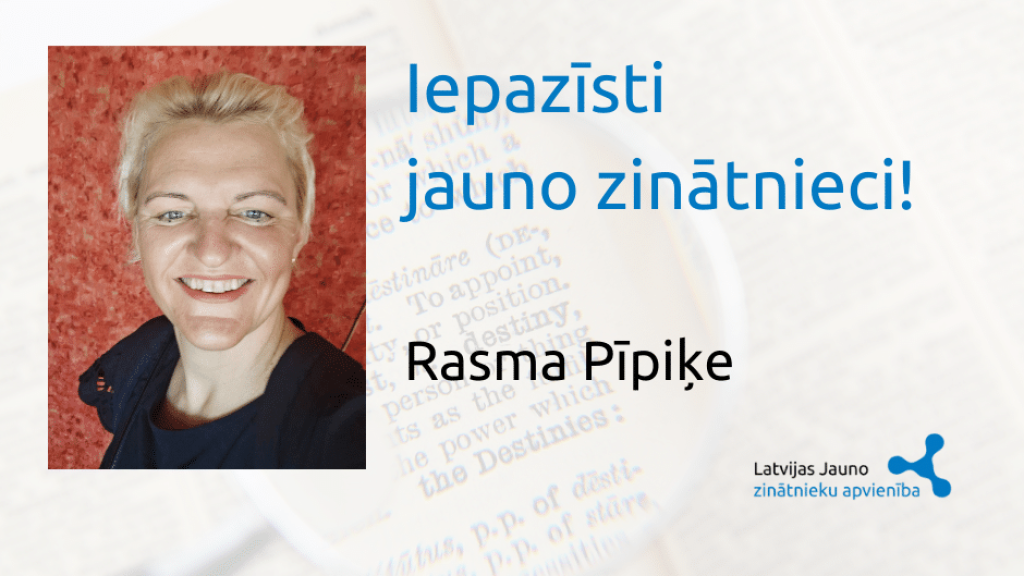
Rasma Pīpiķe is a deep diversity expert, researcher and doctoral student at the Faculty of Engineering Economics and Management of Riga Technical University (RTU). Rasma is a member of the Board of the Latvian Association of Young Researchers and has initiated and implemented several significant activities within the association. To learn more about the importance of diversity management in innovation, civic engagement and freedom in science, we invited Rasma to take part in the interview series “Meet an Early-Career Researcher!”
Your doctoral dissertation focuses on management team members’ attitudes towards diversity, which closely reflects your work and experience as a systemic diversity expert in national programmes and various organisations. What led you to choose this topic for your doctoral research?
The topic is an organic continuation of what I have been doing in my professional life for more than twenty years, building on what I studied during my master’s degree. However, I must also acknowledge that the skills I acquired during my bachelor’s studies – in communication – provide an excellent foundation for everything I do today. Some people who recognised me as a communicator, including the late Rolands Tjarve, were not mistaken: communication is my natural element. When working with organisations and their leaders and developing growth plans for them, this usually does not involve simply “building castles in the air”, but rather realistically assessing the organisation’s current situation, capabilities, resources and foundations, setting a specific objective, and then deciding which methods should be used to achieve it. I increasingly came to the conclusion that procedures alone are not decisive. A great deal depends on people’s attitudes and on how and when leaders and management teams make decisions. This, in turn, is influenced by each individual’s deep diversity.
That led me to doctoral studies. Initially, I wanted to focus specifically on museum management models. I had planned to study the Swiss Museum of Games in La Tour-de-Peilz, Switzerland, which promotes understanding of board games and the history of gaming culture; the Louvre in Paris, one of the best-known art museums in the world; the Museum of Mathematics in New York, United States, which is entirely dedicated to mathematics; and the “unassuming” Museum of the Future in Dubai, one of the world’s most innovative museums. One might debate how innovative its content actually is, but the management of the Museum of the Future remained beyond my reach. The building itself, however, is a work of art! Museums fascinate me, and I thought it would be interesting to study the ways in which they are managed. This interest is connected with one of my dreams, which may never be fulfilled. But, of course, never say never. I am interested not only in what happens within organisations, but also in why it happens. I have always enjoyed looking for connections and understanding systems and the role of the individual within them. My long-time professional colleague Uldis Dūmiņš once said that I see things from a bird’s-eye view. In his opinion, that is unique, although everyone has their own strengths. This comparison also describes my approach to research.
But yes, I entered doctoral studies thanks to my academic mother, Professor Elīna Gaile-Sarkane, who is also my doctoral supervisor and a supporter of my ideas. I can only admire the way she brings into science people from across Latvia who have already accomplished something in their lives. She does it so elegantly that there is much to learn from her. My observations suggest that the RTU doctoral programme in economics and management is attended mainly by people who are at the height of their careers and who then choose – and I emphasise, choose – to devote themselves to science. For that very reason, the environment should allow their accumulated experience to be accelerated and put to use, rather than “pushed into oblivion”.
How would you briefly explain why your research is important to society?
We speak a great deal publicly about diversity, but much less often about how leaders’ attitudes towards diversity affect organisations’ daily operations, work and results. In Latvia, the focus of diversity management is more often associated with social inclusion, and yes, organisations and businesses are a reflection of society. If we want to build a cohesive society founded on trust, we must also understand that we cannot afford a situation in which one in four people feels discriminated against in the workplace. This directly affects how people make decisions within organisations. We should remember that the purpose of organisations and businesses is not for everyone to “always be friends”.
Organisations have social objectives, while businesses aim to generate profit and pay taxes to the state so that we can sustain our system. I am interested in how diversity can become a source of innovation, rather than merely the highest expression of peaceful coexistence.
Innovation, often misunderstood as something that is “always new and exciting”, actually emerges when we are able to look at needs differently and when someone else – or we ourselves – genuinely needs the proposed solution; in other words, when someone, including ourselves, is willing to pay for it. This matters to society because Latvia has struggled for years with being “last” or “among the last” in Europe in terms of economic indicators. For many years, the word “productivity” quite literally infuriated me. To put it bluntly, I wondered how it could be that I was surrounded by people who were constantly overworked, while productivity remained consistently low.
Now, rather than looking for the problem, I am looking for a solution – how to use what I know and research to maximise productivity in businesses and help organisations achieve their objectives. Since I am speaking in the context of science, I will simply note that scientific institutions differ from other legal forms only in certain respects. I would therefore like to say that Latvian science can also become more productive, and I am not referring only to commercialisation.
What motivates you in your research?
Freedom. It is the freedom to decide where I want to go. Usually, I want to go where no one has gone before. The more I learn, the more I realise how much more there is to discover. Science gives me the methods for finding things out. For me, science is not a way to prove that I am “right”; it is an opportunity to ask increasingly better questions and, with the help of different methods, to realise: aha, it can also be like this! That is precisely what fascinates me.
Perhaps to many people’s surprise, I am someone who enjoys working alone, thinking and writing. However, my doctoral experience showed me how important a community is, as well as the opportunity to “air out” ideas with someone and “think them through together”. I greatly value people who ask questions and respectfully help me view a problem from another perspective, while also contributing the perspective of their own scientific discipline. It is such a thrill to talk to a mathematician or a chemist...That is exactly the kind of community I found, and it has been one of the greatest gains of this journey. However, that does not mean remaining in the same community for life. When I feel that the path we were meant to travel together has reached its end, I will move on without hesitation.
You have led various seminars and training sessions for thousands of people – both company teams and individuals. Although your primary field is economics, many people have come to know you as the “Digital Skills Nanny”, helping them learn how to use artificial intelligence (AI) effectively in their everyday work. How do you view AI in science? What should be taken into account when using AI to perform routine tasks, and what should be considered when using AI in research?
Artificial intelligence is a capable assistant, but it does not replace the researcher. Becoming a “digital nanny” gave me opportunities to provide practical support for improving productivity in specific situations. AI helps to structure information, analyse data and simplify routine tasks, but critical thinking, the ability to evaluate information and ask the right questions remain the responsibility of the human user. I view AI in the same way as any other tool. A tool is neither good nor bad in itself; what matters is how it is used. At this point, I can say that I am already fascinated by designing complex tasks and solving them. Soon, I will have gone from being a nanny to becoming an AI architect.
I believe that there are people, including in science, who will be unable to move forward and develop if they remain resistant to innovation. What concerns me in science as a field is the scaremongering or, more precisely, other people’s fear of artificial intelligence. In any interview or LAMPA discussion about artificial intelligence, the conversation somehow ends up focusing on fear. To draw a comparison: the dishwasher has been invented, but I still insist on diligently washing the dishes by hand. As a result, more water is consumed, and arguments over whose turn it is to wash the dishes lead to a family dispute. Not literally, of course, but that is the general idea. Ethics and integrity have not ceased to apply and, frankly, everyone must also consider for themselves what intensive use of artificial intelligence may be doing to their cognitive abilities. This did not concern me before, but now I find myself thinking about it increasingly often. That is why I am reading a book that has to be held in my hands. And laughing.
You lead a work package in the international Horizon Europe project ARENAS (“Analysis of and Responses to Extremist Narratives”), which aims to strengthen society’s ability to recognise and resist extremist messages that affect public and political life in Europe. Does this project connect with your doctoral research, and if so, how? From a social sciences perspective, what common trend do you see in contemporary society?
At first glance, these may appear to be different topics, but both are connected by people’s attitudes and decision-making.
Both within organisations and in society, it is evident that stereotypes, identity, perceptions and trust in “our own” and in “those who are different” influence people’s behaviour far more than we might sometimes wish to admit. The project has three thematic axes – gender equality, nation and science. What our research has revealed is genuinely fascinating.I cannot deny that this project has been my “school” in leading an international research team and a scientific project, as well as in learning more about myself under such circumstances – how to manage crises in international, multicultural teams during “peacetime”.
I am therefore becoming increasingly interested not only in individual projects, but also in their impact on me personally and, in turn, in my own impact on local and international systems. I can say that the thematic intensity has been remarkably high. Through this experience, I am also proving to myself that I am capable of navigating highly complex situations – a kind of “doctorate” in life.
Thematically, everything is interconnected, relevant and open to research. Although this experience is international, it differs entirely from what I experienced while working in international organisations in Switzerland and the former Yugoslavia at the beginning of my career.
International NGO Day is observed on 27 February. The initiative originated in Latvia, and you are one of the co-authors of the idea and coordinated its implementation. Why is it important for both researchers and representatives of other fields to become involved in non-governmental organisations?
I do not know where this assertion that involvement “is important” comes from, but this is how I understand it: people and organisations form civil society because there are issues that the state, local government or the market cannot resolve. These people then establish organisations that focus on a particular issue and attract resources to help society address it.
In my view, to “address” an issue means to work oneself out of a job – to solve the problem, rather than thinking: we have established an organisation so that it can exist for ever and ever. Experience over the past decade suggests that the individual’s ability and actions are more important than the legal entity itself.
I have said before that “a golden duck will lay golden eggs anywhere”. By this I mean: be the golden duck, regardless of the legal structure or formal position in which you find yourself.
You volunteer with various organisations, movements and associations. As an active member of the Latvian Association of Young Researchers (LJZA), you received the LJZA Annual Award from the association’s board in 2023 – a heartfelt recognition of the work you had invested in various initiatives. What motivated you to become involved in the work of the LJZA?
People. There are two important individuals – one who welcomed me as a volunteer at my first Christmas event on 14 December 2022, and another because of whom I stayed in the organisation. I value the environment in which I met people who think differently from me. I do not find a conversation interesting if it contains no challenge – whether in terms of the subject itself, understanding people’s actions, their motivations or their attitudes. Perhaps this is the perspective and instinct I have developed professionally as a seminar facilitator – the desire to see meaning in things... Needless to say, I do not use my professional techniques in everyday life, but in organisational development processes I always try to introduce my management principles and understanding of transparency.
I am also motivated by the fact that the Latvian Association of Young Researchers has goals for which I see my knowledge and skills as particularly valuable at this moment in history. This is also connected with my personal decision to devote the rest of my life to science. The form this will take in the future remains to be seen, as it will be shaped by many factors. I believe that every person in science matters – a minister, a professor, a student or the person who ensures that the university premises are clean every morning. I will most likely find an exciting place for myself as well. Everyone performs work without which the shared outcome would not be possible. At times, I see scientific processes becoming stalled precisely because there is too little understanding of this equal value. There is therefore much to be done to ensure that everyone within the system understands and knows that they are appreciated.
You have been a member of the Board of the Latvian Association of Young Researchers since 2024, and one of your most significant achievements could be considered the education and encouragement of LJZA members and early-career researchers in advocacy. What are currently the main priorities and needs of early-career researchers at the national level?
An early-career researcher needs to feel that they are part of the academic community, that their work is meaningful, that they will be supported, and that there are people with whom they can think about science together. At the national level, a postdoctoral programme is needed through which early-career researchers can access the resources required to remain in science in Latvia. Latvia also undoubtedly needs an Academic Ethics and Research Integrity Office, whose role would be to raise the standard of transparency in science and, consequently, its quality. After all, science is not an individual sport. It develops through dialogue, and we – by which I mean my generation of researchers – must create an environment in which respectful dialogue is the norm.
This year, the Latvian Association of Young Researchers participated in the LAMPA Conversation Festival for the third time. You were one of the driving forces behind these initiatives – from interviews on the World’s Smallest Stage under the motto “Think Slowly!” to this year’s programme “Scientist. Alive.” and the photography project “Scientist. Alive. Leap.” What has brought you the greatest satisfaction from this eventful LAMPA experience?
This is where the importance of deep diversity – or competencies – becomes apparent, which is also the novelty and practical application of my doctoral research. It is a new concept that I have developed and called systemic diversity management. I entered science knowing nothing about it and got somewhat “burnt” in the process. My personal experience motivates me to nurture every bachelor’s and master’s student like a “small child” for whom I bear responsibility, so that they do not have to go through what I experienced.
What I know how to do is generate ideas that add value or address a need I have identified. The main guiding principle of the LAMPA projects is to provide a platform for early-career researchers and scientists, so that we can motivate them, bring them into the spotlight and recognise the person at the very moment when they are becoming a leading figure in their field. I have no problem being the person who “holds the trampoline” for someone else as they make their leap. Frankly, I am self-sufficient enough to make the leap myself even when no one is “holding my trampoline”. Of course, however, I would like us to learn from the good in one another and for each of us to offer a helping hand to at least one person when things are difficult.
Finally, returning to the topic of studies, what would you like to wish for or recommend to students who are currently considering doctoral studies?
I would advise pursuing doctoral studies not for the sake of a degree or status, but because there is a question that will not leave you alone. My motivation for enrolling in a doctoral programme was the desire to give myself a lovely gift for a significant birthday. The entire experience should be enjoyable, because sacrifices are unnecessary – they do not pay off and will go unnoticed.
And definitely seek out your own community. Even if you are someone who prefers working alone, it is valuable to meet people who ask uncomfortable questions, challenge your thinking and help you view problems from a different perspective. But you must walk the path yourself. Science, perhaps, is not really about who knows the most. It is a place for people who are prepared to keep developing in many different ways. In my view, that is one of the most beautiful things science can offer an individual.