Precise cancer diagnostics and targeted treatment today are based on tumour biology, which is enabled by molecular diagnostics, and this is also possible in Latvia. At a completely new level and on a broad scale, the possibilities of molecular diagnostics were tested by doctors at Riga Eastern Clinical University Hospital in a pilot project funded by the European Recovery Fund.
The methods applied in the project make it possible not only to select the most effective therapy, but in some cases also to avoid unnecessary chemotherapy, as well as to enable timely identification of hereditary cancer within a family. The aim of the project was to improve the patient pathway by supplementing it with molecular diagnostics.
In this European Recovery Fund project, pathologists, geneticists, and oncologists‑chemotherapists from Riga Eastern Clinical University Hospital joined forces to introduce new, effective molecular diagnostic methods in cancer treatment.
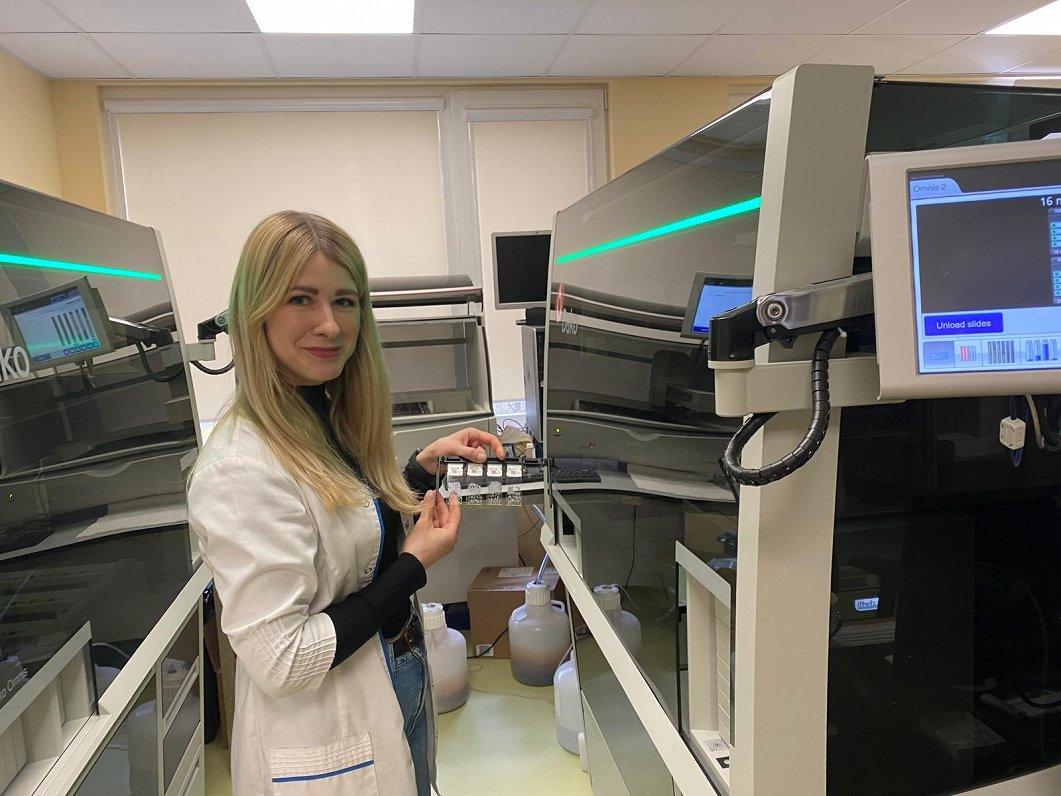
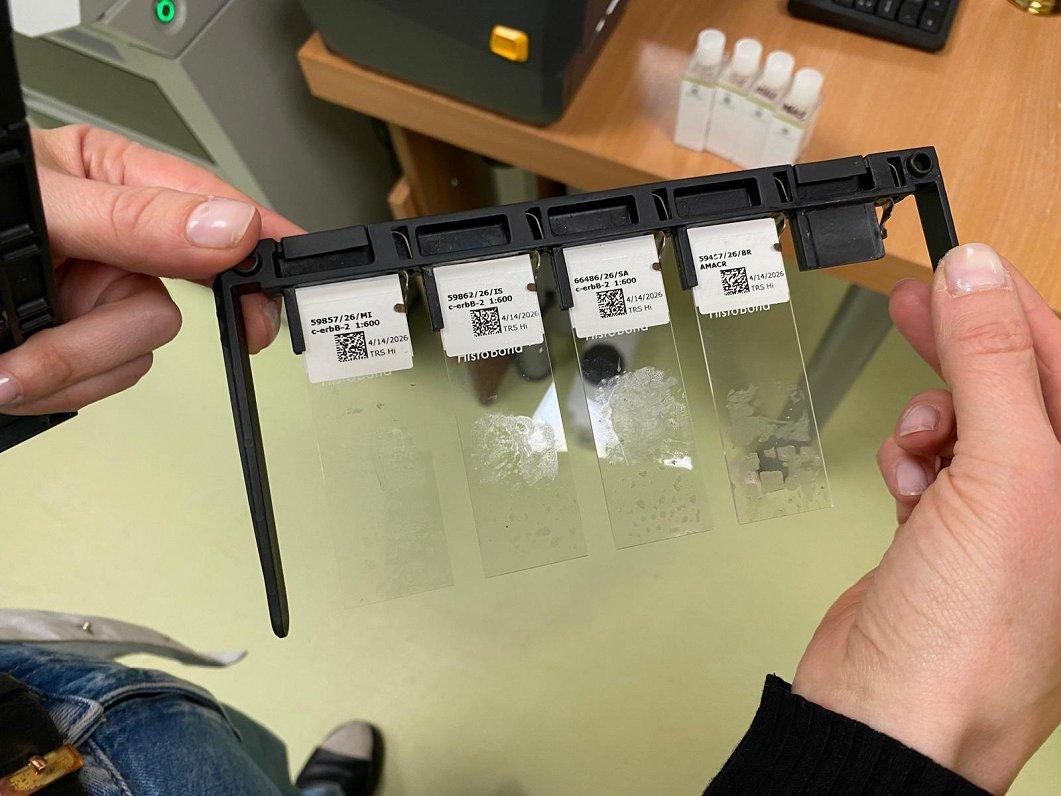
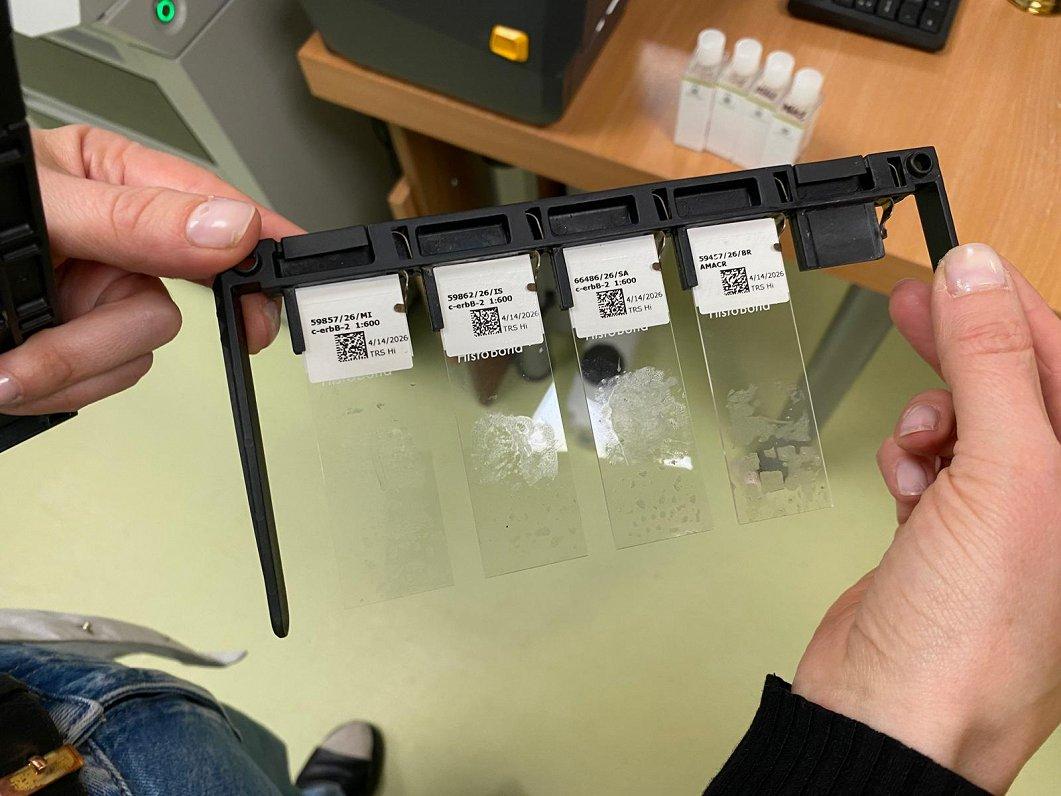
“We have a fully automatic machine; here we also stain microsatellites, and the kit consists of four antibodies,” says biomedical laboratory assistant Ņina Beknazarova, standing between two impressively large devices at the Pathology Centre, as she demonstrates one of the methods used in the pilot project — immunohistochemical staining, which is used to precisely determine the type of tumour.
The microsatellites mentioned are biomarkers that signal a defect in the genome error-repair mechanism. In simple terms, this is when one of the body’s lines of defence fails and a tumour develops. Soon, geneticist Aigars Dzalbs leads us into another room, where he takes in his hand a small device — outwardly less impressive — which he calls a “little miracle machine”: “This is a completely closed system, and it is polymerase chain reaction. Those who work in genetics know that there is an entire laboratory inside. In this cartridge, DNA extraction takes place, reagents are added, the reaction itself takes place, and results are obtained.”
This is another method used in the pilot project. The third is next-generation sequencing, which makes it possible to analyse several hundred genes associated with tumour development in a single test. These methods allow doctors to make more precise decisions about therapy based on the biology of the tumour, rather than on the diagnosis alone.
At the centre of the pilot project launched two and a half years ago are colorectal, or colon and rectal, cancer, endometrial cancer and gastric cancer, all of which are common tumours. More than 1,300 patients have been tested.
“One was the introduction of new methods, such as NGS, or next-generation sequencing, into routine clinical practice. It was also the development of appropriate diagnostic algorithms and economically efficient diagnostic pathways, and therefore also the development of the molecular testing pathway, as well as, of course, diagnosing patients with hereditary diseases, including non-polyposis colorectal cancer, or Lynch syndrome,” Dzalbs explained.
Hereditary cancer also could not previously be tested in Latvia in this kind of routine manner. Oncologist-chemotherapist and University of Latvia associate professor Elīna Sīviņa pointed out that molecular testing is very important for any type of tumour.
Until now, microsatellite instability, or a defect in the genome error-repair mechanism, was not routinely determined at all in patients with early colorectal cancer.
“Now we had this result before starting therapy, and it was an opportunity to select patients according to risk. So, in stage two, if we know that there is a high-risk stage two, intermediate-risk and low-risk, then, taking into account this microsatellite instability indicator as well, we can screen out those patients for whom chemotherapy is not necessary; for them, this chemotherapy is actually harmful — it worsens survival — but for patients for whom it is not necessary, we were also able not to give it, based solely on this indicator,” said Sīviņa.
Patients with metastatic colorectal cancer also benefited. Namely, this makes it possible to determine when it is better to use immunotherapy for them, which in Latvia is paid for from state funds.
The pilot project also allowed patients with a hereditary tumour risk to be identified in a timely manner. Lynch syndrome — the most common hereditary colorectal cancer syndrome — was confirmed in 9.6% of cases, while other diseases that increase the risk of tumour development were detected in 19% of patients.
As geneticist Professor Baiba Lāce said, this project can also save patients’ family members, because by monitoring them, a tumour can be detected very early.
The pilot project has already concluded. The National Health Service reports that the assessment and prioritisation of all European co-financed projects for inclusion in the basket of state-funded services is already under way and will continue until July. To ensure that everything does not end with the project, doctors have submitted solutions to the service that include various options — both the most economical and the most modern, namely those in line with guidelines.
“Such opportunities would never have existed without a project like this, nor would there have been so many proposed options. Our proposals also include options that, in fact, one could say are cheaper than the current solutions,” explained Aija Balode, Head of the Pathology Centre at Riga East University Hospital.
Because the pilot project has provided doctors with entirely new knowledge. The pilot project funding was approximately 770,000 euros.