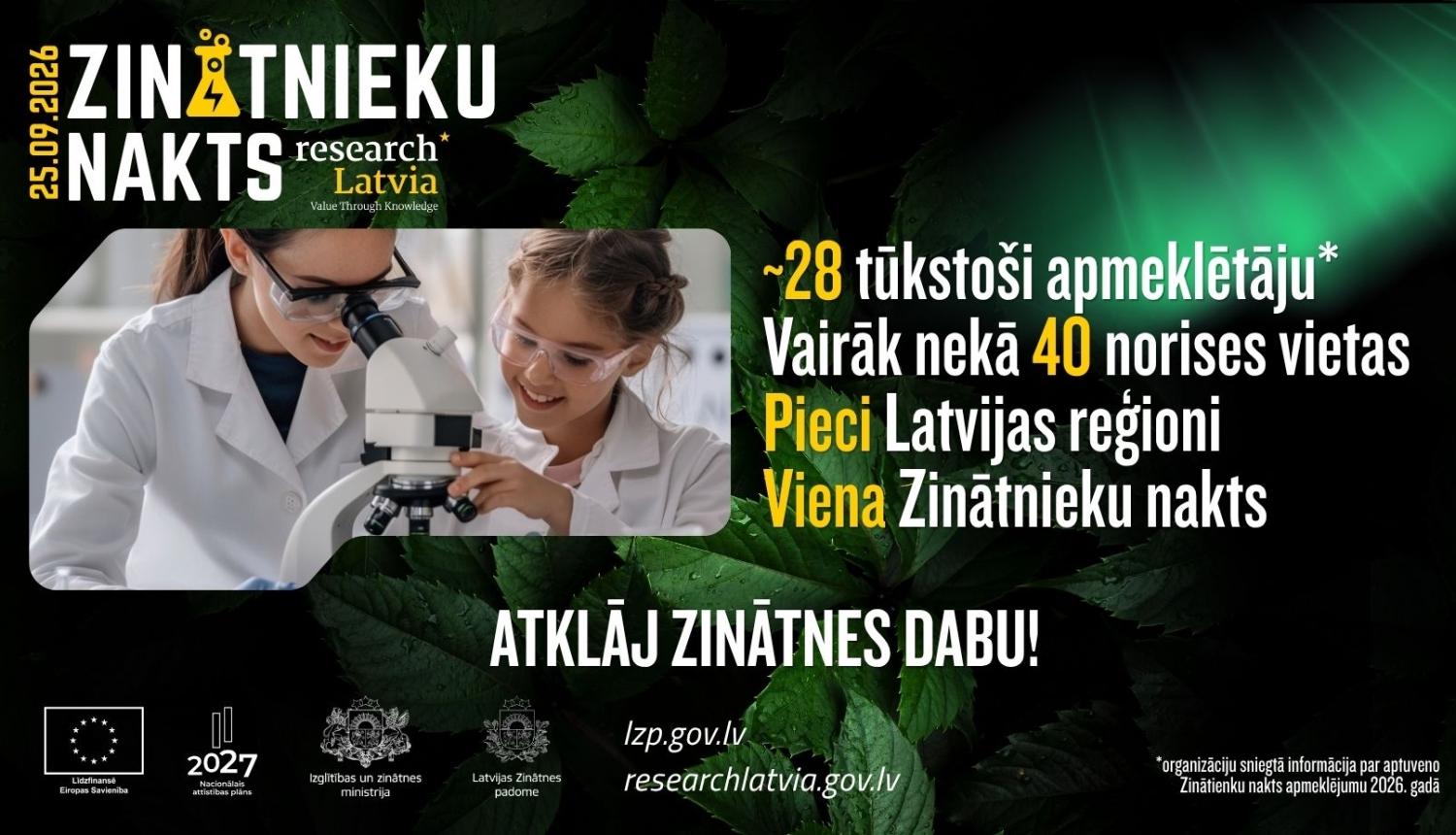
European Researchers’ Night 2026, which took place across Latvia on the last Friday of September, once again demonstrated this year that science can engage people of all ages and attract a wide range of interested visitors. Event venues across Latvia welcomed around 28,000 visitors, who took the opportunity to look inside laboratories, take part in experiments and hands-on workshops, try out technologies and meet researchers in person.
Families with children, preschool and school-age children, and young people were particularly active in attending Researchers’ Night. Organised groups of schoolchildren were also welcomed at several venues, and interest in the activities offered was so great that at some locations tour slots filled up very quickly or group registration even had to be closed.
The highest number of visitors this year was welcomed by:
University of Latvia | 6,360 |
Rīga Stradiņš University | 3,000 |
Daugavpils University | 2,900 |
RTU Rīga | 2,800 |
Latvia University of Life Sciences and Technologies (LBTU) | 2,050 |
Institute of Solid State Physics, University of Latvia | 1,000 |
“Science is inherently complex – behind every discovery there are years of work, specific methods, data and knowledge that are not always easy to explain outside the particular field of science. That is why science communication is both a very challenging and an extremely important task. Researchers’ Night provides an opportunity to reduce this distance – to meet researchers, ask questions, try things out for yourself and see how science works. It is precisely this kind of personal experience that helps build understanding of science, trust in it and interest in how knowledge is created and how it changes our everyday lives,” says Elita Zondaka, Acting Director of the Latvian Council of Science.
At this Researchers’ Night, visitors were most captivated by hands-on workshops, experiments, games and interactive tasks, laboratory visits and technology demonstrations, which were among the most popular activities. Visitors could identify meteorites, work with microscopes, programme robots, watch science theatre performances, go on tours and take part in many other activities.
From cereal breeding and soil research to exploring space and technology, from robotics, drones and food science to forest biodiversity and the study of the microscopic world. The Latvian language, culture and art were also explored. This year, Researchers’ Night demonstrated how diverse and significant the science created in Latvia is.
The success of Researchers’ Night is shaped not only by visitors’ interest, but also by the involvement of scientific institutions, universities, educational institutions and researchers in opening up the world of science to the public. Feedback provided by the organisers also confirms a desire to continue this tradition – most of the institutions surveyed are ready to take part in Researchers’ Night in the future as well. This gives confidence in looking ahead to future Researchers’ Nights, continuing to create opportunities for everyone to experience science up close, meet researchers and personally experience the joy of discovery.
The Researchers’ Night initiative will continue next year as well – European Researchers’ Night 2027 will take place on Friday, 24 September, once again giving the public an opportunity to learn about the practical benefits of science and its usefulness in everyday life.
European Researchers’ Night in Latvia is organised by the Latvian Council of Science and the Ministry of Education and Science’s communication platform Research Latvia in cooperation with Latvian educational institutions, research institutions and organisations.
Thank you to all the institutions and organisations involved, researchers, students, volunteers and cooperation partners for their contribution to Researchers’ Night 2026, as well as to every visitor who set out to discover the nature of science on 25 September. See you at the next Researchers’ Night!