What if surfaces could not only fight microbes themselves but also make it possible to check whether they are still protected? This is exactly the kind of invention that young Latvian scientists are working on. How an idea born during the COVID-19 pandemic has turned into an unusual spray-on coating that helps protect surfaces over the long term is revealed by Rihards Ruska, a researcher at the Institute of Solid State Physics of the University of Latvia (UL), in the programme "Latvia in Science". The interviews are produced in cooperation with Rietumu Banka, while the scientists are supported by the UL Foundation.

An Idea Born During the Pandemic
During the COVID-19 pandemic, Ruska and a fellow student began thinking about how inefficient it is to repeatedly disinfect the same surfaces.
"It seemed very wasteful to constantly use cleaning and disinfecting agents on surfaces, repeating the same action many times every day," says Rihards Ruska.
This led to the idea of a coating that could provide long-lasting protection against microbes. Unlike conventional disinfectants, such as alcohol, which evaporates, the new coating must remain on the surface and provide a long-lasting antimicrobial effect.
Initially, the two used copper, which has antimicrobial properties, but a drawback of this solution quickly became apparent. "It turned out that people were not interested in using it in everyday life, because then all surfaces would have to be covered with copper, everything would look orange, and that is not very aesthetically pleasing," says Ruska.
The researchers began developing a more practical coating, using the antimicrobial properties of copper and silver. The challenge was to ensure that the substances in the coating would kill microbes without posing a threat to people who touch the treated surface.
Ruska points out that such a spray-on antimicrobial coating is needed in places where a safe and clean environment must be maintained over the long term, such as hospitals, laboratories, schools, and elsewhere.
Why Does the Protective Coating Need to Glow?
The first coating developed was completely invisible. However, the researchers realised that in such a case, people would not be able to determine whether the protection was still working. "In reality, all things wear out over time, and then a situation may arise where the coating has worn off, microbes have already started to grow, but there is no way for a person to detect this," explains the scientist.
This led to the idea of adding a luminescent, or light-emitting, component to the coating. This would make it possible to check whether the coating is still present on the surface using appropriate lighting and to detect when it has worn off.
Building on their own "Dezosil" and "Fungosil" coatings, the researchers participated in the biomedical and photonics innovation platform "BioPhoT". Within this framework, they improved the antimicrobial and optical properties of these formulations, resulting in the development of a smart spray-on coating that kills microorganisms and visually indicates its effectiveness through luminescence.
It Works in the Laboratory, but Will It Be Possible to Sell It?
Ruska emphasises that creating a scientifically interesting material is only half the work. It is equally important to understand whether it can be produced on a larger scale and at an affordable price. "What is very easy to make in a laboratory is not always easy to produce and sell on a large scale," he explains.
That is why they chose a practical approach – first investigating which products could be produced simply and economically, and only then looking for opportunities to create something scientifically new. The researchers also familiarised themselves with products available on the market and the requirements that must be met in order to offer the invention to customers in the future.
Where Could the Invention Be Used and Who Is Already Interested in It?
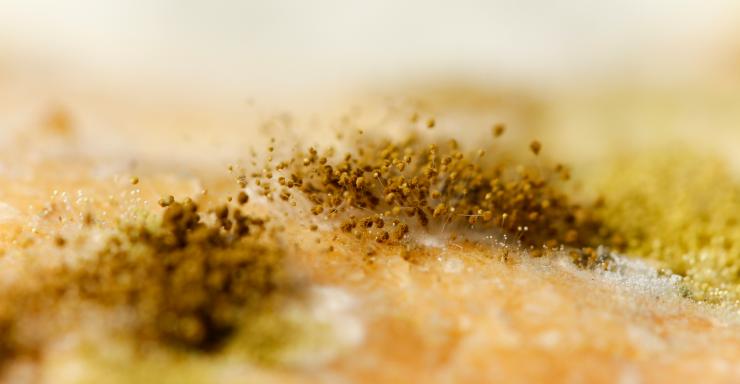
The coating has a wide range of potential applications – from households where mould causes problems to scientific laboratories and healthcare facilities where maintaining a clean environment is particularly important. According to Ruska, hospitals, as well as cleaning product distributors in Latvia and Lithuania, have already expressed interest in the invention.
Ruska suggests that the technology could also be useful in military medicine, where care for the wounded must be provided under difficult conditions.
This happens quite often in science – you start researching one thing, but it turns out that the intended path is blocked and you have to look for another. Or quite the opposite – more and more new directions and opportunities emerge.
The invention developed by Ruska and his colleague has also undergone such changes, evolving from the initial idea of copper surfaces into a luminescent antimicrobial and anti-mould coating. Its composition has already been largely refined, and a patent application has been filed, but work is still ongoing. The next goal is to develop the technology into a product that can be manufactured in Latvia and offered on the market.