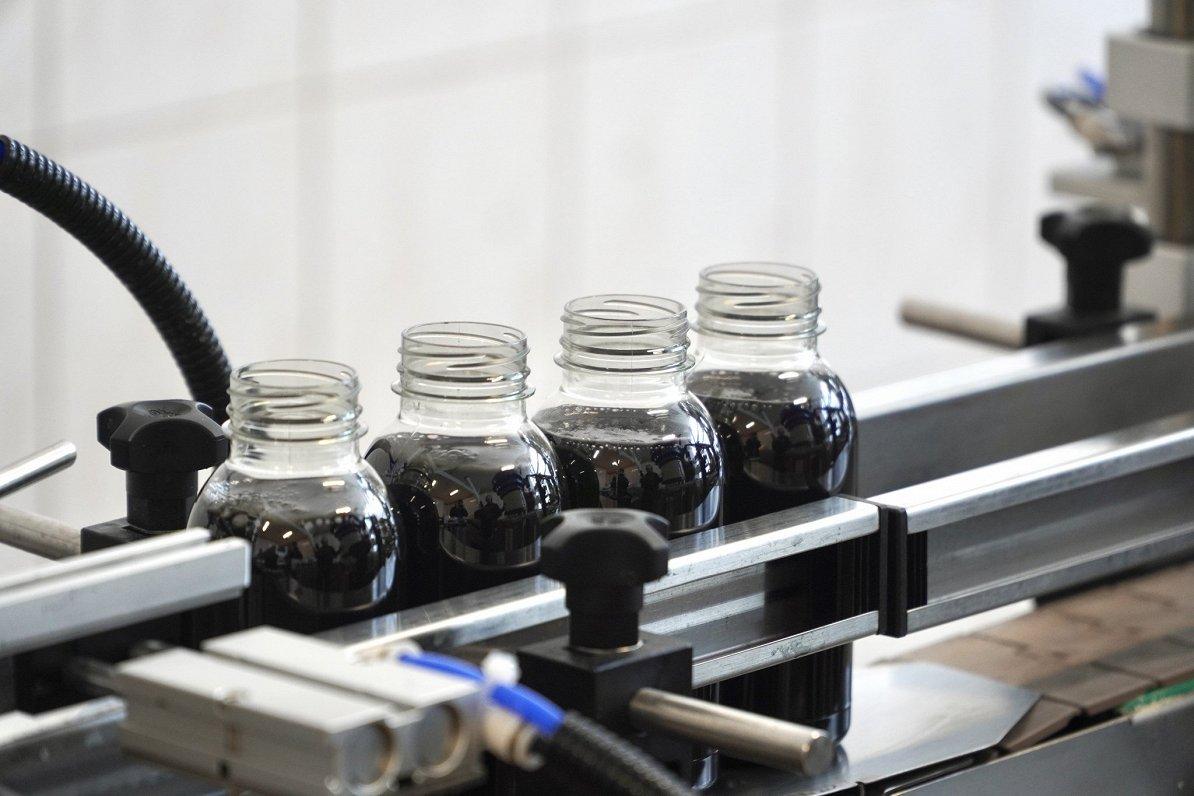
It turns out that green thinking can be not only environmentally friendly but also practical and not a hindrance to business, but even beneficial. In a production facility in Ziepniekkalns, in the former lipstick workshop of the “Dzintars” factory, microalgae — the freshest spirulina in the world — are grown in very efficiently used premises. Afterwards, it reaches customers both frozen and combined with various syrups and juices.
The European Union (EU) food system provides fresh and safe food to more than 400 million residents. Food production is not only a service, but also a source of income for many — including Agnese Stunda‑Zujeva and her team. Agnese holds a doctoral degree in chemical engineering, and she turned to spirulina already during her postdoctoral research. After several years in science, she wanted to do something more practical.
“My doctoral thesis was on bone implants,” Agnese revealed, noting that her previous scientific interests differed significantly from her current business field. “I thought — who needs my research? I wanted to see the results of my work within my lifetime, before retirement.”
The turning point was a colleague’s suggestion to focus on algae, particularly in the context of the European Green Deal. In May 2020, the European Commission presented the “Farm to Fork” strategy as one of the key measures within the European Green Deal. By promoting the achievement of climate neutrality by 2050, the strategy aims to steer the current EU food system towards a sustainable model.
“Industrial agriculture is a desert — it is monoculture, where everything that is not being cultivated is destroyed — neither weeds nor insects are allowed. Nothing is desirable there,” Agnese listed the drawbacks of traditional agriculture. Meanwhile, spirulina cultivation takes place in controlled conditions, which also allows avoiding weather‑related risks: “If everything is controlled, then nothing — hail, drought, too much rain, cold, frost — threatens us. For example, for a farmer, one frost in spring — and that’s it, you can write off the whole year; you sit and wait for the next year and even beg the state for subsidies.”
Superfood
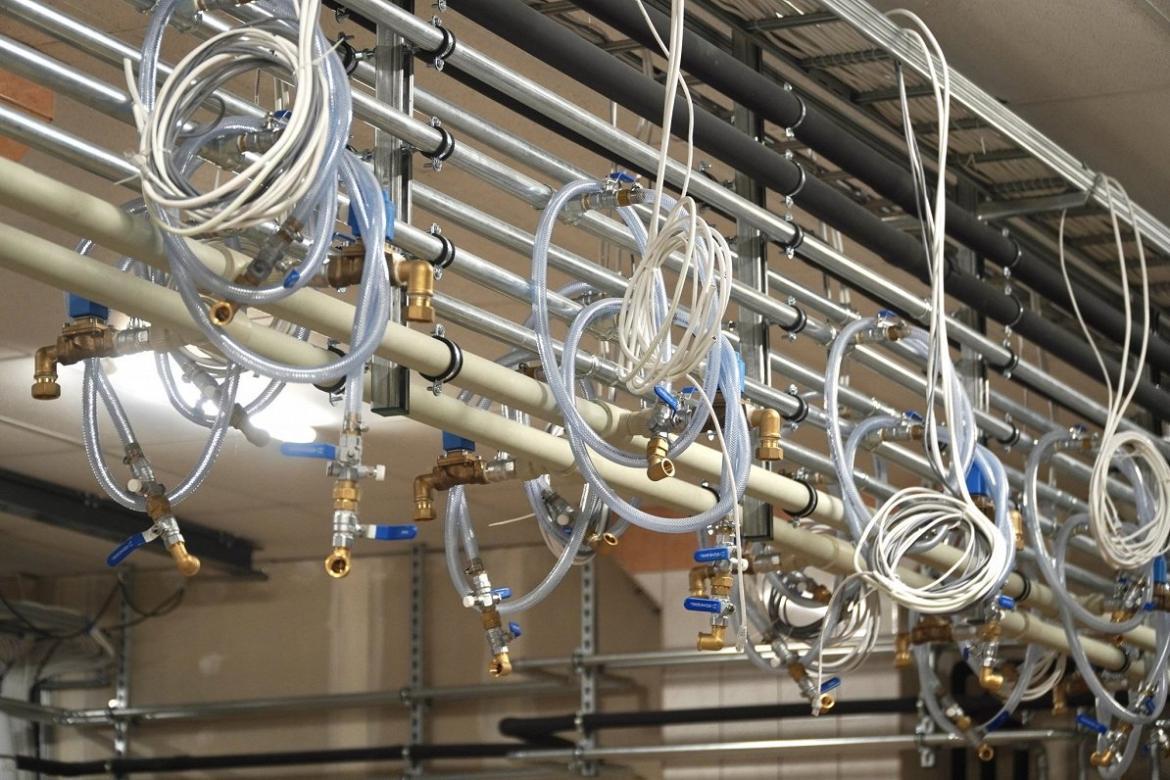
Algae, as microorganisms, reproduce by cell division — if there is one liter on Monday, then by Wednesday there are already two liters of spirulina. “SpirulinaNord” harvests its crop every working day, 12 months a year.
"If we want to increase production, within a week we can double production volumes, provided that we have bioreactors in which all of this can be done,” Agnese explained. “At one point, we calculated that, considering that only two tablespoons of spirulina are needed per day, one cubic meter of spirulina could be equivalent to a 20‑hectare carrot field. Only because carrots are harvested just once a year."
More than 30 years ago, the World Health Organization granted spirulina the status of a “superfood” due to its high‑value composition.
“You obtain more than 200 biologically active substances, and the body itself can choose what it needs,” Agnese explained.
The added value of the Latvian company “SpirulinaNord” lies in the way this nutrient‑rich algae is made attractive to the consumer. In cooperation with the Latvia University of Life Sciences and Technologies (LBTU), new approaches were explored, and specialists suggested “making it into a syrup.”
After Agnese accidentally mixed spirulina with quince syrup at home, the new direction became clear. The idea was later tested together with the Latvian Olympic Unit, for whom spirulina in syrup form was much easier to take along to training camps than frozen spirulina. Currently, “SpirulinaNord” produces spirulina in three flavours.
Hard to believe it’s algae
“SpirulinaNord” is registered as a food industry company, because, as Agnese explained — “from what I saw in the legislation, the food sector is more strictly regulated by the state.” In the company’s communication, it is also emphasized that “SpirulinaNord” produces a food product, not a fast‑acting dietary supplement.
Although there is a large body of research on the potential benefits of spirulina and it has been conducted for decades, introducing the product to the market is not easy, as the product is not immediately understandable, Agnese admitted.
A major challenge is the taste and the assumptions about it. Since spirulina in its pure form is distinctly specific, not to say unpleasant, it is difficult for consumers to believe that algae can be enjoyable.
“Even at algae conferences, people are surprised — how do your algae not taste like algae?” The path to the customer is difficult. In Latvia, tastings and direct experience are important. “Now we will enter the European market — it is important for us to reach a critical mass, so that information spreads ‘by word of mouth’, both about the perceived effects and by friends letting friends taste it,” Agnese and her team reflected on how to achieve this.
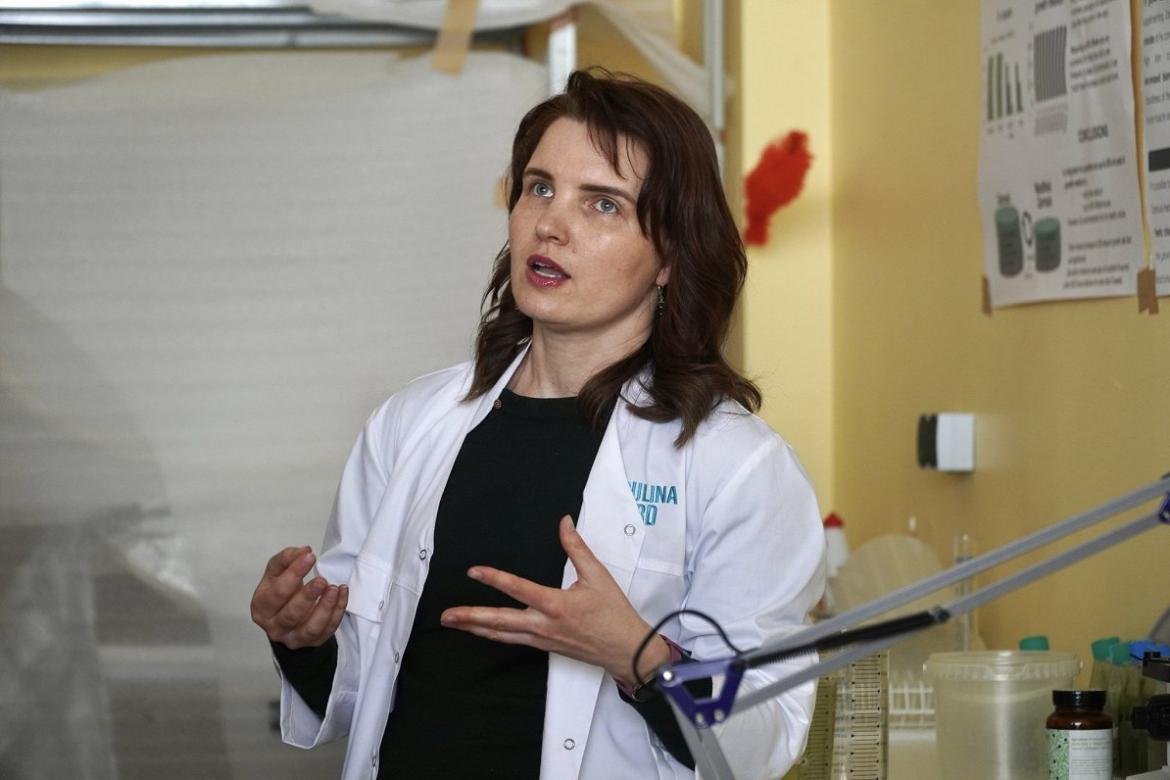
In everyday operations, the company has nine full‑time employees. Currently, four people work in production. Each new employee must be trained from the very basics.
“There are no algae biotechnologists, no photobioreactor engineers — even at LBTU no one can help, so we have to take whoever we can get and train them, try to create such instructions so that the so‑called onboarding or integration into the workplace is as smooth as possible,” Agnese revealed. “I also do not have an education in algae — I had to retrain, read books, and use my creative and technical thinking to get involved.”
The situation is the same across the entire European Union — there are no serious study programmes related to algae: “In that sense, algae are still in their infancy, and we hope that within the next decade this will change.”
Latvia’s demand is changing export plans
Last year, “SpirulinaNord” increased its capacity tenfold, and now the team is considering how to expand the market; the website has been updated to make greater use of e‑commerce opportunities. In Latvia, “SpirulinaNord” can also be purchased in various organic product stores, including the “Rimi Klēts” section, while outside Latvia it operates through e‑commerce.
Agnese admitted that finding the right shelf for “SpirulinaNord” is not easy: “Too expensive for syrups, we do not want to be in the niche vegan shelf — if there are no cabbages there, then our product is not there either. That is why we are not in supermarkets as such; we are in small eco shops, because there is greater variety there.”
“From the very beginning, we said — we will go into export, but we are happy that Latvians ate everything. Well done!” Agnese laughs. For now, purchases from other countries are mostly within the diaspora, which the company can tell from buyers’ names. “We are working to increasingly activate the market among ‘original’ Europeans.”
Achieving export plans in the long term will certainly also be helped by “EU Inc.” — an initiative that is gradually taking on more concrete shape. Currently, the biggest problem for innovative entrepreneurs is that for too many of them even expanding within the borders of the European Union already means a challenge in navigating a fragmented business legal environment. Entrepreneurs still in many cases have to deal with the legal systems of 27 countries and more than 60 legal forms of companies.
This complexity can delay the establishment of a company by weeks or even months, slowing down growth, increasing costs, and discouraging scaling.
“EU Inc.” is planned to be introduced as a regulation and to provide a unified, harmonised set of business rules that companies will be able to choose, instead of having to navigate multiple national regimes.
Business is still easier than science
The equipment required for spirulina cultivation and product manufacturing is expensive, and the investment needed to start a business is enormous. However, Agnese confidently said that securing funding for her business, with all the available European financing opportunities, was many times easier than obtaining grants for her scientific research. Agnese submitted her idea to RTU “Idea Lab”, wrote a business plan, and participated in the “EIT Climate KIC” accelerator, where she received the first 50 thousand euros.
“They were in such a very pleasant format where there was no need for procurement and no need to report with receipts, and then I thought — wow, is this how money is given for business?” Agnese recalled her surprise.
“A researcher’s constant desperation to look for funding is very useful when you are an entrepreneur. You are used to the fact that money does not fall from the sky, and in fact, recurring customers who know this product are something that does not happen in science. Just imagine — in research, no reviewer comes back and gives you money because you had a good project. Coming from such a harsh environment, it seems to me that entrepreneurship is a bit more predictable and a more harmonious environment.”