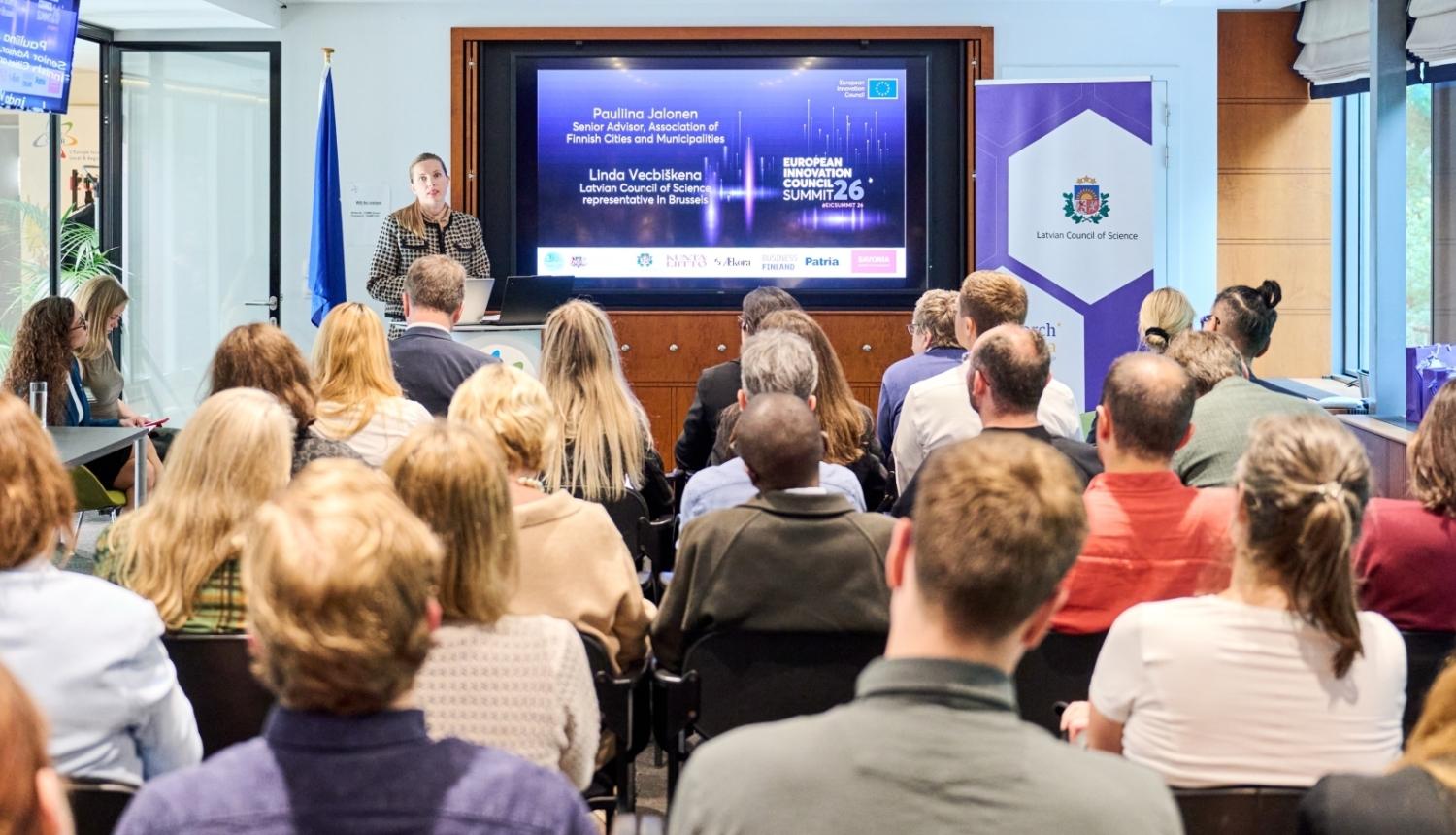
At the beginning of June this year, the event “Eastern Border Innovation Ecosystems: Finnish–Latvian Cooperation to Foster Resilience and Competitiveness” took place in Brussels, Belgium, bringing together 60 representatives of the Latvian and Finnish innovation ecosystems, as well as experts from higher education institutions, companies, public authorities and European Union institutions. The event was organised as a thematic event of the European Innovation Council Summit 2026 (EIC Summit 2026) and as a platform for discussion on the preparedness, resilience and strengthening of the innovation potential of eastern border regions in a changing geopolitical and economic environment.
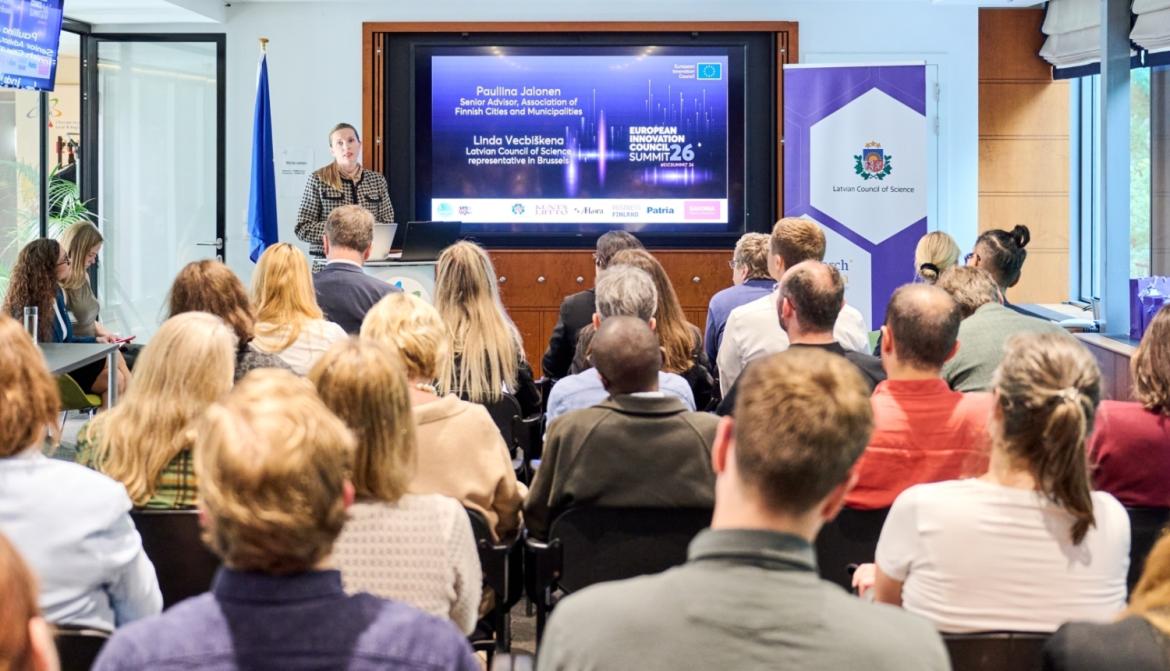
The event was opened by Pauliina Jalonena, Senior Adviser at the Association of Finnish Cities and Municipalities (Kuntaliitto), and Linda Vecbiškena, representative of the Latvian Council of Science in Brussels. The opening remarks emphasised that, for countries on the eastern border of the European Union, resilience is not an abstract concept but a practical necessity – Latvia and Finland face common challenges in the areas of geopolitical uncertainty, economic security, technological sovereignty, supply chain resilience and the protection of critical infrastructure. The discussions highlighted that innovation ecosystems today must be not only excellent and competitive, but also resilient, adaptable and secure.
“Resilience is not built during a crisis. It is built in advance – through strong institutions, trusted partnerships, investment in talent, effective public–private cooperation, and a culture that constantly strives for excellence,” emphasised Linda Vecbiškena.
Research security was highlighted at the event as one of the key challenges of the next decade – the protection of intellectual property, the security of sensitive technologies, trusted partnerships and the strengthening of strategic autonomy must become an integral part of innovation ecosystems. At the same time, it was emphasised that openness, international cooperation and freedom of research must be preserved.
Nordic–Baltic cooperation – a fundamental framework, not an occasional initiative
The event highlighted several initiatives demonstrating that Nordic–Baltic research cooperation has become one of the main frameworks for Latvia’s participation in international science and innovation. Under the NordForsk programme, established under the auspices of the Nordic Council of Ministers, Latvian researchers have received funding in two calls for eight projects together with Nordic partners. Within the Baltic Research Programme, implemented under the EEA and Norway Grants from 2021 to 2024, Latvia carried out nine research projects and five small cooperation projects with total funding of approximately EUR 8.5 million. In the broader context, the results achieved under Horizon Europe should also be noted – to date, 349 joint projects have been approved in which Latvian institutions cooperate with at least one Nordic partner.
Examples of good practice from Latvia and Finland
The experience of Latvia’s scientific community was presented by Gunita Deksne, Director of the Innovation and Acceleration Centre at the University of Latvia, and Marija Plotniece, Senior Expert at the Latvian Council of Science on matters related to the European Innovation Council, European Innovation Ecosystems, and the European Institute of Innovation and Technology. They provided an insight into Latvia’s innovation ecosystem and the strengthening of academic commercialisation capacity. Jānis Zandbergs, Chairman of the Board of D Dupleks Ltd, shared the company’s experience, describing the journey of a Latvian company from research and development to international competitiveness.
Finland’s experience with the eALLIANCE initiative was presented by Hanna Viitala, representative of Business Finland’s European Research and Development Cooperation Office, and Juha Välimäki, Head of eALLIANCE at the Patria Group, outlining cooperation between public authorities, research institutions and companies in the development of strategic technologies. The cooperation model between Finnish municipalities and higher education institutions was presented by representatives of the City of Kuopio and Savonia University of Applied Sciences.
The event also featured addresses by Member of the European Parliament Ivars Ijabs and a representative of the cabinet of Henna Virkkunen, Executive Vice-President of the European Commission for Tech Sovereignty, Security and Democracy. Linda Sproģe, Acting Head of the Estonia, Finland, Latvia and Lithuania Unit at the European Commission’s Directorate-General for Regional and Urban Policy, provided an insight into how the European Union’s cohesion policy supports the strengthening of resilience and preparedness in the eastern border regions.
The event was jointly organised by the Permanent Representation of Finland to the European Union, the Permanent Representation of Latvia to the European Union, the Association of Finnish Cities and Municipalities (Kuntaliitto), the Latvian Council of Science, Ækora, Savonia University of Applied Sciences, Business Finland, the City of Kuopio and Patria.
The participation of the Latvian Council of Science in the event was ensured within the framework of Project No. 1.1.1.5/1/24/001 “Support for Latvia’s Participation in International Research and Innovation Programmes”.