Latvia has become one of 13 EU Member States to strengthen its position in the European digital space by receiving support for the implementation of a strategic national initiative aimed at boosting artificial intelligence (AI) capacity and expertise. This marks an important achievement in Latvia’s digital and innovation landscape, demonstrating the country’s ability to integrate into the European AI and high-performance computing excellence network.
The European Commission and the EuroHPC Joint Undertaking have granted support for the implementation of the project "AI Factory Antenna – Latvia" (AIFA-LAT) from 2026 to 2028.
The project aims to establish a national-level competence centre that will strengthen Latvia’s AI ecosystem and connect it to the LUMI AI Factory consortium in Finland, which already includes Finland, the Czech Republic, Denmark, Estonia, Norway, and Poland. Latvia will gain access to European-level supercomputing capacity, algorithmic support, and AI skills-development opportunities.
The planned project budget is 8.4M EUR million, including 3.98M EUR million in national co-funding from the Ministry of Education and Science and additional private sector contributions.
The initiative will be implemented by Riga Technical University (RTU) in cooperation with the University of Latvia, the Culture Information Systems Centre, the State Digital Development Agency, the Latvian Artificial Intelligence Association, the Latvian IT Cluster, and the Artificial Intelligence Centre.
Currently, Latvia is already specialising in several niche AI fields:
- Language technologies – using AI for translation, speech recognition, and text-analysis solutions;
- Health data analytics – where AI helps analyse genomics, microbiomes, and diagnostic imaging;
- Cybersecurity – where AI solutions are applied to monitoring and threat detection in national critical infrastructure.
The AIFA-LAT project will help further develop these areas by providing access to powerful AI and computing resources and by fostering collaboration between science, industry, and public administration.
Minister of Education and Science Dace Melbārde emphasises:
"Latvia’s inclusion among 13 European countries receiving support for this ambitious initiative is a significant achievement – it demonstrates our national competence and reliability within the European digital space. Joining the international consortium and creating an AI Factory ‘antenna’ is a strategic step that will help establish a national-scale AI competence centre and foster deeper integration into Europe’s digital infrastructure."
This project marks an important milestone for Latvia’s science and innovation development – strengthening capacity, developing human capital, technology, and digital skills to boost regional economic growth, innovation, and the creation of new companies and products. It is an investment in the future – in a smarter, more innovative, and digitally empowered Latvia.
The establishment of a national AI competence centre will promote cooperation between science and industry, strengthen national digital sovereignty, and allow Latvian researchers and engineers to collaborate with Europe’s leading experts to develop new solutions locally.
RTU Rector Tālis Juhna notes:
"Strengthening AI capacity in science and industry is a prerequisite for competitiveness. Latvia’s participation in the European AI development plan broadens our opportunities for cooperation and innovation and reinforces our role in the next stages. Strengthening AI capacity in the Baltics will enhance digital skills, foster innovation, and contribute to regional economic growth, including the creation of new companies and products across a wide range of fields – from dual-use cybersecurity solutions, satellite technologies, and autonomous systems to personalised precision-medicine tools and applications for the preservation of the Latvian and other small EU languages."
Minister for Smart Administration and Regional Development Raimonds Čudars adds:
"The establishment of an AI competence centre is a strategic investment in national development, bringing additional resources and expertise for AI research, solution development, and implementation across economic sectors. The public sector will also benefit by being able to train and enhance its services through AI-based solutions. In cooperation with the State Digital Development Agency and the Artificial Intelligence Centre, the project will provide several million AI training hours for the public sector, enabling state institutions to use these resources efficiently, reduce costs, and accelerate innovation and AI adoption in public administration."
European context
This project is part of the EuroHPC Joint Undertaking initiative “AI Factories”, which aims to strengthen national AI ecosystems across Europe.
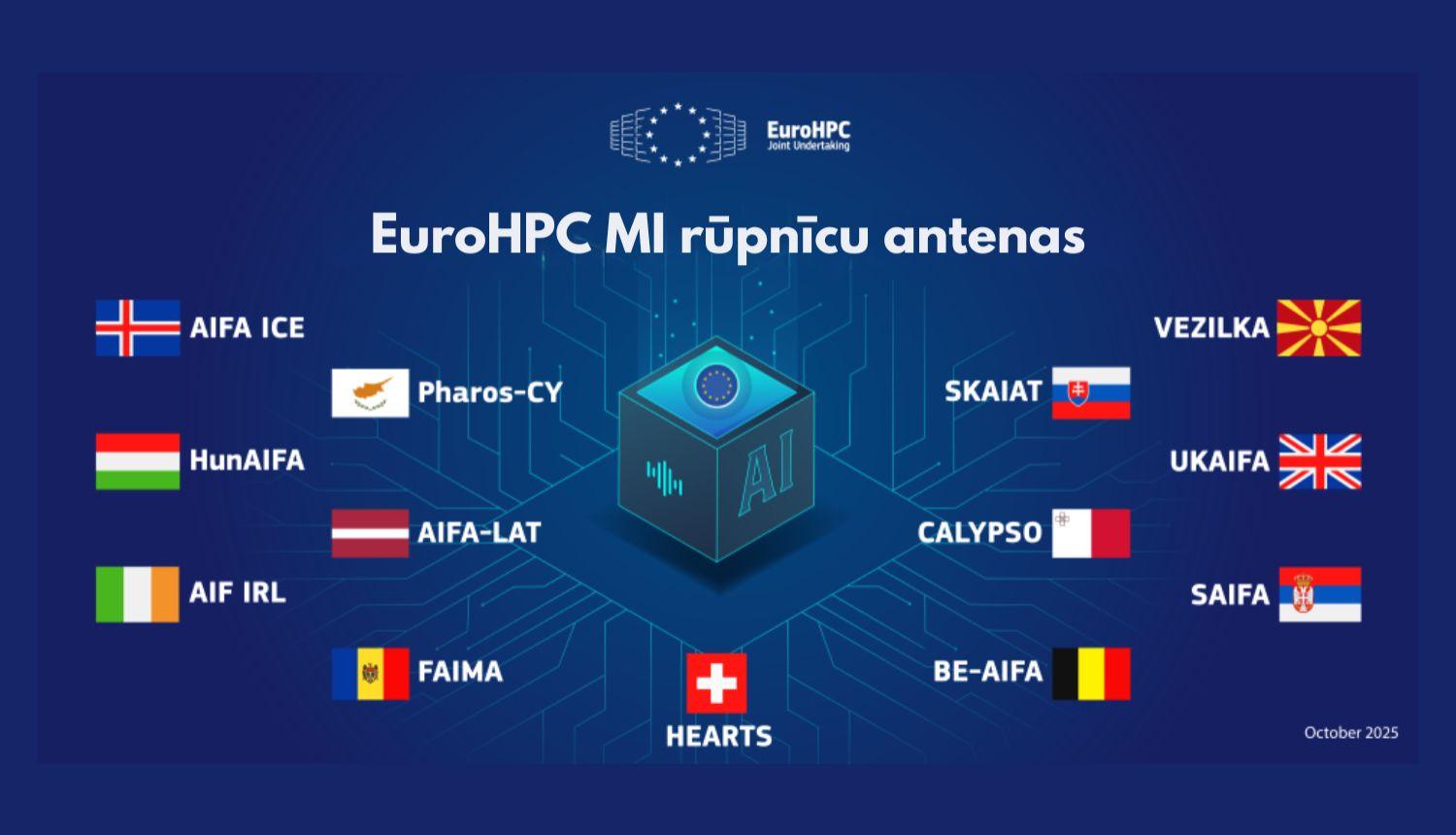
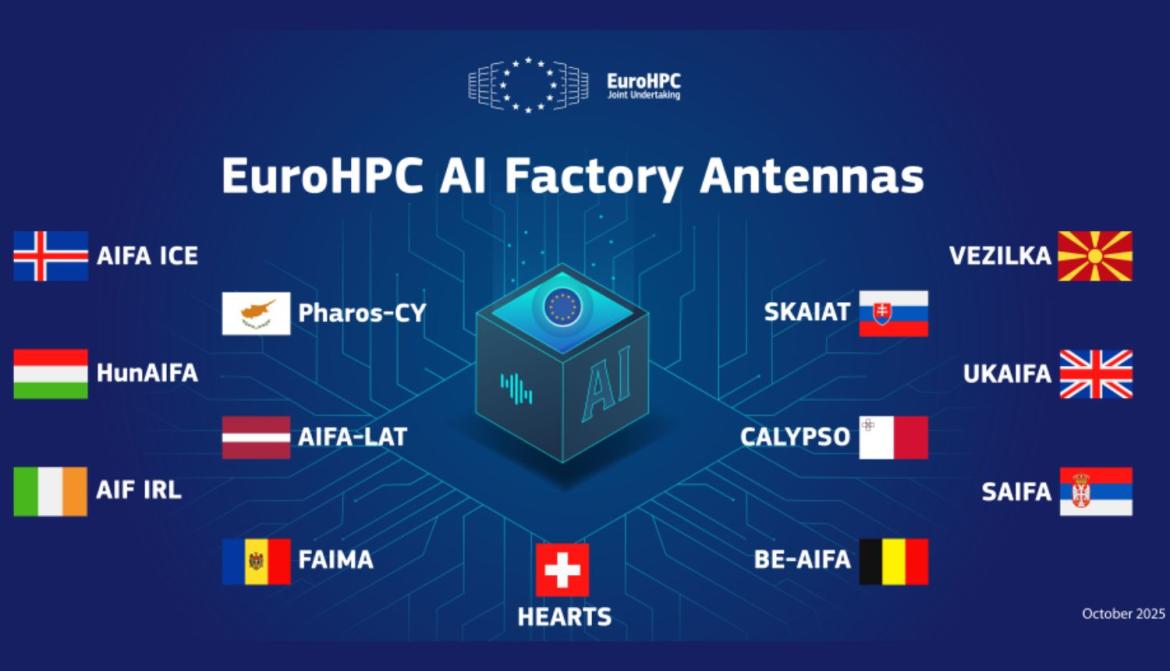
This autumn, 13 “antennas”, including Latvia, were selected to expand access to AI-adapted supercomputing resources throughout Europe. These antennas will complement existing AI Factories, forming an integrated network that supports research, innovation, and industrial applications across sectors.
By mid-2026, all selected antennas and their partners will sign a Memorandum of Understanding defining cooperation principles with their respective AI Factories.
The initiative aligns with the Digital Transformation Guidelines, the EU Digital Decade strategy, and the European Green Deal objectives, while strengthening Latvia’s competitiveness and innovation growth.