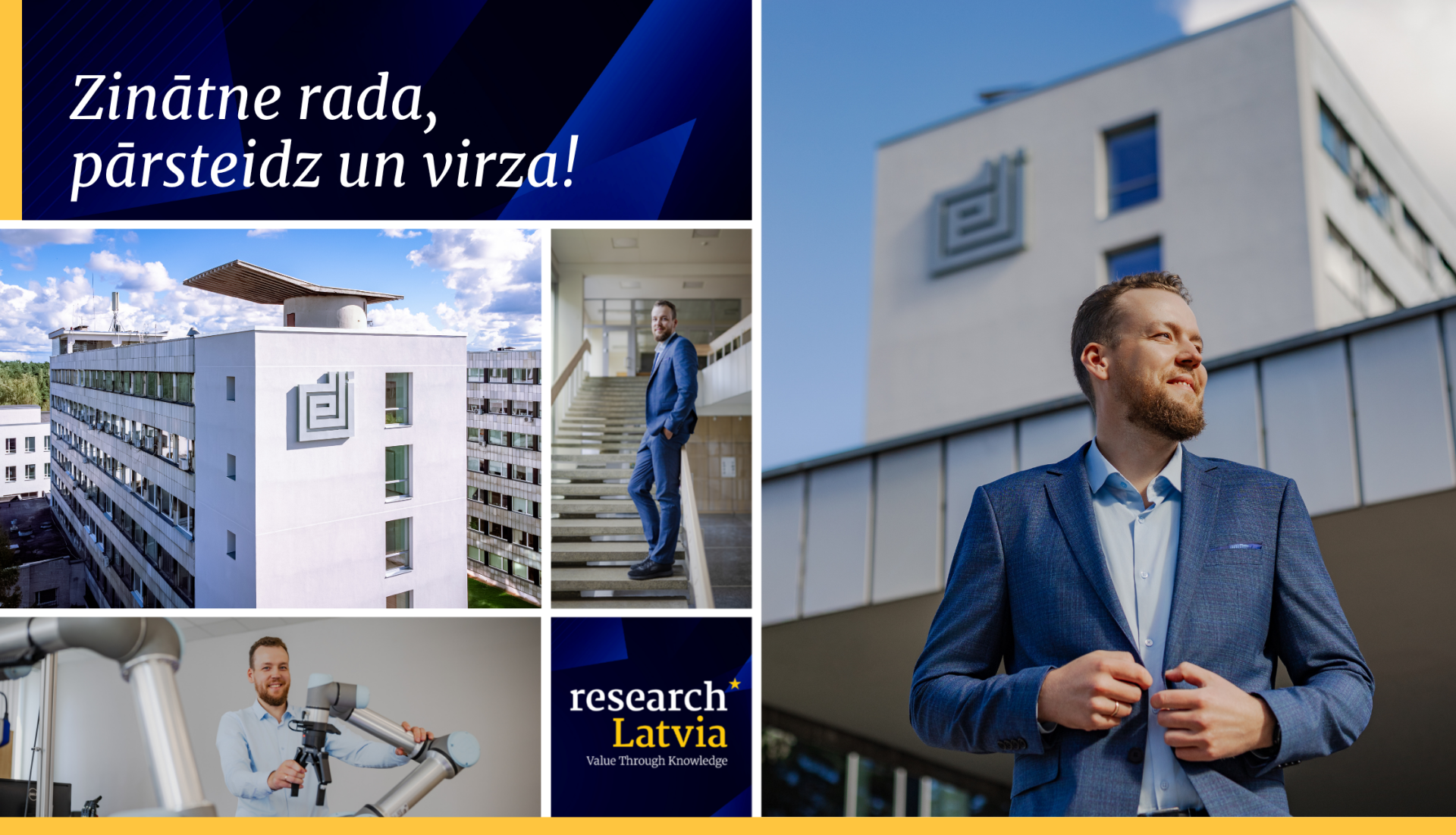
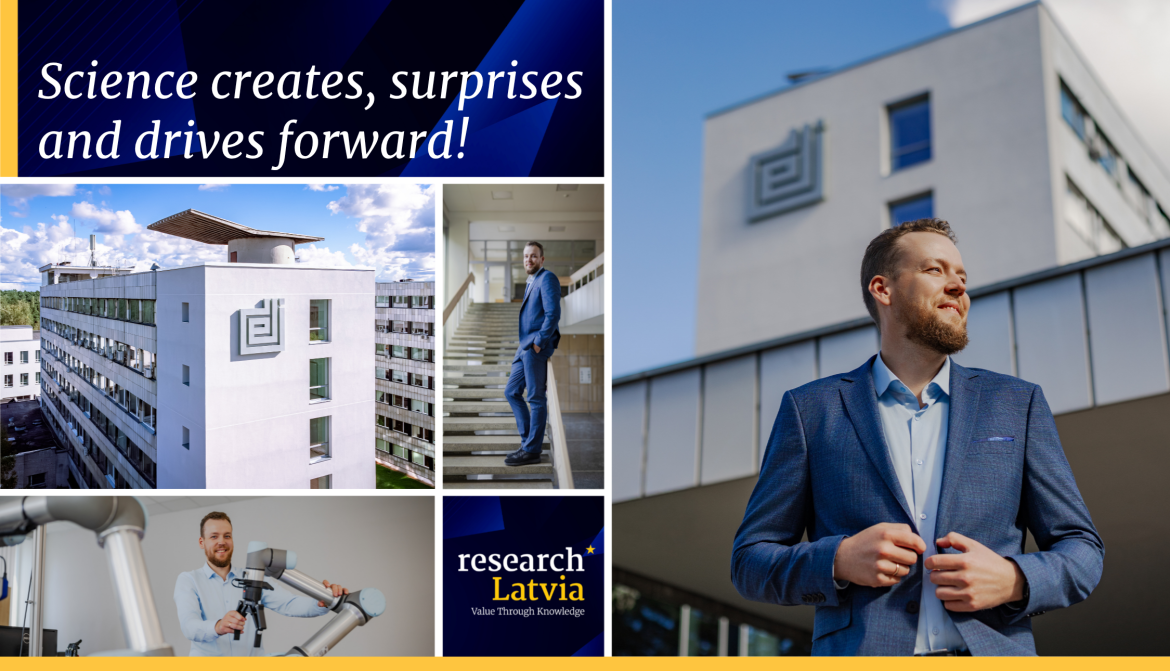
At the Robotics and Machine Perception Laboratory of the Institute of Electronics and Computer Science (IECS), PhD Jānis Ārents leads research on how robots can navigate complex environments, interpret human instructions and apply learned skills to new tasks.His work seeks answers to a central question: how to enable robots to move through forests, construction sites or industrial settings and interact with humans as naturally as colleagues.
“Stubbornness allows you to stick to an idea, perseverance allows you to develop it step by step, discipline means keeping the course even when motivation wanes, and finally – creative courage means seeing opportunities where others see limitations.”
IECS specialises in signal processing and embedded intelligence, robotics and machine perception, smart sensors, and the Internet of Things (IoT). Guided by the National Policy for the Development of Science and Technology, its mission is to support the growth of a knowledge-based economy in Latvia. The Institute pursues this by generating new knowledge and creating innovative technologies that foster high-value products and strengthen the competitiveness of Latvia and the European Union.
The Robotics Group led by PhD Jānis Ārents develops robotic systems that can safely operate in dynamic and unpredictable environments. Their work focuses on:
environmental sensing systems that allow robots to create spatial maps and recognise objects in their surroundings;
natural language–based interaction, where generative artificial intelligence converts human instructions into executable action plans;
development of reusable skills – the building blocks of motion and behaviour that enable robots to generalise learned skills to new tasks and environments.
The group’s achievements have been recognised as significant Latvian scientific contributions. These include the development of a smart robot with advanced perception, sensor integration and gesture recognition capabilities (2022), and a system for robot perception and interpretation of high-level natural language instructions (2024).
Their research addresses a crucial contemporary challenge: ensuring that robots serve as reliable assistants and effective tools for society. Such technologies improve workplace safety, support heavy or hazardous tasks, and create new possibilities for industries with limited human capacity. Potential applications range from manufacturing and logistics to agriculture, forestry and space exploration.
The work of the Robotics Group demonstrates the scientific and technological potential of Latvia in the international research arena. Jānis notes: “I have always found it fascinating to watch ideas turn into reality. Modern robotics is changing the relationship between humans and technology — no longer a one-way automation process, but a dynamic, interactive partnership. Science allows me to help shape this interaction and find the balance between human creativity and technological precision.”
Watch the video story about PhD Jānis Ārents’ research:
The science calendar “Research Latvia 2026” and the researcher descriptions were developed within the ERDF-funded project No. http://1.1.1.1/1/24/I/001 “More Efficient Implementation and Management of Latvia‘s Science Policy”, implemented by the Ministry of Education and Science.