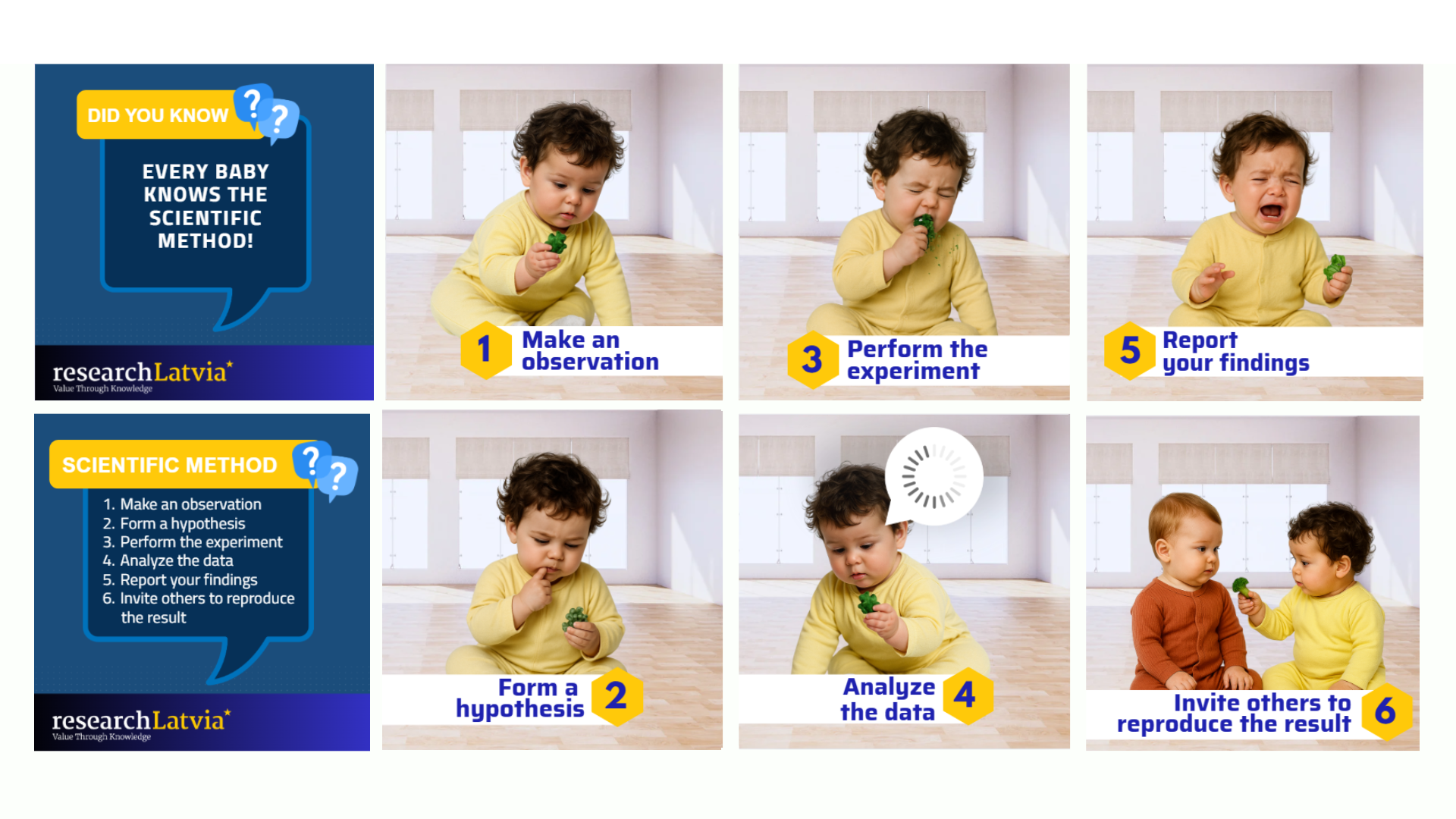
From the first question to a verified discovery – these steps are equally important in research and in everyday life.
The scientific method is a universal approach that enables researchers worldwide to obtain reliable, verifiable, and repeatable results. The science communication platform researchLatvia explains that the basic steps of the scientific method are universal: they can be observed from early childhood and are equally important across all fields of science, regardless of the subject or discipline.
Although the scientific approach may seem complex, in reality, its basic principles are learned in early childhood, even before a child can read or write. Every child’s daily life is full of observations, experiments, and conclusions, which serve as proof of this.
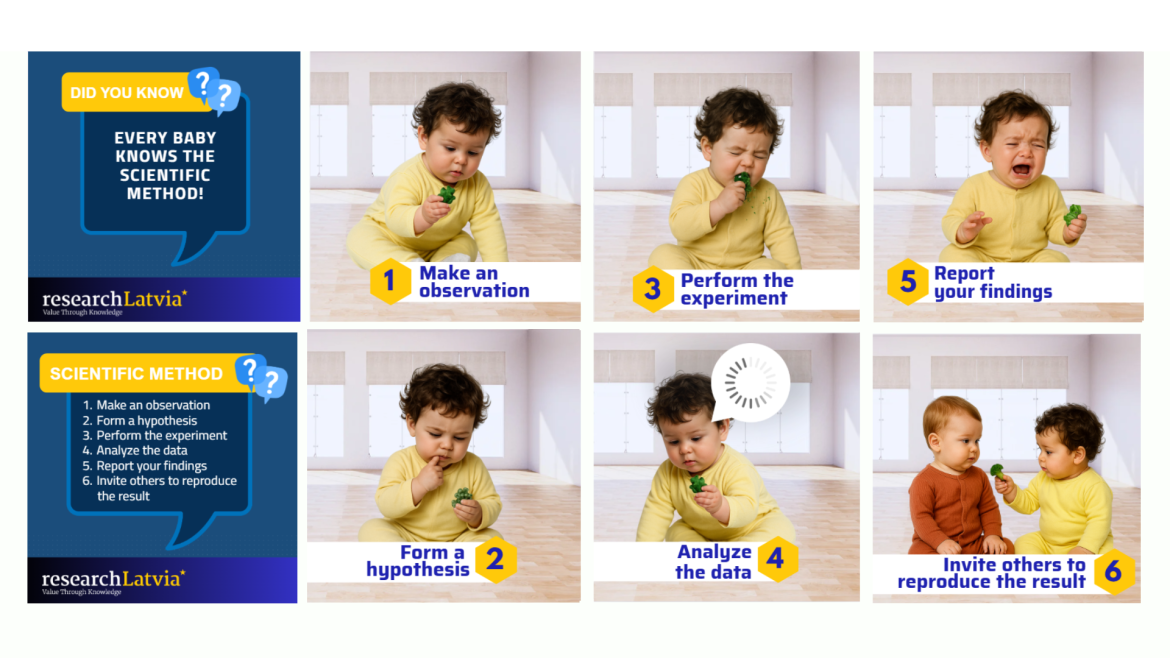
This universal approach is applied across all branches of science: natural sciences, engineering and technology, medicine and health sciences, agricultural sciences (bioeconomy), social sciences, as well as the humanities and arts.
The scientific method is based on six steps: 1) observation; 2) formulating a hypothesis; 3) experimentation; 4) data analysis; 5) reporting results; 6) repetition of the experiment
1. Make an Observation
The first step in research is to notice and carefully describe a phenomenon or problem. This means recording what is seen, heard, or measured without adding subjective judgments. Accurate observations are necessary to formulate a research question.
2. Formulate a Hypothesis
A hypothesis is a testable assumption based on observations and prior knowledge. It gives direction to the research, defining what result the researcher expects and why.
3. Conduct an Experiment
An experiment is a way to test a hypothesis in practice. It should be designed so that variables can be controlled and factors that could affect the results are minimized. The design of the experiment is crucial for the quality of the data.
4. Analyze the Data
The collected data is compiled and analyzed using appropriate qualitative and quantitative methods. At this stage, patterns are sought, and it is determined whether the results support or reject the hypothesis.
5. Report the Results
Results should be presented clearly and comprehensibly – both through numbers and graphs, and through well-formulated conclusions. At this stage, it is also essential to indicate possible errors and limitations.
6. Invite Others to Repeat the Experiment
One of the fundamental principles of science is repeatability – independent researchers, by repeating the study under similar conditions, should obtain similar results. This demonstrates that the conclusions are not accidental.
The scientific method ensures that knowledge is based on evidence and data rather than assumptions. It helps avoid subjectivity, allows discoveries to be verified and justified, and strengthens public trust in science.
This approach is equally important in the laboratory, in policy-making, and in the development of new technologies.