As Easter approaches, many people in Latvia follow long‑standing traditions: saving onion skins since winter, collecting torn stockings, searching for white eggs in shops or from local farms, and revisiting existential questions about nature. This year, the science communication platform invites the public to explore the evolution of the chicken and the age‑old question that has puzzled society for centuries: Which came first – the chicken or the egg? Inspired by the research of palaeontologist Xing Xu, we asked Professor Ervīns Lukševičs from the Faculty of Science and Technology at the University of Latvia (FST) to explain this question.
First, let us clarify the facts. Birds evolved from saurischian (Saurischia) theropod (Theropoda) maniraptor (Maniraptora) dinosaurs, that is, from small, agile, feathered, carnivorous dinosaurs. As it turns out, this was known even before the publication by Xing Xu. However, this publication stands out for its comprehensive overview of new dinosaur and bird fossil discoveries from China and other parts of the world, as well as for successfully integrating information from comparative anatomy, morphology, embryology, DNA studies, and even paleoecology.
In Latvia, very few researchers specialise in palaeontology, one could count them on the fingers of both hands. Even so, under the supervision of Dr. geol. Ervīns Lukševičs has completed four doctoral theses, and it turns out that Latvia is rich in geological treasures.
“Most finds consist of Devonian–period armored fishes and the earliest tetrapods. Around 400–360 million years ago, much of what is now Latvia was covered by sea, inhabited by marine fish. The Lode clay quarry is the only place in the world where nearly complete specimens of armoured fish have been found, preserved with eye plates, fins, and tails, sometimes missing only small parts of the body. Meanwhile, in outcrops of the Ketleri Formation near Skrunda, the skull of Ventastega, a dinosaur-age precursor and one of our own early ancestors, is the third best‑preserved Devonian tetrapod specimen in the world. Though quite fragile, it offers an excellent insight into the anatomy of the fauna of that time.”
Second, it is not entirely accurate to say that the chicken evolved directly from a dinosaur. Chickens as a species evolved from earlier forms of birds. The transition from dinosaurs to birds was gradual, with different bird‑like characteristics appearing in different dinosaur groups and at different times. Well‑preserved dinosaur fossils discovered in China (in Liaoning and elsewhere) over recent decades, especially in the 21st century, have provided substantial new evidence of this transition.
As LU EZTF Professor Dr. geol. Ervīns Lukševičs explains:
“These discoveries have allowed us to refine the sequence of dinosaur‑to‑bird evolution. For example, it is now clear that feathers were ‘invented’ by dinosaurs. Numerous fossil remains of feathered dinosaurs have been discovered in China, both in marine and Cretaceous sedimentary deposits. Initially, the main function of feathers was to prevent heat loss. But as it turns out, feathers also served as signals - "Look how beautiful I am!"
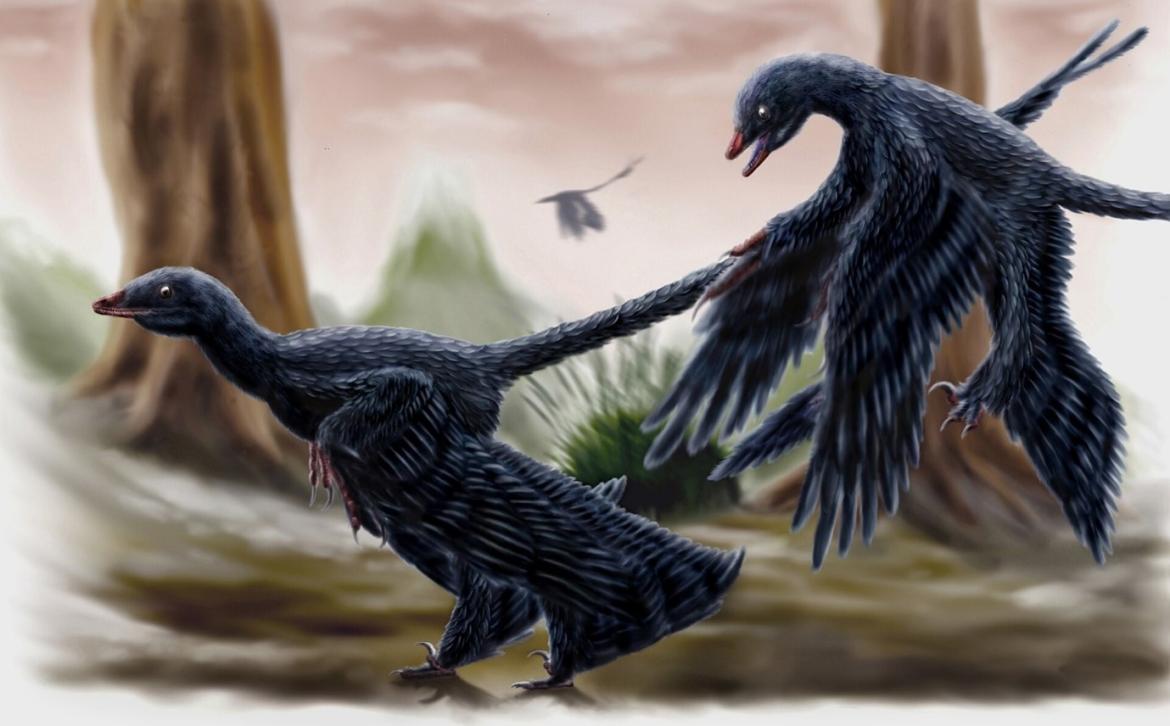
It is fascinating that the earliest birds and some dinosaurs initially flew using four wings, as they had the asymmetrical flight feathers required for flying not only on their forelimbs, what we now call “wings” in birds, but also on their hind limbs, which in a chicken we refer to simply as “legs.” Over the course of evolution, the hind wings were “abandoned,” as they interfered with active flapping flight, even though they had previously supported efficient gliding.
Third, returning to the core question, the researcher is fully convinced that the correct answer is the EGG.
“In the debate about which came first, the winner is unquestionably the egg! Although the ‘first chicken’ did not hatch from a ‘dinosaur egg,’ but from the egg of another chicken‑like creature, both dinosaurs and their closer and more distant ancestors reproduced by laying eggs, not by spawning, like fish or the earliest amphibians,” confirms Dr. geol. Ervīns Lukševičs, Professor and Lead Researcher at the Department of Geology, Faculty of Computing, Physics and Engineering, University of Latvia.