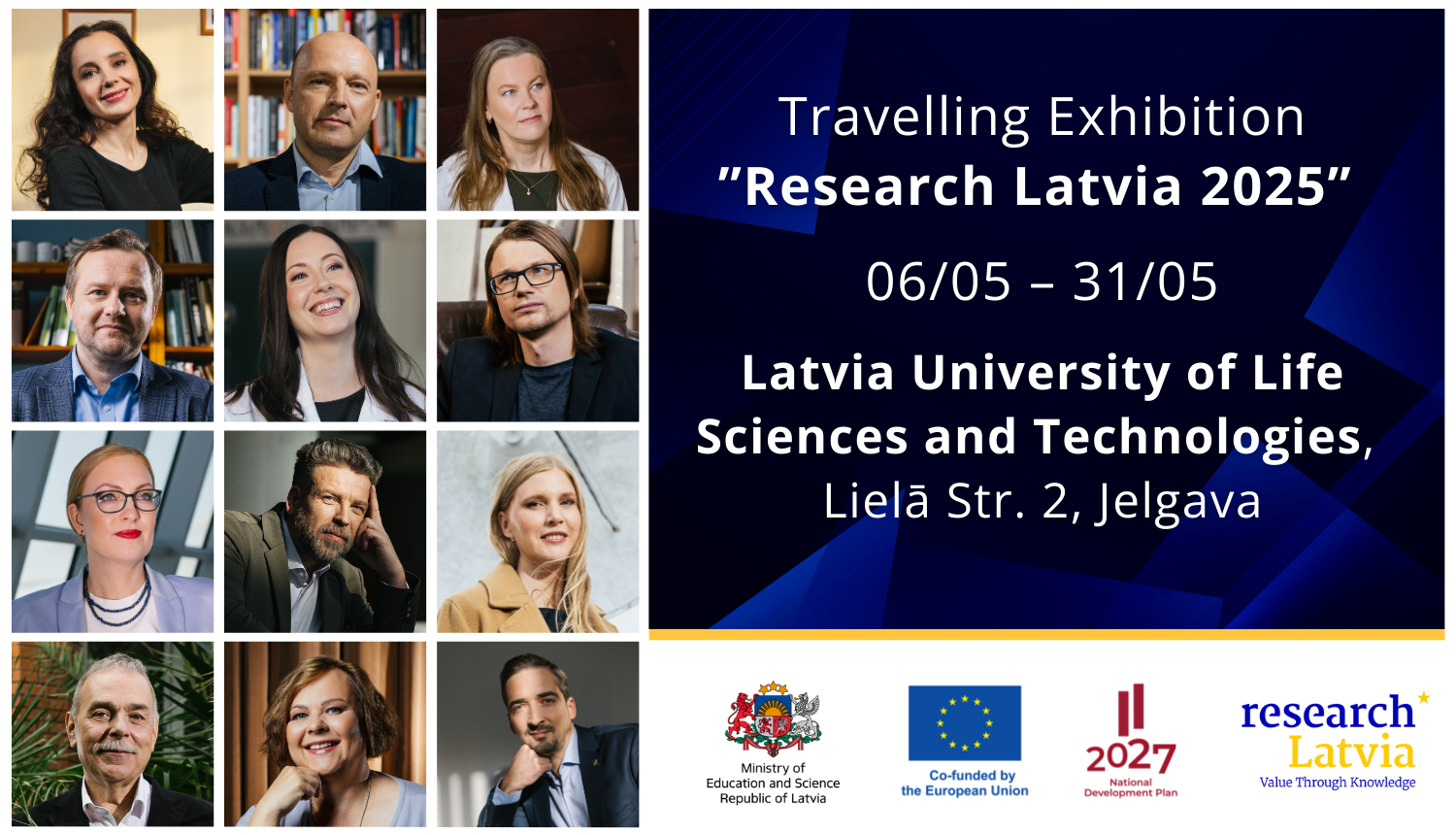
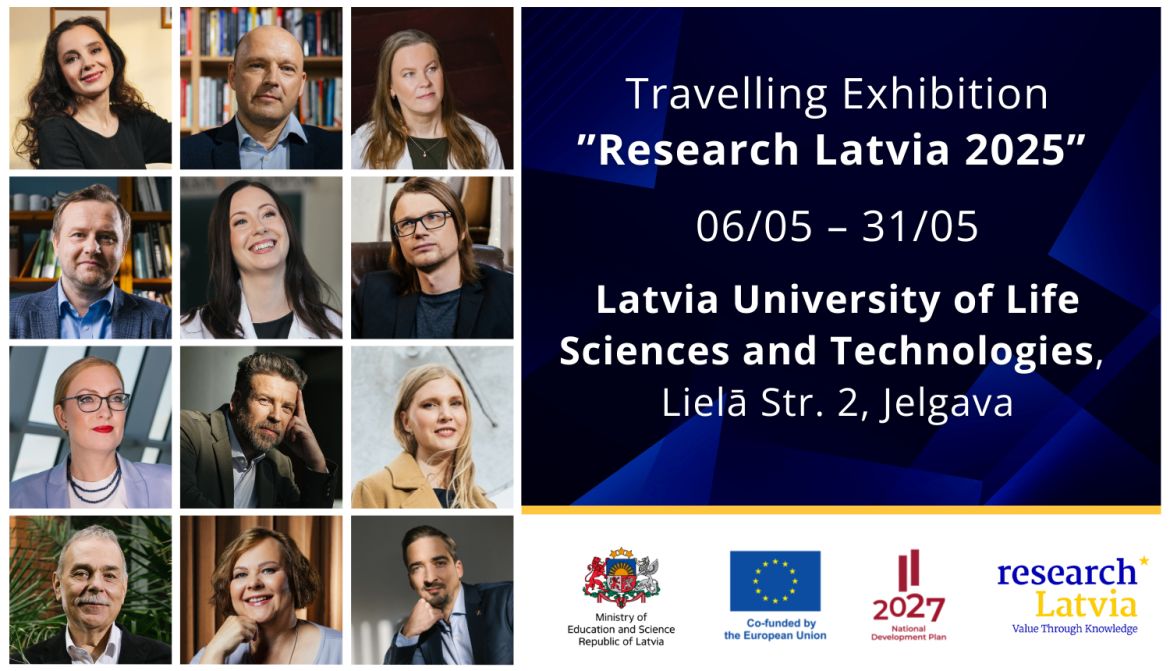
The travelling exhibition “Research Latvia 2025”, created by the Ministry of Education and Science, offers a unique opportunity to discover 12 outstanding Latvian researchers and their contributions to the advancement of society and science. From May 6 to 31, this diverse exposition will be on view at the Latvia University of Life Sciences and Technologies (LULST), Lielā Str. 2, Jelgava.
Twelve distinguished scientists representing 12 leading Latvian research institutions highlight the strength and diversity of Latvian science within the European Research Area. In collaboration with the science communication platform researchLatvia, the “Research Latvia 2025” exhibition and calendar showcase research topics that impact our society, environment, and culture. In May, special attention is given to the LULST's contribution to research and its role in the development of science.
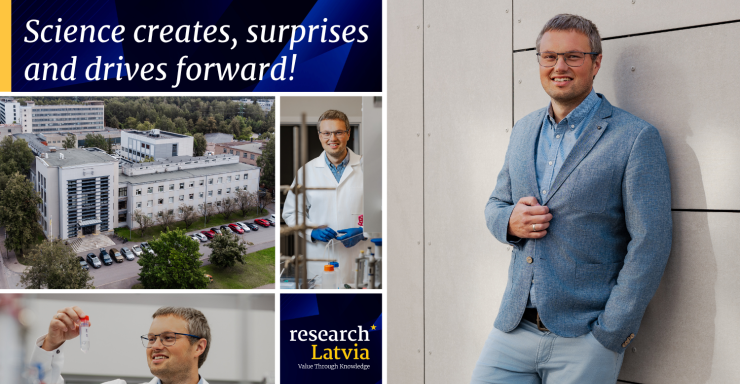
“The true satisfaction in research comes when scientists from different fields and industry experts come together to turn ideas into innovations that tackle global environmental challenges,” komentē Ph. D. Rūta Ozola-Davidāne, LBTU Meža un vides zinātņu fakultātes Ainavu arhitektūras un vides inženierijas institūta asociētā tenūrprofesore.
Each researcher represents a unique field of research, including choreomusicology, national defence and security, pharmacogenetics, the protection of rare and endangered species, mitigating waterbody overgrowth, comet activity studies, art science, simulation modelling, the inner logic of modern society through philosophy, cultural studies, as well as book history and library science.
Throughout the year, the traveling exhibition will be showcased at various higher education institutions and public cultural venues across Latvia. Visitors can watch all 12 video stories by scanning QR codes. This initiative not only raises awareness of science but also strengthens the public's connection with it.
The 12 scientists – six women and six men – contribute to the development of interdisciplinary national and international-level science centers through their unique research work:
- Dr. art. Diāna Zandberga (Vice-Rector for Scientific and Creative Work at the Jāzeps Vītols Latvian Academy of Music, Director of the Joint Professional Doctoral Program in Arts of Latvian Art Academies, and Pianist);
- Dr. sc. pol. Toms Rostoks (Director of the Center for Security and Strategic Research at the National Defence Academy of Latvia, Associate Professor);
- Dr. biol. Renāte Ranka (Tenured Professor at the Faculty of Pharmacy, RĪga Stradiņš University, Lead Researcher at the Institute of Public Health);
- Dr. biol. Artūrs Škute (Professor at the Institute of Life Sciences and Technology, DU);
- Ph. D. Rūta Ozola-Davidāne (Tenured Associate Professor at the Faculty of Forest and Environmental Sciences, Latvia University of Life Sciences and Technologies);
- Mg. sc. comp. Karina Šķirmante (Leading Researcher at Ventspils International Radio Astronomy Center, Ventspils University of Applied Sciences, Doctoral Student);
- Art. D. Ansis Rozentāls (Lecturer at the Art Academy of Latvia, IT Specialist, Painter);
- Ph. D. Oskars Java (Director of the Institute of Sociotechnical System Engineering, Vidzeme University of Applied Sciences);
- Dr. phil. Raivis Bičevskis (Tenured Professor of Philosophy at the Faculty of Humanities, University of Latvia);
- Dr. sc. ing. Sergejs Gaidukovs (Tenured Professor at the Faculty of Science and Technology, Riga Technical University);
- Ph. D. Baiba Tjarve (Deputy Head and Leading Researcher at the Institute of Culture and Arts, Latvian Academy of Culture);
- Mg. art., Mg. soc. Dagnija Baltiņa (Director of the National Library of Latvia, Doctoral Student).
Modern science inspires, amazes, and builds a knowledge-based society! May the achievements of Latvia's universities continue to encourage us to seek, create and grow!
The science calendar has been developed within the ministry implemented ERDF project No. 1.1.1.1/1/24/I/001, “More Effective and Smarter Implementation and Management of Latvia's Science Policy”. Contributors include “Entuziasti Digital” Ltd., Mārtiņš Pavasaris, video director Kristaps Mozgirs, and photographer Mārtiņš Goldbergs, in collaboration with the researchLatvia creative team.