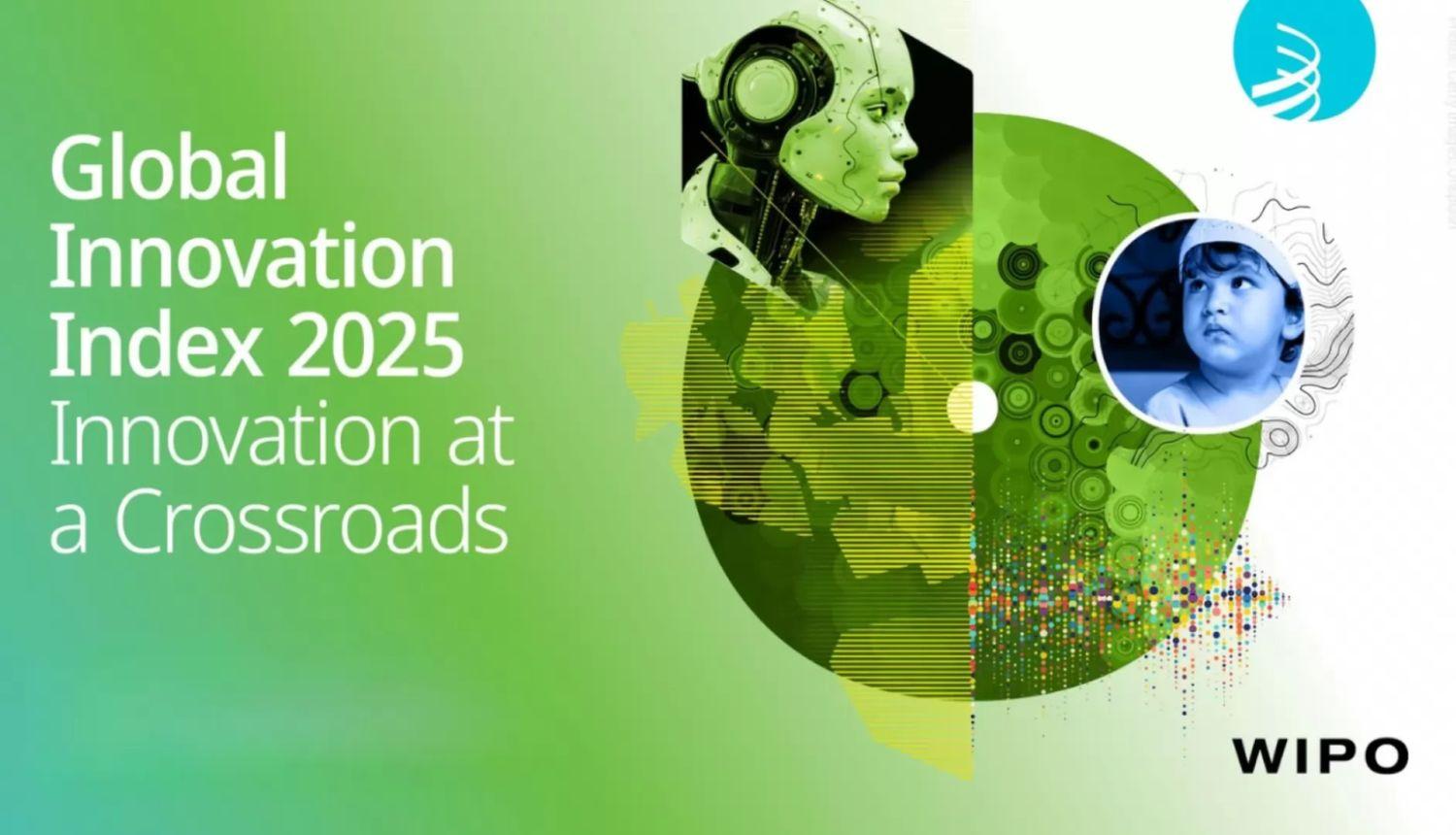
The World Intellectual Property Organisation (WIPO) has published the latest Global Innovation Index (GII) 2025, and three Latvian science universities have been recognised as the country’s strongest innovation centres – Riga Technical University (RTU), the University of Latvia (UL), and Riga Stradiņš University (RSU).
These universities are ranked between 721st and 1000th among all higher education institutions included in the survey. At the same time, it is noted that Latvia ranks 83rd in terms of the number of graduates in science and engineering disciplines. In terms of the number of researchers per one million inhabitants, Latvia is ranked 41st, according to the Latvian Patent Office.
Overall, Latvia has shown improvements in six indicators and has climbed one position to 41st place, which is still one of the lowest rankings since 2020. In the short term, Latvia has improved in six indicators but declined in four.
Latvia’s pace of development is described as moderate. Globally, the country belongs to the high-income group – ranked 38th out of 54 countries – while in Europe it is 27th out of 39 analysed countries. In the short term (2023–2024), Latvia has improved performance in the following indicators:
- R&D investment (+3.7%);
- Venture capital deals (+26.3%);
- Broadband coverage (+0.1%);
- 5G network availability and automation (+66.7%);
- Life expectancy forecast (+1.8%).
Short-term declines were recorded in:
- Scientific publications (–5.4%);
- International patent applications (–3.3%);
- Labor productivity (–0.2%);
- Average air temperature increased from 2.3°C to 3.1°C.
In the field of innovation, it is concluded that Latvia generates fewer innovations than could be expected given the level of investment. Latvia ranks 39th in innovation inputs, one position lower than last year (its highest ranking was 35th in 2025). However, innovation outputs have shown slight improvement – Latvia has climbed two positions to 44th place (its best ranking was 35th in 2020).
Latvia’s strongest areas are infrastructure and creative outputs. For example, the country ranks highly in:
- National film production (5th place);
- Cultural and creative services exports (10th place);
- Number of mobile applications (12th place);
- Employment of women with higher education (12th place);
- Number of students in higher education institutions (16th place).
Weaker areas include:
- Market development level (56th place);
- Knowledge and technology outputs (51st place);
- Human capital and research, business sophistication (47th place).
Particularly weak indicators are:
- Policy stability for business (126th place);
- Youth demographic resource (117th place);
- Payments for the use of intellectual property (108th place);
- Cluster development (102nd place).
Latvia’s position is also negatively affected by the absence of unicorn companies and globally recognised brands.
The Global Innovation Index ranks the world’s 139 most innovative economies and identifies the 100 richest innovation clusters worldwide. The index highlights global trends based on investment types, technological progress, and socio-economic impact. Countries are ranked using 80 different indicators.
The top five global innovation leaders are Switzerland, Sweden, the United States, South Korea, and Singapore. Among the other Baltic States, Lithuania ranks 33rd and Estonia 16th.